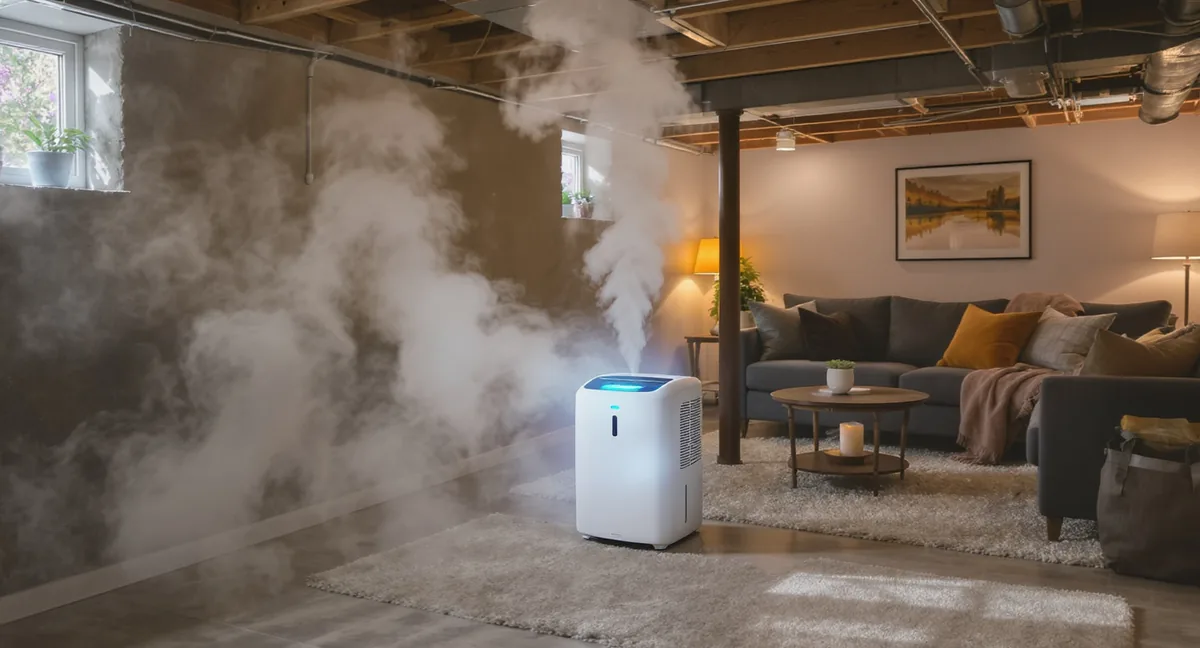
Excess humidity is not just uncomfortable — it causes mold growth, dust mite proliferation, wood damage, and musty odors. But dehumidifiers cost $160-280 and add $20-50/month to your electricity bill. Before you buy one, make sure you actually need it.
This guide helps you determine whether a dehumidifier will solve your problem — and if so, which type and size.
Warning Signs You Need a Dehumidifier
You probably need a dehumidifier if you notice two or more of these signs:
Definite Signs (Take Action)
- Visible mold on walls, ceilings, or surfaces — mold cannot grow below 50% humidity
- Musty smell in basements, closets, or enclosed spaces — this is mold or mildew you may not see yet
- Condensation on windows — water droplets on interior glass indicate humidity above 60%
- Peeling wallpaper or paint bubbling — moisture trapped behind wall coverings
- Warped wood — doors that stick, floors that buckle, furniture that swells
- Persistent damp feeling in specific rooms
Probable Signs (Test First)
- Allergies that worsen indoors (dust mites thrive above 50% humidity)
- Rust on metal fixtures in basements or garages
- Stains on walls or ceilings (possibly hidden moisture damage)
- Basement or crawl space feels noticeably cooler and clammier than upper floors
Seasonal Patterns
- Summer only — Normal in many climates; a dehumidifier during summer months may be all you need
- Year-round — Indicates a structural moisture source (leak, poor drainage, inadequate vapor barrier)
- After rain — Suggests water intrusion through foundation or poor grading
How to Test Your Humidity
Before buying a dehumidifier, measure your actual humidity levels. This takes the guesswork out of the decision.
Option 1: Hygrometer ($10-15)
A basic digital hygrometer from any hardware store gives you current humidity and temperature. Place it in the suspect room for 24-48 hours and check readings at different times of day.
Option 2: Smart Air Quality Monitor ($70-299)
An air quality monitor provides continuous humidity tracking with historical trends. This shows you when humidity spikes and how long it stays elevated.
- Budget: Amazon Smart Air Quality Monitor ($50) — humidity + PM2.5 + VOCs with Alexa
- Comprehensive: Airthings View Plus ($329.99) — adds radon, CO2, and long-term data storage
How to Interpret Your Readings
Take readings at multiple times over 48-72 hours. Focus on the highest sustained reading, not brief spikes after showering or cooking.
Humidity Levels: What They Mean
| Humidity Level | Status | Action |
|---|---|---|
| Below 30% | Too dry | You need a humidifier, not a dehumidifier |
| 30-40% | Slightly dry | Monitor; humidifier in winter if symptoms occur |
| 40-50% | Ideal | No action needed |
| 50-55% | Slightly high | Improve ventilation first; dehumidifier if it persists |
| 55-60% | High | Dehumidifier recommended; dust mites thriving |
| Above 60% | Mold risk | Dehumidifier required; mold growth begins within 24-48 hours |
| Above 70% | Severe | Dehumidifier required immediately; investigate moisture source |
The critical threshold is 60%. Above 60% relative humidity, mold spores that are present in every home begin actively growing on surfaces. Below 50%, dust mite populations decline significantly.
Common High-Humidity Locations
Basements
The most common problem area. Cool concrete walls attract condensation from warm humid air. Unfinished basements with exposed earth or inadequate vapor barriers can have humidity above 70% even in moderate climates.
Solution: A Frigidaire 50-pint dehumidifier with built-in pump for continuous drainage. Set to 45% and let it run continuously. For smaller basements, the GE 25-pint offers smart monitoring at a lower price.
Bathrooms
Daily showers generate significant moisture. A bathroom without an exhaust fan — or one with a fan that is never used — accumulates humidity that promotes mold on grout, ceilings, and behind tiles.
Solution: First, install or repair an exhaust fan and run it during and 20 minutes after every shower. If humidity persists, a small dehumidifier like the Midea 20-pint handles bathrooms well.
Laundry Rooms
Dryers vent moisture. If vented indoors (common with condenser dryers) or if the vent hose leaks, humidity spikes during every cycle.
Solution: Ensure dryer vents to the outdoors. Check the vent hose for leaks or disconnections. A dehumidifier is a band-aid; fixing the vent is the real solution.
Crawl Spaces
Dirt-floor crawl spaces are chronic humidity sources. Moisture evaporates from the soil and has nowhere to go.
Solution: Install a vapor barrier (6+ mil polyethylene sheeting) over exposed earth. Add a crawl space dehumidifier for persistent issues. This may require professional installation.
What Size Dehumidifier Do You Need
| Room Size | Humidity Level | Recommended Size |
|---|---|---|
| Under 500 sq. ft. | 50-60% | 20-pint (Midea 20-pint) |
| Under 500 sq. ft. | Above 60% | 20-30 pint |
| 500-1,000 sq. ft. | 50-60% | 30-40 pint |
| 500-1,000 sq. ft. | Above 60% | 50 pint (Frigidaire 50-pint) |
| 1,000-1,500 sq. ft. | Any level | 50-pint (Frigidaire 50-pint) |
| Above 1,500 sq. ft. | Any level | Two units or commercial grade |
When in doubt, size up. An oversized dehumidifier reaches your target humidity faster and then cycles less frequently — using less total energy than an undersized unit running constantly.
Dehumidifier vs. Other Solutions
A dehumidifier is not always the answer. Consider alternatives first:
| Problem | Best Solution | Dehumidifier Needed? |
|---|---|---|
| Humid basement, no water intrusion | Dehumidifier | Yes |
| Water leaking through foundation | Foundation repair + dehumidifier | Fix leak first |
| Humid bathroom after showers | Exhaust fan (run 20+ min) | Usually not |
| Humid laundry room | Fix dryer vent | Usually not |
| Seasonal summer humidity | Dehumidifier or air conditioning | Yes, if AC alone is insufficient |
| Condensation on windows | Improve ventilation | Maybe — test humidity first |
| Whole-house humidity in winter | Check humidifier settings | No — turn down humidifier |
Air conditioning dehumidifies naturally. If you run central AC in summer, it removes moisture as a byproduct of cooling. You may not need a separate dehumidifier in air-conditioned spaces. Test humidity with AC running before buying.
Our Recommendations
For Large Basements (500-1,500 sq. ft.)
Frigidaire 50-Pint Dehumidifier — $314
The most dehumidification power with a built-in pump and Wi-Fi. Handles continuous drainage without gravity. Set to 45%, connect the drain hose, and forget about it.
For Smart Monitoring on a Budget
GE 25-Pint Dehumidifier — $229
Wi-Fi app control via SmartHQ lets you monitor humidity from anywhere. Best for bedrooms, garages, and moderate spaces up to 1,500 sq. ft.
For Small Spaces (Under 500 sq. ft.)
Midea Cube 20-Pint Dehumidifier — $179
Compact, quiet, and Wi-Fi enabled with Alexa support. Perfect for bedrooms, bathrooms, and small basements with moderate humidity.
This guide was researched and written by the AirQualityNest editorial team. We update our content regularly to reflect the latest products, pricing, and research.
Frequently Asked Questions
How do I know if I need a dehumidifier or a humidifier?+
Measure your humidity with a hygrometer ($10-15). If it is consistently above 55%, you need a dehumidifier. If it is consistently below 30%, you need a humidifier. The ideal range is 40-50%. Most homes need a dehumidifier in summer/basements and a humidifier in winter.
Will a dehumidifier kill mold?+
No. A dehumidifier prevents new mold growth by keeping humidity below 50%, but it does not kill or remove existing mold. If you have visible mold, clean it with hydrogen peroxide or hire a mold remediation professional. Then use a dehumidifier to prevent regrowth.
How much does it cost to run a dehumidifier?+
A 50-pint dehumidifier running 12 hours/day costs approximately $25/month in electricity. A 20-pint unit costs about $15/month. Costs decrease over time as the unit maintains target humidity with less continuous operation. Budget $200-400/year for a large basement dehumidifier.
Should I run my dehumidifier in winter?+
Usually not. Cold air holds less moisture, so winter indoor humidity is typically low (often too low). If your basement stays humid year-round, you may have a water intrusion problem that needs structural repair, not just dehumidification. Test humidity levels in winter before running the unit.
Can I use a dehumidifier and air purifier at the same time?+
Yes, and this is often the best approach for basements. A dehumidifier controls moisture and prevents mold, while a HEPA air purifier captures mold spores, dust, and allergens already in the air. They serve different functions and complement each other well.
Related Reading
Best Dehumidifiers for Basements
Our top 3 picks ranked by performance
Frigidaire vs GE Dehumidifier
Head-to-head comparison of the two best basement options
Air Purifier vs Humidifier
Understand the difference between air quality devices
How to Test Your Home Air Quality
Measure humidity and other air quality metrics
Best Smart Dehumidifiers
Wi-Fi dehumidifiers with app control and smart features
Best Quiet Dehumidifiers
Low-noise dehumidifiers for bedrooms and living spaces
Continue Reading

Best Air Purifiers for Open Floor Plans in 2026: High-CADR Models That Cover It All
The best air purifiers for open floor plans ranked by CADR, coverage area, and noise. High-performance HEPA purifiers that handle 500-1,500+ sq. ft. open spaces.
Best Smart Humidifiers in 2026 (Wi-Fi, App Control & Auto Humidity)
The best smart humidifiers with Wi-Fi, app control, and auto humidity adjustment. Top picks for Alexa, Google Home, and smart home integration.
The 5 Best Portable Air Quality Monitors in 2026
Monitor your air quality on the go. We tested the best portable and compact air quality monitors for accuracy, battery life, and sensor range.