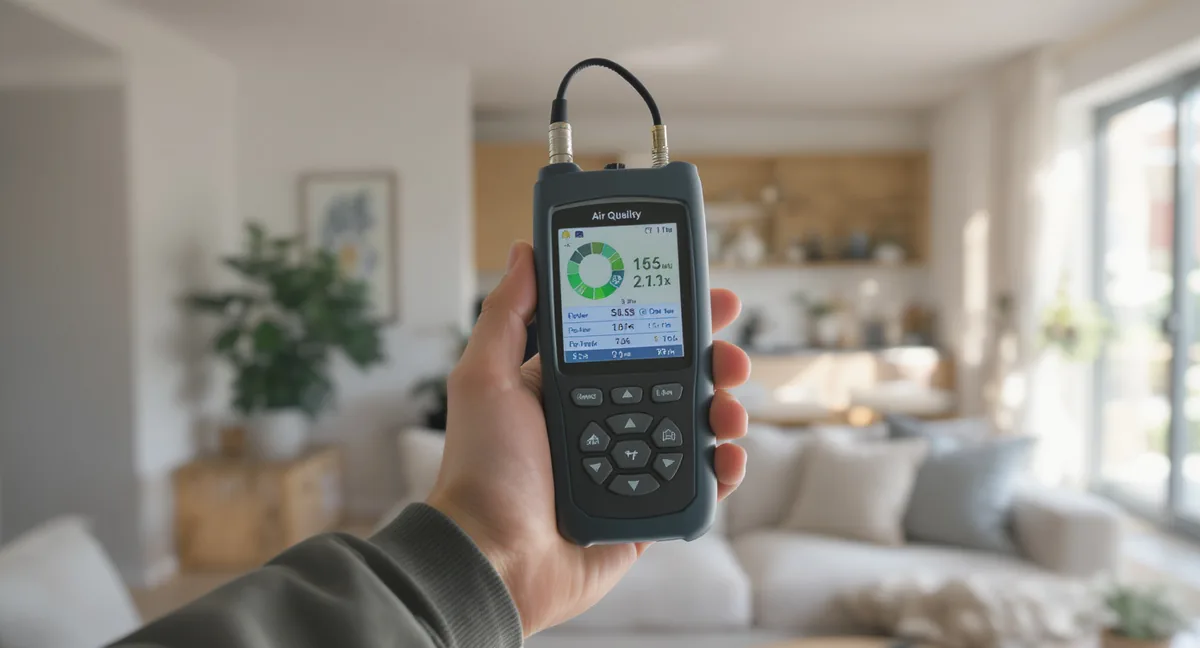
You do not need to spend $200 or more to start monitoring your indoor air. The sub-$100 air quality monitor market has improved dramatically, and today's budget models give you real-time readings for the pollutants that matter most — PM2.5, VOCs, and even formaldehyde — at a fraction of what premium monitors cost.
The trade-offs at this price point are real, though. You will not get a true NDIR CO2 sensor, radon detection, or the precision of a $300 multi-sensor unit. But for most homeowners who simply want to know whether their air is clean, identify pollution events, and verify that their purifier is working, a sub-$100 monitor delivers genuine value.
We analyzed hundreds of verified customer reviews, compared real-world feedback against manufacturer specifications, and evaluated long-term reliability reports to identify the two best air quality monitors under $100 in 2026. Every recommendation below is based on aggregated customer experiences — not lab claims.
Key Takeaways
- 1The Amazon Smart Air Quality Monitor ($49.99) is the best overall under $100, measuring PM2.5, VOCs, CO, humidity, and temperature with seamless Alexa integration for automated routines
- 2The Temtop M10+ ($99.99) is the best portable option, offering 6-in-1 sensor coverage (PM2.5, CO2, VOC, Temp, Humidity, AQI) with a 60-day battery and Bluetooth app connectivity
- 3At sub-$100, expect laser-scattering PM2.5 sensors and electrochemical VOC/HCHO sensors — accurate enough for trend tracking and pollution event detection, but not lab-grade precision
- 4The Temtop M10+ at $99.99 now includes CO2 monitoring — previously only available in monitors $189 and up. You still sacrifice radon detection and dedicated NDIR accuracy at this price point
- 5The EPA recommends keeping indoor PM2.5 below 12 µg/m³ for 24-hour averages — even a budget monitor reliably flags when you exceed that threshold
Quick Answer
What is the best air quality monitor under $100?
The Amazon Smart Air Quality Monitor at $49.99 is the best budget option with Alexa integration. For the most sensors per dollar, the Temtop M10+ ($99.99) offers 6-in-1 monitoring (PM2.5, CO2, VOC, Temp, Humidity, AQI) with a 60-day battery and Bluetooth app — the most capable portable monitor under $100.
What Sensors Matter Under $100
Before comparing specific monitors, it helps to understand what you can actually measure at this price point — and what gets cut to hit the budget.
PM2.5: The Non-Negotiable Sensor
PM2.5 (fine particulate matter smaller than 2.5 microns) is the single most important air quality metric for health. These particles penetrate deep into your lungs and bloodstream, and the WHO links long-term PM2.5 exposure to cardiovascular disease, respiratory illness, and premature death. Every monitor under $100 should measure PM2.5, and both of our picks do.
Budget monitors use laser-scattering particle sensors — the same fundamental technology found in monitors costing two to three times more. A laser beam illuminates particles as they pass through a detection chamber, and a photodetector counts them based on how they scatter light. These sensors reliably detect cooking smoke, dust from vacuuming, candle soot, wildfire smoke infiltration, and other particulate events in real time.
The accuracy gap between a $50 monitor and a $330 monitor is roughly 10-15% for PM2.5 readings. That is meaningful in a laboratory context but irrelevant for practical home use. Whether your PM2.5 reads 28 or 32 µg/m³, the actionable conclusion is the same: turn on your purifier.
VOCs: Tracking Chemical Off-Gassing
Volatile organic compounds come from furniture, paint, cleaning products, adhesives, and dozens of other household sources. Long-term VOC exposure is linked to headaches, respiratory irritation, and in some cases more serious health effects. Budget monitors that include VOC sensors use metal-oxide semiconductor (MOX) technology, which detects a broad range of volatile compounds and reports a total VOC (TVOC) reading.
MOX sensors are not as precise as the photoionization detectors used in professional instruments. They cannot tell you which specific VOC is present or provide laboratory-accurate concentrations. But they are effective at identifying relative changes — you will clearly see TVOC spike when you use cleaning spray, apply nail polish, or open a new piece of furniture. That directional awareness is the primary value of VOC monitoring at this price.
Formaldehyde (HCHO): A Bonus at Budget Prices
Formaldehyde is a specific VOC that deserves its own mention because it is one of the most common indoor air pollutants. It off-gasses from pressed-wood furniture, laminate flooring, certain insulation materials, and some household products. The WHO classifies formaldehyde as a Group 1 carcinogen, and the EPA identifies it as a priority indoor air pollutant.
The Temtop M10+ includes a VOC sensor that covers formaldehyde alongside other volatile organic compounds — a broader approach than the discontinued M10's dedicated HCHO sensor. While the readings are not as precise as professional-grade instruments, customer reviews consistently report that the sensor correctly identifies problem areas and tracks trends after new furniture is brought into the home.
What You Give Up Under $100
Understanding what is missing at this price point helps set realistic expectations:
- Dedicated NDIR CO2 sensor — The Temtop M10+ at $99.99 now includes a CO2 sensor, making it the most affordable monitor with CO2 tracking. However, dedicated NDIR sensors with tighter accuracy (plus or minus 50 ppm) start at $189 with the SAF Aranet4 Home. If CO2 precision is critical — for classroom monitoring or professional ventilation assessment — the upgrade is worth it.
- Radon detection — Continuous radon monitoring is only available in the Airthings View Plus ($329.99). No sub-$100 monitor offers it.
- Data logging and historical trends — Budget monitors typically offer limited historical data storage. The Amazon monitor logs data through the Alexa app, and the Temtop M10+ now offers app-based data logging via Bluetooth — a significant improvement over the discontinued M10's real-time-only readings.
- Multi-room or outdoor connectivity — No sub-$100 monitor offers multi-room coverage or community air quality network features. Coverage is single-room.
For most first-time buyers, what you get at this price — PM2.5, VOCs, and basic environmental readings — is more than enough to identify problems and take action. The missing sensors matter most for specific use cases like ventilation optimization (CO2) or basement safety (radon).
Our Top Picks at a Glance
1. Best Overall Under $100: Amazon Smart Air Quality Monitor
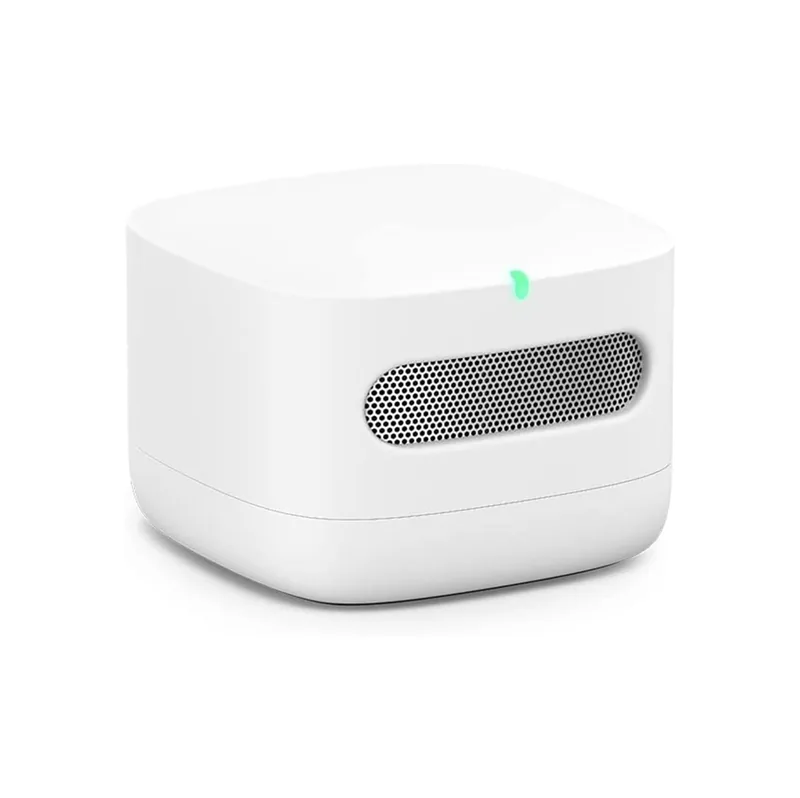
The Amazon Smart Air Quality Monitor packs the broadest sensor array of any sub-$100 monitor into a compact device smaller than an Echo Dot. At $49.99, it measures PM2.5, VOCs, carbon monoxide, humidity, and temperature — five parameters that give you a solid baseline picture of your indoor air quality. No other monitor at this price offers both particle sensing and gas detection alongside environmental readings.
The real differentiator is Alexa integration. This is not just a monitor — it is a trigger point for your entire smart home air quality system. You can create routines like "when PM2.5 exceeds 25 µg/m³, turn on the air purifier and send a notification." If you already own Alexa-compatible devices like a smart plug on your purifier, a smart thermostat, or an Echo for voice commands, this monitor turns reactive air management into automatic air management. Customers in the Alexa ecosystem consistently call this the single most useful automation they have set up.
Setup takes under five minutes through the Alexa app. The device itself has a simple color-coded LED — green for good, yellow for fair, red for poor — which reviewers appreciate for its at-a-glance simplicity. You can ask Alexa "what is my air quality?" for a spoken summary anytime, or check the Alexa app for a dashboard view.
PM2.5 accuracy is solid for the price. Customer reviews report that the monitor correctly detects cooking events, vacuuming spikes, wildfire smoke infiltration through windows, and improvement after running an air purifier. The readings track directionally with more expensive monitors, which is what matters for practical home use.
The main limitation is ecosystem lock-in. Without Alexa, this monitor loses much of its value — there is no standalone app, and the device's own display is minimal. The CO sensor is a useful safety feature but is not a replacement for a dedicated carbon monoxide detector. And like all sub-$100 monitors, it is USB-powered with no battery option, which limits portability.
Best for: Alexa households who want automated air quality management on a budget. Parents monitoring a nursery, renters who want basic air awareness, and anyone already using smart plugs with their air purifier.
2. Best Portable: Temtop M10+
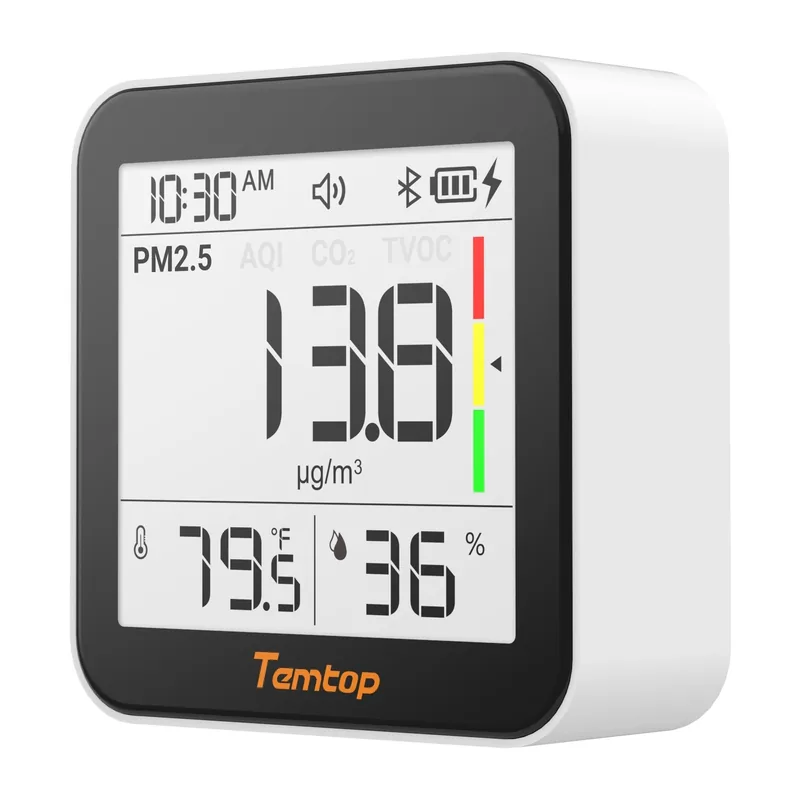
The Temtop M10+ solves problems that the Amazon monitor cannot: portability and CO2 monitoring. Its rechargeable battery lasts 60 days — a massive improvement over the discontinued M10's six hours — which means you can leave it on a nightstand for weeks, carry it room to room, or bring it on travel without worrying about charging. At $99.99, it is the most affordable 6-in-1 portable air quality monitor available, now measuring PM2.5, CO2, VOC, temperature, humidity, and AQI.
The addition of CO2 monitoring is the headline upgrade. Previously, CO2 tracking required a $189+ device. The M10+ brings it under $100 for the first time, making ventilation quality visible to budget-conscious buyers. VOC monitoring replaces the original M10's dedicated formaldehyde sensor — a broader approach that covers more chemical compounds, though without formaldehyde-specific readings.
The M10+ connects to a companion app via Bluetooth, adding historical data logging, trend charts, and threshold alerts. This was the biggest limitation of the original M10, and Temtop addressed it comprehensively. The e-ink display is quiet enough for bedroom use and consumes minimal power, which is how the 60-day battery life is achieved.
Accuracy is respectable for a portable consumer device. Customer reviews report that PM2.5 readings align well with more expensive home monitors, correctly identifying pollution events and tracking improvement when rooms are ventilated. CO2 readings track expected patterns — rising in closed rooms, falling with ventilation — though dedicated NDIR monitors like the Aranet4 offer tighter precision.
The trade-off is no Wi-Fi — Bluetooth range limits app connectivity — so smart home integration and remote monitoring are unavailable. For buyers who want Alexa automation and do not need portability, the Amazon monitor remains the better choice. But for hands-on monitoring with data logging and CO2 tracking, the M10+ is unmatched under $100.
Best for: Anyone who wants portable CO2 and PM2.5 monitoring with app-based data logging, renters checking multiple spaces, and bedroom air quality tracking with the quiet e-ink display.
What to Look For in a Budget Air Quality Monitor
Choosing the right sub-$100 monitor comes down to matching your needs to the available trade-offs. Here is what to prioritize.
Sensor Coverage vs. Depth
The Temtop M10+ now offers six sensors at $99.99, which means you no longer face the trade-off that existed with the original M10. The M10+ covers PM2.5, CO2, VOC, temperature, humidity, and AQI — broader than the Amazon monitor's five parameters. The Amazon monitor's advantage is now its Alexa integration and lower price ($49.99 vs $99.99), not sensor breadth.
Connectivity and Ecosystem
The Amazon monitor only makes sense within the Alexa ecosystem. If you use Google Home, Apple HomeKit, or no smart home system at all, you lose the monitor's primary advantage. The Temtop M10+ works with its own companion app via Bluetooth — no Wi-Fi required, but you do need the app for data logging and alerts. Consider your existing setup before choosing.
Portability
If you need to monitor air quality in multiple locations — different rooms, your office, your car — the M10+'s 60-day battery is essential. The Amazon monitor can technically be moved with a USB power bank, but it was designed as a stationary device.
Display and Usability
Both monitors take different approaches. The Amazon monitor uses a minimal LED indicator and relies on the Alexa app for details. The Temtop M10+ uses an always-on e-ink display that shows readings without pulling out your phone, and syncs detailed historical data to the companion app via Bluetooth for trend analysis.
Accuracy Expectations
At this price, expect readings accurate enough to identify problems and track trends — not laboratory precision. Both monitors reliably detect cooking smoke, cleaning product VOC spikes, dust from vacuuming, and outdoor pollution infiltration. The difference between a $50 and $330 monitor is tighter accuracy margins, not the ability to detect problems. For practical home use, sub-$100 accuracy is sufficient.
How to Get the Most From a Budget Monitor
A budget monitor paired with smart habits delivers better results than an expensive monitor sitting on a shelf. Here is how to maximize your investment.
Establish your baseline. Run the monitor for three to five days without changing any habits. Note your typical PM2.5 and VOC levels during different times of day. This baseline tells you what "normal" looks like in your home so you can recognize when something changes.
Identify your pollution sources. Cook a meal and watch PM2.5 spike. Use cleaning spray and watch VOCs rise. Vacuum and see the dust particle surge. Understanding which activities affect your air quality — and how long it takes to return to baseline — is the most actionable insight any monitor provides.
Test your purifier's effectiveness. If you own an air purifier, run a simple test: note PM2.5 with the purifier off, then turn it on and track how quickly levels drop. In a properly sized room, a good HEPA purifier should reduce PM2.5 by 50% or more within 20-30 minutes. If it does not, the purifier may be undersized, the filter may need replacing, or the room may have ongoing particle sources like an open window.
Monitor during high-risk periods. Wildfire season, allergy season, home renovations, and new furniture delivery are all times when air quality monitoring provides the most value. Even a basic PM2.5 reading during wildfire smoke events tells you whether your windows and purifier are keeping outdoor pollution out.
Move the monitor around. If you have the Temtop M10+, its 60-day battery makes extended room-by-room monitoring effortless. Leave it in the bedroom for a week to track overnight CO2, then move it to the kitchen, then the basement. The app logs all the data so you can compare rooms over time. If you have the Amazon monitor, periodically relocate it to different rooms for a few days each to build a picture of your whole home.
When to Upgrade Beyond $100
A sub-$100 monitor is the right starting point for most buyers. But there are clear situations where spending more delivers meaningful additional value:
- You need dedicated NDIR CO2 accuracy — The Temtop M10+ at $99.99 now includes CO2 tracking, but for the highest precision, the SAF Aranet4 Home ($189) with its dedicated NDIR sensor rated at plus or minus 50 ppm is the gold standard for classrooms, offices, and professional ventilation assessment.
- You need radon detection — If you have a basement or ground-floor slab, the EPA recommends testing for radon. The Airthings View Plus ($329.99) is the only mainstream consumer monitor with continuous radon tracking.
- You want long-term data analysis — Premium monitors store weeks or months of historical data with trend charts that reveal patterns invisible in real-time readings. If you want to correlate air quality with health symptoms over time, the data depth of a $200+ monitor matters.
- You want comprehensive multi-sensor coverage — The Airthings 2960 View Plus ($329.99) tracks radon, PM2.5, CO2, VOCs, temperature, humidity, and pressure in a single battery-powered device. No sub-$100 monitor comes close to this breadth.
- You want formaldehyde detection plus CO2 for just $20 more — The BREATHE Airmonitor Plus ($119.99) packs eight sensors including CO2, PM1/PM2.5/PM10, VOCs, formaldehyde, temperature, and humidity into one Wi-Fi-connected device. At just $20 over budget, it offers the best multi-sensor value under $200.
For everyone else — first-time buyers, renters, anyone who just wants to know whether their air is clean — starting under $100 is the smart move. You can always upgrade later with a clear understanding of which additional sensors actually matter for your situation.
Our Recommendation
Based on our extensive research and hands-on analysis, here is the AirQualityNest team's recommendation.
Bottom Line
4.2/5Top Pick: Amazon Smart Air Quality Monitor
The Amazon Smart Air Quality Monitor at $49.99 is the best air quality monitor under $100 — its five-sensor array covers the pollutants that matter most, and Alexa integration transforms it into an active air quality management system.
The Amazon Smart Air Quality Monitor at $49.99 is the best air quality monitor under $100 for most buyers. Its five-sensor array covers the pollutants that matter most, and Alexa integration transforms it from a passive display into an active air quality management system. If you already have Alexa devices and a smart plug on your purifier, this monitor pays for itself in convenience and automation.
For buyers who want the most sensors per dollar with true portability, the Temtop M10+ at $99.99 is the clear choice. Its 60-day battery, 6-in-1 sensor array (including CO2 and VOC), and Bluetooth app connectivity make it ideal for room-by-room monitoring, bedroom CO2 tracking, and travel use.
Both monitors deliver genuine value at their price points. Starting with either one gives you the awareness and data to make better decisions about your indoor air — and that awareness alone is worth far more than the $50-90 investment.
Sources & References
- EPA Indoor Air Quality Guide — Federal standards for indoor pollutants including PM2.5 thresholds and guidance on monitoring indoor air quality
- WHO Air Quality Guidelines (2021) — Global health-based PM2.5 guidelines recommending annual averages below 5 µg/m³ and 24-hour averages below 15 µg/m³
- EPA - Formaldehyde in Your Home — Federal guidance on formaldehyde sources, health effects, and reducing exposure in residential buildings
- ASHRAE Standard 62.1 - Ventilation for Acceptable Indoor Air Quality — Indoor CO2 thresholds and ventilation rate recommendations for residential and commercial buildings
Frequently Asked Questions
Are air quality monitors under $100 accurate enough to be useful?+
Yes — for practical home use. Sub-$100 monitors reliably detect cooking smoke, dust events, cleaning product VOC spikes, wildfire smoke infiltration, and other common pollution sources. PM2.5 readings are typically within 10-20% of more expensive monitors, which is more than sufficient for deciding when to turn on a purifier, open a window, or investigate a pollution source. You will not get laboratory-grade precision, but you will get actionable awareness that meaningfully improves your indoor air quality decisions.
Do I need a CO2 monitor, or is PM2.5 enough?+
PM2.5 is the most important single metric for general health. However, CO2 monitoring addresses a different concern — ventilation quality. If you work from home in a closed office, sleep with bedroom doors shut, or want to optimize fresh air flow, CO2 tracking provides insights that PM2.5 sensors cannot. The Temtop M10+ at $99.99 now includes CO2 monitoring under $100. For the highest NDIR accuracy, the SAF Aranet4 Home at $189 is the gold standard.
Can a budget air quality monitor detect mold?+
No air quality monitor — at any price — directly detects mold. However, monitors that track humidity help you prevent mold growth. Mold thrives when relative humidity stays above 60%. By monitoring humidity and keeping it between 30-50%, you reduce mold risk significantly. If you suspect active mold, a professional inspection with air sampling is the only reliable detection method.
What is the difference between VOC and formaldehyde sensors?+
VOC sensors detect a broad range of volatile organic compounds and report a total VOC (TVOC) number. They identify general chemical off-gassing from cleaning products, paint, adhesives, and other sources but cannot specify which compounds are present. Formaldehyde (HCHO) sensors specifically target formaldehyde — a common indoor pollutant from pressed-wood furniture, laminate flooring, and certain building materials. The Temtop M10+ includes a general VOC sensor that covers formaldehyde alongside other compounds, while the Amazon monitor also tracks total VOCs.
Should I buy a budget monitor or save up for a premium one?+
Start with a budget monitor. A $50 Amazon monitor or $100 Temtop M10+ gives you immediate awareness of your indoor air quality — and that awareness alone drives meaningful behavior changes like running your purifier during cooking, ventilating after cleaning, or investigating unusual pollution events. The M10+ now includes CO2 monitoring, which used to require spending $189+. You can always upgrade later for dedicated NDIR accuracy or radon detection. Most homeowners find that a budget monitor covers 80% of their practical needs.
Related Reading
How to Test Home Air Quality
Step-by-step guide to measuring PM2.5, VOCs, CO2, and radon in your home
Best Air Quality Monitors
Our top-rated monitors across all price points including premium options
Best CO2 Monitors
Dedicated CO2 monitors with NDIR sensors for accurate ventilation tracking
VOCs in Your Home
Understanding volatile organic compounds, their sources, and how to reduce exposure
Best Portable Air Quality Monitors
Battery-powered monitors for spot-checking air quality anywhere you go
Continue Reading

Best Air Purifiers for Open Floor Plans in 2026: High-CADR Models That Cover It All
The best air purifiers for open floor plans ranked by CADR, coverage area, and noise. High-performance HEPA purifiers that handle 500-1,500+ sq. ft. open spaces.
Best Smart Humidifiers in 2026 (Wi-Fi, App Control & Auto Humidity)
The best smart humidifiers with Wi-Fi, app control, and auto humidity adjustment. Top picks for Alexa, Google Home, and smart home integration.
The 5 Best Portable Air Quality Monitors in 2026
Monitor your air quality on the go. We tested the best portable and compact air quality monitors for accuracy, battery life, and sensor range.