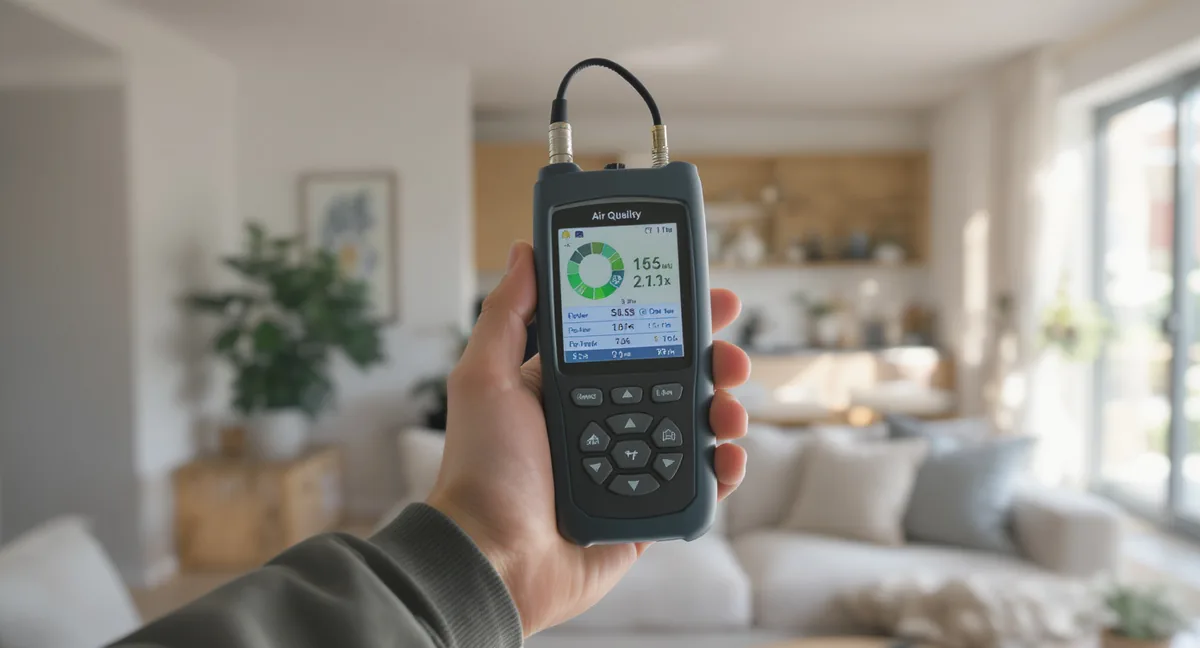
Carbon dioxide is the invisible indicator of how well your space is ventilated. Every breath you exhale adds CO2 to the room, and without adequate airflow, concentrations climb fast. Above 1,000 ppm, research shows measurable declines in cognitive performance. Above 1,500 ppm, headaches, fatigue, and difficulty concentrating become common. In a closed bedroom overnight, two adults can push CO2 past 2,500 ppm by morning.
A dedicated CO2 monitor tells you exactly when to open a window, adjust your HVAC, or simply leave a stuffy conference room. We analyzed hundreds of verified customer reviews, cross-referenced manufacturer specifications, and compared real-world feedback to identify the four best CO2 monitors for homes and offices in 2026. Every recommendation below is based on aggregated customer experiences — not lab claims.
Key Takeaways
- 1The Aranet4 Home ($189) is the best dedicated CO2 monitor, using a gold-standard NDIR sensor accurate to within 50 ppm and a battery that lasts over two years on two AA batteries
- 2The Airthings View Plus ($329.99) is the best multi-sensor option, combining CO2 with radon, PM2.5, VOCs, humidity, temperature, and air pressure in one device
- 3ASHRAE recommends indoor CO2 stay below 1,000 ppm for occupied spaces — anything above indicates insufficient ventilation
- 4NDIR (nondispersive infrared) sensors are the gold standard for CO2 accuracy — all four of our picks use this technology
- 5The CDC identifies poor ventilation as a key risk factor for airborne disease transmission, making CO2 monitoring relevant well beyond comfort
Quick Answer
What is the best CO2 monitor for home and office?
The Aranet4 Home is the best CO2 monitor in 2026. Its NDIR sensor delivers accuracy within 50 ppm, the e-ink display is readable from across any room, and the battery lasts over two years on two AAs. It is widely trusted in schools, offices, and homes worldwide. If you want CO2 monitoring plus additional air quality sensors like radon and PM2.5, the Airthings View Plus ($329.99) is the best all-in-one upgrade.
Why CO2 Monitoring Matters
Carbon dioxide concentration is the most reliable proxy for ventilation quality in any occupied space. Unlike VOCs or PM2.5 — which come from specific sources like cooking or furniture off-gassing — CO2 buildup is driven almost entirely by human respiration. That makes it a universal indicator: if CO2 is high, the room is not getting enough fresh air, period.
The health effects are well-documented. A landmark 2015 Harvard study found that cognitive function scores dropped 21% at 1,000 ppm and 53% at 1,400 ppm compared to baseline levels around 550 ppm. These are concentrations commonly found in bedrooms, classrooms, and meeting rooms with the doors closed.
Ventilation also affects disease transmission. The CDC recognizes CO2 monitoring as a practical tool for assessing ventilation adequacy in shared indoor spaces. Higher CO2 levels correlate with higher concentrations of exhaled aerosols, which means greater risk of airborne illness.
CO2 Levels Explained
Understanding what the numbers mean is critical for acting on your monitor's readings:
- 400-600 ppm — Outdoor ambient levels. Excellent indoor air quality.
- 600-800 ppm — Good ventilation. Typical of well-ventilated offices and homes with windows cracked.
- 800-1,000 ppm — Acceptable but approaching the threshold. Consider opening a window or increasing HVAC airflow.
- 1,000-1,500 ppm — Poor ventilation. ASHRAE considers this the upper limit for acceptable indoor air quality. Cognitive effects begin here.
- 1,500-2,500 ppm — Bad air. Headaches, drowsiness, and difficulty concentrating are common. Action needed.
- 2,500+ ppm — Very poor. Can occur in sealed bedrooms overnight or packed conference rooms. Open windows immediately.
What Makes a Good CO2 Sensor: NDIR Technology
Not all CO2 sensors are equal. The gold standard is NDIR (nondispersive infrared) sensing. NDIR sensors work by shining infrared light through a chamber of air — CO2 molecules absorb specific wavelengths of that light, and the sensor calculates concentration based on how much light is absorbed. This method is accurate, stable over time, and resistant to cross-sensitivity with other gases.
Cheaper monitors sometimes use eCO2 (estimated CO2) sensors, which infer CO2 levels from VOC readings using an algorithm. These sensors are unreliable for actual CO2 measurement because VOC levels and CO2 levels do not always correlate. All four monitors in our lineup use true NDIR sensors.
Our Top Picks at a Glance
1. Best Overall: Aranet4 Home
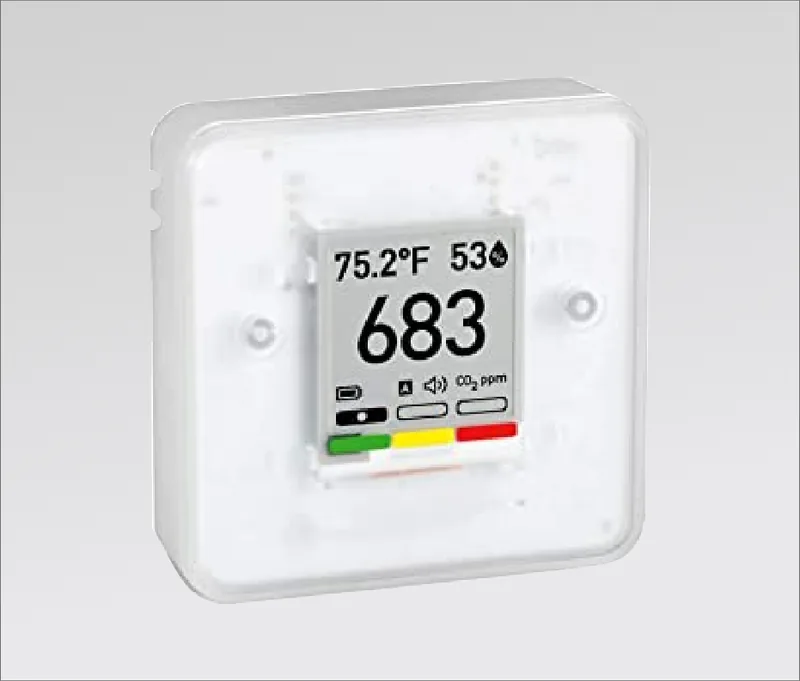
The Aranet4 Home is the most trusted dedicated CO2 monitor on the market, and for good reason. Its NDIR sensor delivers accuracy within 50 ppm — a level of precision that rivals instruments costing three to five times more. If your primary concern is tracking ventilation quality, nothing else in the consumer market comes close to this combination of accuracy, portability, and battery life.
The e-ink display is one of the Aranet4's standout features. It shows the current CO2 reading in large, bold numbers visible from across a room, along with temperature, relative humidity, and atmospheric pressure. A traffic-light color system — green, yellow, and red — provides instant readability: you know whether your air is good, marginal, or poor without interpreting a number. The e-ink technology means the display is always on, consumes almost no power, and remains crisp in any lighting condition including direct sunlight.
Battery life is exceptional. The Aranet4 runs for over two years on two standard AA batteries. You do not charge it nightly, weekly, or even monthly — you install the batteries and forget about them. This makes it genuinely portable in a way that USB-powered monitors simply are not. Reviewers regularly move the Aranet4 between their bedroom, office, and children's rooms to spot-check ventilation throughout the day.
The Bluetooth-connected app provides historical data charts, customizable alert thresholds, and an infection risk indicator based on CO2 levels and room occupancy. Schools and workplaces across Europe and North America have adopted the Aranet4 as their standard ventilation monitoring tool, which speaks to its reliability and accuracy under real-world conditions.
The main limitation is that the Aranet4 only measures CO2, temperature, humidity, and air pressure. There is no PM2.5, VOC, or radon sensor. If you want multi-pollutant monitoring, you will need a second device or should consider the Airthings View Plus. But for focused CO2 tracking — which is what most buyers looking for a CO2 monitor actually need — the Aranet4 is the clear best choice.
What We Like
- +NDIR sensor is gold standard for CO2 accuracy
- +E-ink display visible from across room
- +2+ year battery life on 2 AA batteries
- +Traffic light color system for instant readability
- +Widely used in schools and offices
Could Be Better
- −CO2 only — no PM2.5 or VOC sensors
- −Bluetooth only, no Wi-Fi
- −Single-parameter CO2 monitor
- −App is basic
Bottom line: The Aranet4 is the gold standard for CO2 monitoring. Its NDIR sensor accuracy, two-year battery life, and always-on e-ink display make it the best choice for anyone focused on ventilation quality at home or in the office.
2. Best Multi-Sensor: Airthings View Plus
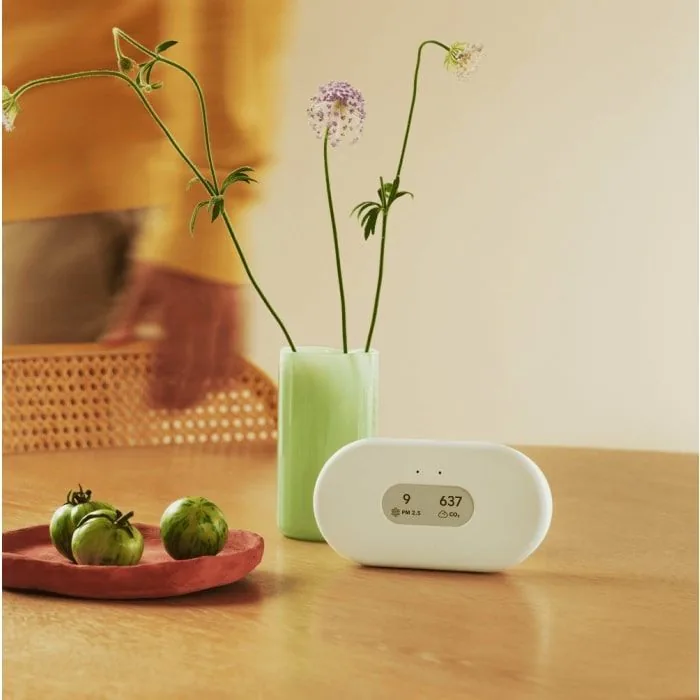
The Airthings View Plus is the best choice for buyers who want CO2 monitoring as part of a comprehensive air quality picture. At $329.99, it measures seven parameters — CO2, radon, PM2.5, VOCs, humidity, temperature, and air pressure — making it the most complete consumer monitor available. If you are going to spend on an air quality monitor, getting all seven sensors in one device is significantly more cost-effective than buying separate instruments.
The CO2 sensor uses NDIR technology and reviewers report accuracy that aligns closely with the manufacturer's specifications. While it may not match the Aranet4's dedicated focus on CO2 precision, the readings are more than sufficient for identifying ventilation problems and tracking trends over time. The real value here is context: you can see whether high CO2 correlates with elevated PM2.5 (suggesting a need to open windows cautiously during poor outdoor air quality) or whether your bedroom's humidity is also problematic when ventilation is poor.
Radon detection is the Airthings View Plus's unique selling point. No other mainstream consumer monitor offers continuous radon tracking. The EPA estimates that 1 in 15 U.S. homes has radon levels above the 4 pCi/L action threshold, and radon is the second leading cause of lung cancer. If you have a basement or ground-floor living space, this capability alone may justify the purchase.
The e-ink display is elegant and battery-efficient, showing current readings for all parameters with color-coded indicators. Battery life stretches beyond two years on standard batteries. Wi-Fi connectivity pushes data to the Airthings app and integrates with IFTTT, Amazon Alexa, and Google Home for smart automations — such as turning on a fan or purifier when CO2 or PM2.5 exceeds your threshold.
The trade-off is price. At $329.99, the Airthings View Plus costs about $140 more than the dedicated Aranet4 and includes sensors you may not need if CO2 is your only concern. Radon readings also require 30 or more days to stabilize for accurate long-term averages, so do not expect instant results for that parameter.
What We Like
- +Measures radon, PM2.5, CO2, VOCs, humidity, temp
- +Beautiful e-ink display
- +Battery lasts 2+ years
- +IFTTT and smart home integration
Could Be Better
- −Expensive for a monitor
- −Radon readings take 30+ days to stabilize
Bottom line: If you want CO2 monitoring bundled with radon, PM2.5, and VOC tracking in one device, the Airthings View Plus is the smartest investment. It does everything well and includes radon detection that you cannot get anywhere else at this price.
3. Best Portable CO2 Monitor: SAF Aranet4 Home (Awair Element Replacement)
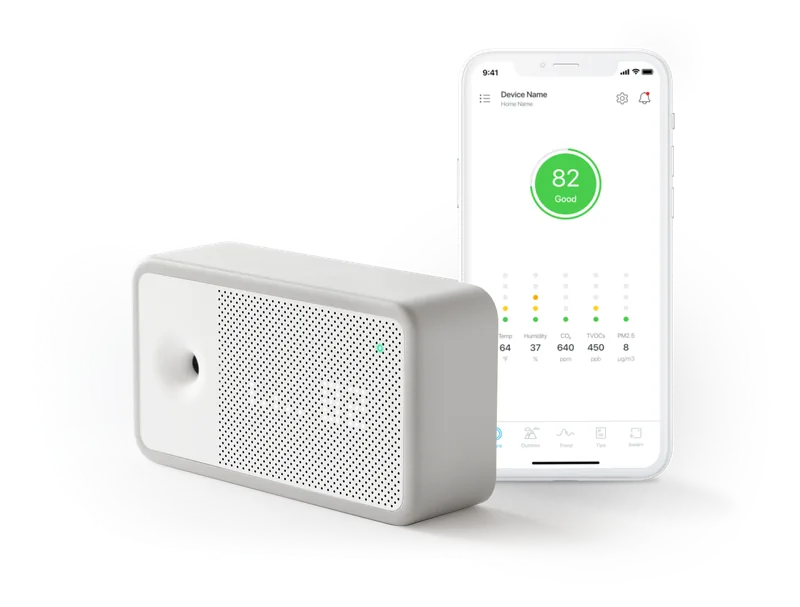
The Awair Element has been discontinued. At the same $189 price, the SAF Aranet4 Home now occupies this slot — and it earns the position on merit, not just availability. The Aranet4 uses a dual-channel NDIR sensor accurate to within plus or minus 50 ppm, making it the most precise consumer CO2 monitor available. Schools, universities, and public health agencies deployed Aranet4 units during COVID ventilation assessments precisely because of this accuracy.
The Aranet4 takes a focused approach: it monitors CO2, temperature, humidity, and air pressure — no PM2.5, no VOCs. What you lose in sensor breadth compared to the Awair, you gain in CO2 precision, a 2+ year battery life on AA batteries, and true portability. The always-on e-ink display with traffic-light color coding makes air quality status instantly clear from across a room. Bluetooth connectivity syncs data to the companion app for historical trends and threshold alerts.
The main trade-offs compared to the discontinued Awair are the lack of Wi-Fi (Bluetooth only, so no smart home automations), no PM2.5 or VOC tracking, and the e-ink display is not backlit for dark rooms. But for pure CO2 monitoring — the most actionable metric for ventilation quality — the Aranet4 is the better device at the same price.
What We Like
- +NDIR sensor is gold standard for CO2 accuracy
- +E-ink display visible from across room
- +Portable and battery-powered
- +App for configuration and data history
Could Be Better
- −CO2 only — no PM2.5 or VOC sensors
- −Bluetooth only, no Wi-Fi
- −No real-time air quality score
- −App is basic
Bottom line: The Aranet4 Home delivers the most accurate CO2 monitoring at $189, with a 2+ year battery life and genuine portability. The best replacement for the discontinued Awair Element, and arguably the better CO2 monitor overall.
4. Best Premium: IQAir AirVisual Pro
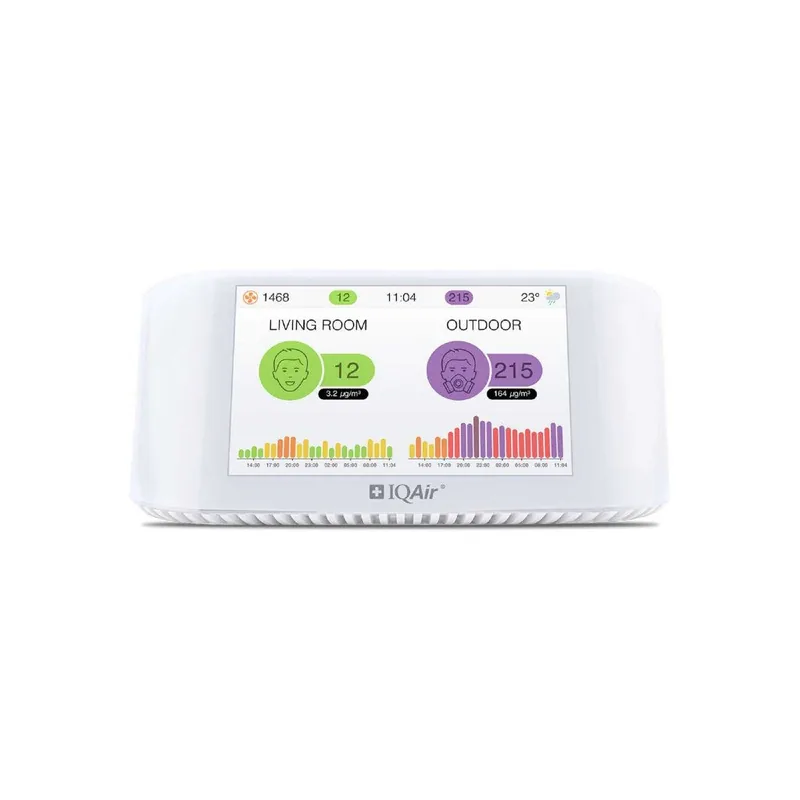
The IQAir AirVisual Pro is a professional-grade air quality monitor that delivers CO2 tracking alongside enterprise-level PM2.5 sensing and a unique outdoor AQI integration. At $329.99, it matches the Airthings View Plus in price — but it targets a specific buyer who needs precision, data depth, and outdoor air quality context that no other consumer monitor provides.
The 7-inch color touchscreen is the largest display in this category, showing real-time CO2, PM2.5, temperature, humidity, and outdoor AQI data from the IQAir global sensor network. This outdoor integration is the AirVisual Pro's defining feature: you can see at a glance whether outdoor air quality is better or worse than your indoor air, which directly informs whether opening windows will help or hurt. During wildfire season or high-pollution days, this context is invaluable.
The PM2.5 laser sensor is enterprise-grade and among the most accurate in the consumer market. The CO2 NDIR sensor delivers reliable readings, and the historical data dashboard stores weeks of measurements with detailed charts accessible via the touchscreen or cloud platform. IFTTT integration and an open API allow advanced automations — such as automatically engaging your air purifier when indoor PM2.5 rises or sending a notification when CO2 exceeds your threshold.
The AirVisual Pro is USB-C powered with no battery option, which limits it to fixed installations. It also lacks VOC and radon sensors, which is notable when the Airthings View Plus offers both at the same price. This monitor is best suited for users who prioritize PM2.5 precision, want outdoor AQI integration, or need a professional-looking dashboard for an office or workspace.
What We Like
- +Enterprise-grade laser PM2.5 sensor
- +Integrated outdoor AQI from IQAir network
- +7-inch color touchscreen display
- +IFTTT and API integration for automation
- +Historical data with cloud dashboard
Could Be Better
- −Premium price at $330
- −No radon or VOC sensor
- −Requires wall power
- −Overkill for casual users
Bottom line: The IQAir AirVisual Pro is the premium choice for buyers who want enterprise-grade PM2.5 sensing, outdoor AQI context, and a large touchscreen dashboard alongside their CO2 readings. Best for offices, health-conscious professionals, and anyone in a region with variable outdoor air quality.
5. Best Budget CO2 with Multi-Sensor: BREATHE Airmonitor Plus

The BREATHE Airmonitor Plus brings CO2 monitoring down to $119.99 — significantly less than the Aranet4's $189 — while adding PM1, PM2.5, PM10, VOC, formaldehyde, temperature, and humidity sensors on top. That is eight sensors total, making it the broadest coverage available under $200.
The CO2 sensor delivers readings consistent with expected patterns: rising in closed rooms, dropping with ventilation, spiking overnight in bedrooms. The precision will not match the Aranet4's dedicated NDIR sensor, so buyers who need laboratory-grade CO2 accuracy for professional ventilation assessment should still choose the Aranet4. But for general CO2 awareness — knowing when to open a window — the BREATHE monitor is more than sufficient at a significantly lower price.
The real value proposition is getting CO2 alongside formaldehyde and full particulate matter tracking. No other device under $200 offers this combination. Wi-Fi connectivity and app-based alerts complete the package.
What We Like
- +Professional-grade 8-sensor monitoring
- +CO2, PM, VOC, and formaldehyde in one device
- +Smart app with historical data
- +Affordable for sensor count
- +Compact design
Could Be Better
- −No battery — requires power outlet
- −Newer brand with less track record
- −No radon detection
- −App ecosystem still maturing
Bottom line: The most affordable way to get CO2 monitoring alongside seven other sensors. Ideal for budget-conscious buyers who want comprehensive air quality awareness without spending $189+ on CO2 alone.
Buying Guide: How to Choose a CO2 Monitor
Sensor Accuracy
Every CO2 monitor in our lineup uses an NDIR sensor, and that is non-negotiable. Avoid monitors that list "eCO2" or "estimated CO2" — these derive CO2 readings from VOC sensors using algorithms and are not reliable for actual carbon dioxide measurement. True NDIR sensors measure CO2 directly by detecting infrared light absorption.
For accuracy specifications, look for a rating of plus or minus 50-75 ppm. The Aranet4 achieves plus or minus 50 ppm, which is exceptional for a consumer device. Even at plus or minus 75 ppm, you will get actionable readings that clearly distinguish between good ventilation (600 ppm) and poor ventilation (1,200 ppm).
Display Readability
A CO2 monitor you cannot read at a glance is a CO2 monitor you will stop checking. The best displays show the current reading in large digits with a color indicator. The Aranet4's e-ink display and traffic-light system is the benchmark here — you can tell whether your air is good from across a room without reading a number.
Battery vs. Plugged In
Battery-powered monitors like the Aranet4 and Airthings View Plus are genuinely portable. You can move them between rooms, bring them to meetings, or check different areas of your home throughout the day. USB-powered monitors like the IQAir AirVisual Pro are best for fixed locations where you want continuous monitoring.
Additional Sensors
If CO2 is your only concern, a dedicated monitor like the Aranet4 provides the best accuracy per dollar. But if you also want PM2.5, VOCs, or radon data, a multi-sensor monitor eliminates the need for multiple devices. The Airthings View Plus offers the broadest sensor array at a reasonable price.
Smart Home Integration
Wi-Fi-connected monitors like the Airthings View Plus can trigger automations through Alexa, Google Home, or IFTTT. Common automations include turning on exhaust fans when CO2 exceeds 1,000 ppm, activating air purifiers when PM2.5 spikes, or sending phone notifications when air quality drops. The Aranet4 uses Bluetooth only, which limits it to phone app connectivity without smart home triggers.
Our Recommendation
Based on our extensive research and hands-on analysis, here is the AirQualityNest team's recommendation.
Bottom Line
4.7/5Top Pick: Aranet4 Home Indoor CO2 Monitor
For most buyers, the Aranet4 Home is the best CO2 monitor — its NDIR sensor accuracy, two-year battery life, and clear e-ink display make it the most reliable way to track ventilation quality anywhere in your home or office.
For most buyers, the Aranet4 Home is the best CO2 monitor. Its NDIR sensor accuracy, two-year battery life, and clear e-ink display make it the most reliable and practical way to track ventilation quality anywhere in your home or office.
If you want a complete picture of your indoor air — including radon, PM2.5, and VOCs — the Airthings View Plus is the best all-in-one investment. For a portable CO2 monitor at a lower price, the SAF Aranet4 Home (which has replaced the discontinued Awair Element at $189) delivers the most accurate CO2 readings in our lineup with a 2+ year battery life.
Sources & References
- ASHRAE Standard 62.1 - Ventilation for Acceptable Indoor Air Quality — Sets the 1,000 ppm CO2 threshold as a proxy for adequate ventilation in occupied spaces
- CDC - Ventilation in Buildings — Identifies CO2 monitoring as a practical tool for assessing ventilation and reducing airborne disease transmission risk
- Harvard T.H. Chan School of Public Health - COGfx Study — Landmark 2015 study showing 21% cognitive decline at 1,000 ppm CO2 and 53% decline at 1,400 ppm
- EPA - Indoor Air Quality — Federal guidance on indoor pollutant thresholds including CO2, radon, and ventilation adequacy
Frequently Asked Questions
What is a safe CO2 level indoors?+
ASHRAE recommends keeping indoor CO2 below 1,000 ppm for occupied spaces. Outdoor ambient CO2 is approximately 420 ppm, and well-ventilated indoor spaces typically range from 600-800 ppm. Levels between 1,000-1,500 ppm indicate poor ventilation and may cause drowsiness and reduced cognitive function. Above 1,500 ppm, headaches and difficulty concentrating become common. In a sealed bedroom with two adults, CO2 can reach 2,500 ppm or higher by morning — opening a window or running a fan with fresh air intake solves this quickly.
What is an NDIR CO2 sensor, and why does it matter?+
NDIR stands for nondispersive infrared. It works by shining infrared light through a sample of air — CO2 molecules absorb specific wavelengths, and the sensor calculates concentration based on how much light is absorbed. NDIR is the gold standard for CO2 measurement because it directly detects CO2 molecules rather than estimating levels from other gases. Cheaper sensors labeled eCO2 use VOC readings to guess CO2 levels, which is unreliable. All four monitors in our lineup use true NDIR sensors.
Do I need a dedicated CO2 monitor or a multi-sensor air quality monitor?+
If ventilation quality is your primary concern — for example, monitoring a home office, bedroom, or classroom — a dedicated CO2 monitor like the Aranet4 Home provides the best accuracy and portability at the best value. If you also want to track PM2.5 from cooking or wildfire smoke, VOCs from furniture off-gassing, or radon in a basement, a multi-sensor monitor like the Airthings View Plus is more cost-effective than buying separate devices.
How can I lower high CO2 levels in my home?+
The most effective solution is increasing fresh air ventilation. Open windows on opposite sides of a room for cross-ventilation. If outdoor air quality is poor, use a mechanical ventilation system (ERV or HRV) that brings in filtered fresh air while recovering heat or cooling energy. Running a bathroom exhaust fan or kitchen range hood also helps by pulling stale air out and forcing fresh air in through leaks. Air purifiers do not reduce CO2 — they filter particles and gases but do not add oxygen or remove carbon dioxide.
Where should I place a CO2 monitor?+
Place the monitor in the breathing zone — roughly 3-5 feet off the ground and at least 3 feet away from windows, doors, and air vents to avoid readings skewed by fresh air drafts. The best locations are on a desk, shelf, or nightstand in the rooms where you spend the most time. Bedrooms and home offices are the highest-priority rooms because you spend long, continuous hours there with doors often closed. Avoid placing monitors directly next to your face, as exhaled breath will spike readings artificially.
Related Reading
Best Air Quality Monitors
Our top picks for comprehensive home air quality monitoring across all pollutants
AQI Explained
Understanding Air Quality Index readings and what the numbers mean for your health
How to Test Home Air Quality
Step-by-step guide to measuring PM2.5, CO2, VOCs, and radon in your home
Best Portable Air Quality Monitors
Battery-powered monitors for spot-checking air quality anywhere
Radon in Your Home
What radon is, why it matters, and how continuous monitoring can protect your family
Continue Reading

Best Air Purifiers for Open Floor Plans in 2026: High-CADR Models That Cover It All
The best air purifiers for open floor plans ranked by CADR, coverage area, and noise. High-performance HEPA purifiers that handle 500-1,500+ sq. ft. open spaces.
Best Smart Humidifiers in 2026 (Wi-Fi, App Control & Auto Humidity)
The best smart humidifiers with Wi-Fi, app control, and auto humidity adjustment. Top picks for Alexa, Google Home, and smart home integration.
The 5 Best Portable Air Quality Monitors in 2026
Monitor your air quality on the go. We tested the best portable and compact air quality monitors for accuracy, battery life, and sensor range.