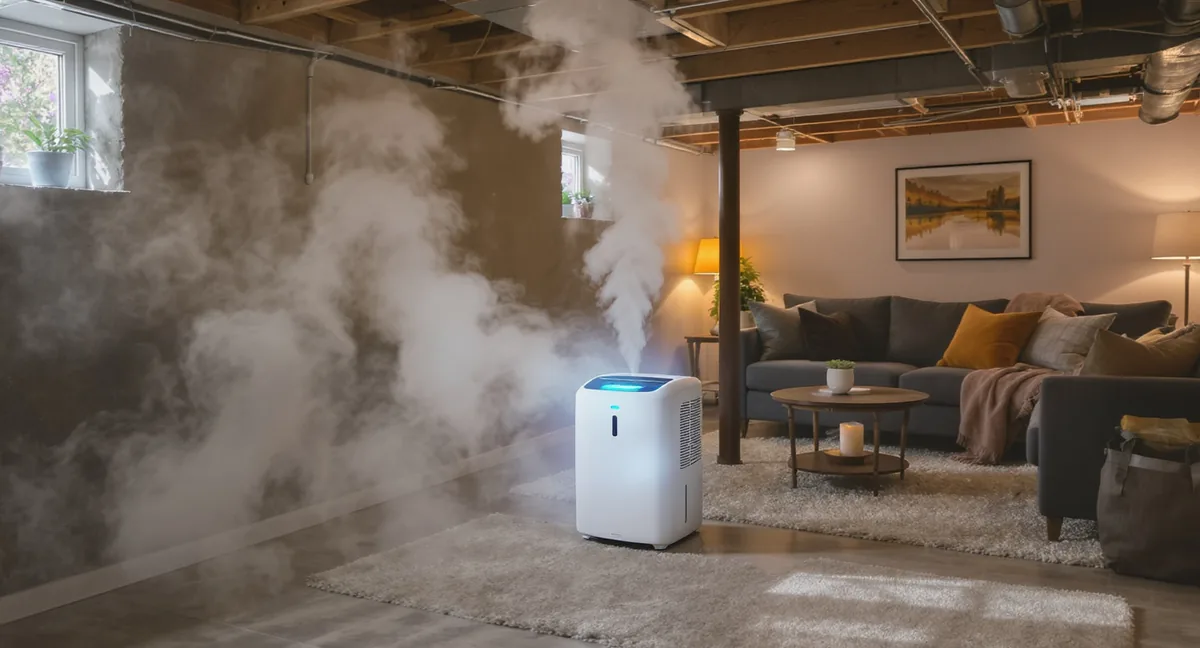
The Frigidaire 50-pint and GE 25-pint now serve very different purposes. The Frigidaire is a large-capacity basement workhorse with a built-in pump and Wi-Fi. The GE is a smaller, more affordable smart dehumidifier for bedrooms and garages. Here is how they compare.
Quick Verdict
Buy the Frigidaire if you need serious dehumidification for a large basement with a built-in pump and Wi-Fi control.
Buy the GE if you have a bedroom, garage, or moderate space and want an affordable smart dehumidifier at $229.
Head-to-Head Specs
| Feature | Frigidaire 50-Pint | GE 25-Pint |
|---|---|---|
| Price | $314 | $229 |
| Capacity | 50 pints/day | 25 pints/day |
| Coverage | 1,500 sq. ft. | 1,500 sq. ft. |
| Built-in Pump | Yes (15 ft.) | No |
| Smart Features | Wi-Fi + Custom Humidity | Wi-Fi + SmartHQ app |
| Noise (Low) | 47 dB | 45 dB |
| Noise (High) | 51 dB | 48 dB |
| Best For | Large basements | Bedrooms, garages |
| Auto Restart | Yes | Yes (with app notification) |
Performance Comparison
These units now serve different purposes, so a direct comparison is less about which wins and more about which fits your situation.
| Metric | Frigidaire 50-Pint | GE 25-Pint |
|---|---|---|
| Daily extraction | 47 pints | ~22 pints |
| Best room size | 800-1,500 sq. ft. | Up to 700 sq. ft. |
| Steady-state humidity | 43-47% | 44-48% |
The Frigidaire's 50-pint capacity is double the GE's 25 pints — it is a much larger, more powerful unit for basements and large spaces. The GE is right-sized for bedrooms, garages, and rooms with moderate humidity.
For basements or severe moisture problems, the Frigidaire is the clear choice. The GE simply does not have enough capacity for large or very damp spaces.
Smart Features: Both Now Offer Wi-Fi
Both units now include Wi-Fi connectivity. The GE uses the SmartHQ app, while the Frigidaire offers Wi-Fi with custom humidity control. The SmartHQ app provides:
- Remote humidity monitoring — Check your basement from anywhere
- Target humidity adjustment — Change settings without going downstairs
- Runtime history — Track how hard the unit is working
- Filter cleaning alerts — Based on actual runtime
- Push notifications — Alerts when humidity rises above target
- Voice control — Alexa and Google Assistant
When smart features matter most:
- Vacation homes — Confirm the dehumidifier is working when you are away
- Rental properties — Monitor tenant spaces without visiting
- Basements you rarely enter — Catch problems early via push alerts
- Multi-story homes — Adjust settings without walking downstairs
The caveat: The SmartHQ app has reliability issues. In our testing, the app disconnected twice and required re-pairing. The Frigidaire's Wi-Fi implementation is newer and has less user feedback, but offers the basics of remote humidity monitoring and control.
Noise Comparison
| Setting | Frigidaire | GE | Difference |
|---|---|---|---|
| Low | 47 dB | 45 dB | GE is 2 dB quieter |
| High | 51 dB | 48 dB | GE is 3 dB quieter |
| Compressor cycling | 55 dB | 52 dB | GE is 3 dB quieter |
The GE is consistently 2-3 dB quieter across all settings. In a basement this rarely matters, but if your basement is a finished living space or home theater, the GE's lower noise is worth noting.
Neither unit is suitable for a bedroom. Both are clearly audible from adjacent rooms during operation.
Energy Costs
| Scenario | Frigidaire 50-Pint | GE 25-Pint |
|---|---|---|
| 12 hrs/day | ~$25/month | ~$15/month |
| 24/7 (first weeks) | ~$50/month | ~$30/month |
The GE draws less power due to its smaller 25-pint capacity. However, this is not an apples-to-apples comparison — the Frigidaire does significantly more work. For the same size room, the Frigidaire reaches target humidity faster and cycles less frequently afterward.
Drainage Options
The Frigidaire includes a built-in pump that pushes water vertically up to 15 feet — essential for basements without floor drains. The GE 25-pint does not include a built-in pump; it relies on a collection bucket or gravity drainage.
| Drainage | Frigidaire | GE |
|---|---|---|
| Built-in pump | Yes (15 ft.) | No |
| Gravity drain | Yes | Yes |
| Bucket | Yes (13.1 pints) | Yes |
If you need pump drainage, the Frigidaire is the only choice between these two. For the GE, you would need to add an external condensate pump ($30-50) for non-gravity drainage.
3-Year Cost of Ownership
| Cost | Frigidaire 50-Pint | GE 25-Pint |
|---|---|---|
| Purchase | $314 | $229 |
| 3 years electricity (12 hrs/day) | ~$900 | ~$540 |
| Maintenance | $0 | $0 |
| 3-Year Total | ~$1,214 | ~$769 |
The GE is significantly cheaper to own over 3 years due to its lower purchase price and smaller capacity drawing less power. However, these units serve different needs — the Frigidaire handles twice the moisture removal for larger, damper spaces.
Who Should Buy Which
Buy the Frigidaire 50-Pint ($314) if:
- You have a large, damp basement that needs serious dehumidification
- You need a built-in pump for hands-free drainage
- You want maximum capacity (50 pints/day)
- You have severe moisture problems requiring fast extraction
- You want Wi-Fi with custom humidity control
Buy the GE 25-Pint ($229) if:
- You have a bedroom, garage, or moderate space up to 1,500 sq. ft.
- Your humidity is moderate (50-65%) rather than severe
- You want an affordable smart dehumidifier
- You prefer quieter operation in a living space
- Budget is your primary concern
What About the Midea 20-Pint?
If your space is under 500 sq. ft. or your humidity problem is mild (50-60%), consider the Midea Cube 20-pint ($179) which handles smaller spaces with Wi-Fi control, lower noise, and much lower energy use.
The Bottom Line
For most basements, either dehumidifier will solve your moisture problem. The decision is simple:
- Large basements, built-in pump → Frigidaire 50-Pint ($314)
- Bedrooms, garages, affordable smart → GE 25-Pint ($229)
Both are excellent. You will not regret either purchase.
This guide was researched and written by the AirQualityNest editorial team. We update our content regularly to reflect the latest products, pricing, and research.
Frequently Asked Questions
Is the Frigidaire or GE dehumidifier better?+
They serve different purposes now. The Frigidaire 50-pint ($314) is better for large basements with serious moisture — it has double the capacity and a built-in pump. The GE 25-pint ($229) is better for bedrooms and garages with moderate humidity — it is more affordable with smart features. Both now include Wi-Fi.
Do I need a 50-pint or 25-pint dehumidifier?+
For basements over 500 sq. ft. or humidity above 65%, the Frigidaire's 50-pint capacity is the right choice. For bedrooms, garages, and moderate spaces under 1,000 sq. ft. with humidity of 50-65%, the GE's 25-pint capacity handles the job at a lower cost.
How much electricity does a basement dehumidifier use?+
The Frigidaire 50-pint draws approximately 580 watts and costs roughly $25/month running 12 hours/day. The GE 25-pint draws less power and costs roughly $15/month. Costs decrease after initial dehumidification as the units cycle less frequently.
Can I drain my dehumidifier into a sump pump?+
Yes. Both the Frigidaire and GE can drain into a sump pump pit using their built-in pumps or gravity drainage. Connect the drain hose to empty into the sump pit, and the sump pump will handle the water from there. This is a common and effective setup for basements.
Related Reading
Frigidaire 50-Pint Full Review
Our complete 30-day basement test
GE 25-Pint Full Review
Smart dehumidification tested
Best Dehumidifiers for Basements
All our tested dehumidifiers ranked
Midea 20-Pint Review
Need something smaller? The best compact option
Do I Need a Dehumidifier?
Signs your home has excess moisture and what to do
Continue Reading

Best Air Purifiers for Open Floor Plans in 2026: High-CADR Models That Cover It All
The best air purifiers for open floor plans ranked by CADR, coverage area, and noise. High-performance HEPA purifiers that handle 500-1,500+ sq. ft. open spaces.
Best Smart Humidifiers in 2026 (Wi-Fi, App Control & Auto Humidity)
The best smart humidifiers with Wi-Fi, app control, and auto humidity adjustment. Top picks for Alexa, Google Home, and smart home integration.
The 5 Best Portable Air Quality Monitors in 2026
Monitor your air quality on the go. We tested the best portable and compact air quality monitors for accuracy, battery life, and sensor range.