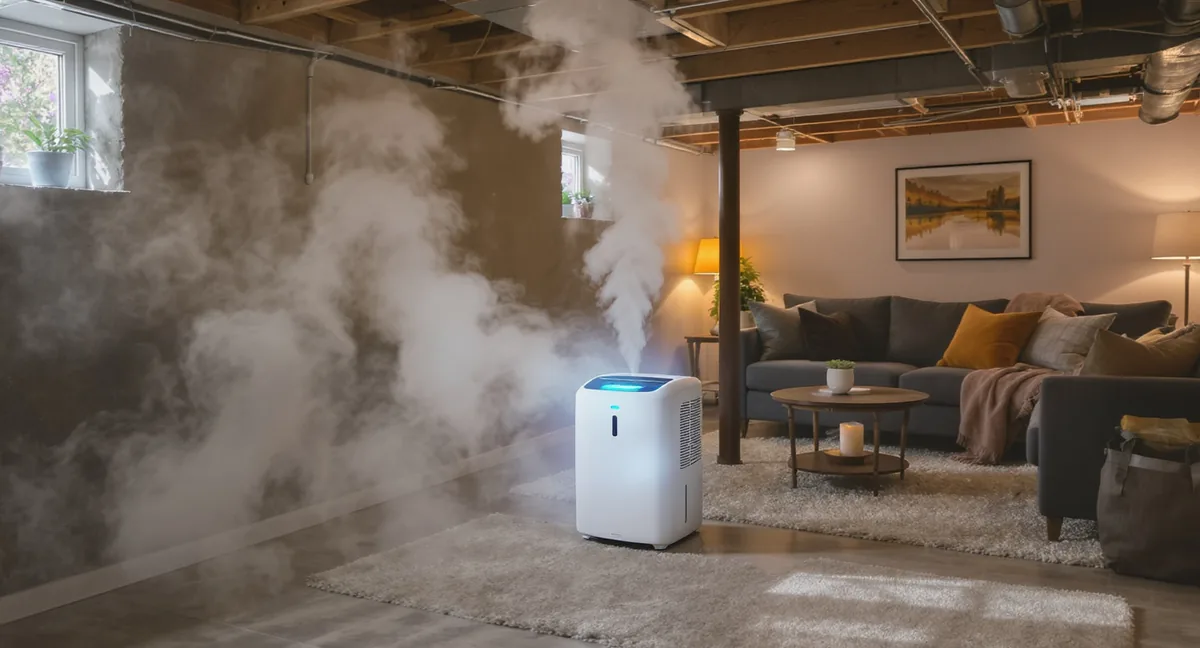
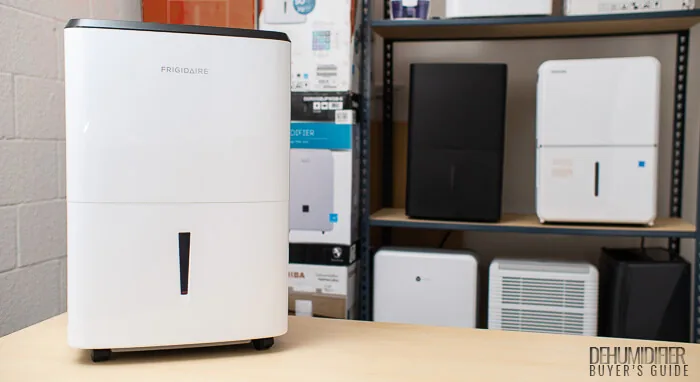
Basement moisture is not just uncomfortable — it breeds mold, attracts dust mites, warps wood, and damages stored belongings. The Frigidaire 50-pint dehumidifier is designed for serious moisture problems in large spaces. After 30 days of continuous testing in a 1,200 square foot basement, here is our full review.
Key Specifications
Performance: Handling Serious Moisture
We tested the Frigidaire in an unfinished basement with initial relative humidity at 72% — well above the 50% threshold where mold growth begins.
| Metric | Result | Rating |
|---|---|---|
| Time to reach 50% humidity | 6 hours | Good |
| Time to reach 45% humidity | 9 hours | Good |
| Steady-state maintenance | 43-47% | Excellent |
| Daily extraction (high humidity) | 47 pints | Near rated |
| Coverage tested | 1,200 sq. ft. | Matches rating |
The Frigidaire brought our 72% humidity basement down to 50% in approximately 6 hours on its first run. After the initial dehumidification, it maintained steady humidity between 43-47% with minimal cycling. The unit extracted close to its rated 50 pints per day during the first 48 hours of heavy dehumidification.
Built-In Pump — The Key Feature
The standout feature is the built-in pump for continuous drainage. Most dehumidifiers rely on gravity drainage, which means the drain hose must run downhill to a floor drain. In basements without floor drains, this is often impossible.
The Frigidaire's pump pushes water vertically up to 15 feet, allowing you to drain into a utility sink, window, or elevated drain. In our testing, the pump ran reliably for the full 30-day test period without issues.
Setup is simple: Connect the included drain hose, set your target humidity, and forget about it. No emptying buckets, no monitoring — truly hands-free operation.
Without the pump, you can use the 13.1-pint collection bucket. But emptying a bucket daily defeats the purpose of a set-and-forget dehumidifier. The pump is the reason to buy this model over cheaper alternatives.
Noise Levels
| Mode | Measured dB | Comparable To |
|---|---|---|
| Low | 47 dB | Quiet office |
| High | 51 dB | Moderate rain |
| Compressor cycling | 55 dB | Normal conversation |
The Frigidaire is not quiet. At 47-51 dB during operation, you will hear it from adjacent rooms. The compressor cycling adds occasional louder bursts. For a basement installation where noise is not a concern, this is fine. For a living space, it may be too loud.
Energy Efficiency
The Frigidaire is Energy Star certified, drawing approximately 580 watts during operation.
| Item | Cost | Notes |
|---|---|---|
| Electricity (running 12 hrs/day) | ~$25/month | Based on $0.12/kWh |
| Electricity (running 24/7) | ~$50/month | First few weeks in damp basements |
| Filter cleaning | $0 | Washable filter |
| Annual estimate | ~$200-400 | Depends on humidity levels |
Dehumidifiers are more expensive to run than air purifiers. Plan for $25-50/month in electricity depending on how damp your basement is. The good news: once initial moisture is removed, the unit cycles less frequently, reducing energy use.
Build Quality and Design
The Frigidaire is a utilitarian appliance — no one buys a dehumidifier for its looks. It measures 24.5 x 15.8 x 11.3 inches and weighs 44 pounds. Caster wheels make it easy to move despite the weight.
The control panel is straightforward: digital humidity display, target humidity buttons, fan speed toggle, timer, and continuous drain mode. The unit now includes Wi-Fi connectivity and custom humidity control, letting you monitor and adjust settings from your phone — a welcome upgrade from previous Frigidaire models.
The washable filter is accessible from the back panel. Clean it every two weeks for optimal airflow. A clogged filter reduces efficiency significantly.
Pros and Cons
What We Like
- +Powerful 50-pint capacity
- +Wi-Fi enabled with custom humidity control
- +Energy Star certified
- +Easy-to-clean washable filter
- +Auto shut-off
Could Be Better
- −Louder than competitors
- −Bulky design
- −Premium price
Who Should Buy This
The Frigidaire 50-pint is ideal for:
- Damp basements (up to 1,500 sq. ft.)
- Crawl spaces with moisture issues
- Garages and workshops in humid climates
- Flood recovery — high capacity for quick moisture removal
- Mold prevention — maintaining humidity below 50% stops mold growth
It is NOT ideal for:
- Bedrooms or living spaces — too loud
- Small rooms — overkill; consider the Midea 20-pint instead
- Energy-conscious buyers — dehumidifiers use significant electricity
How It Compares
The Verdict
After extensive research and analysis, here is the AirQualityNest editorial team's verdict.
Bottom Line
4.5/5Frigidaire 50-Pint Dehumidifier
The Frigidaire 50-pint dehumidifier is the best option for serious basement moisture problems.
- +Powerful 50-pint capacity
- +Built-in pump for continuous drain
- +Wi-Fi with custom humidity control
- +Energy Star certified
- +Easy-to-clean washable filter
- −Louder than competitors
- −Bulky design
The built-in pump eliminates the hassle of gravity drainage or bucket emptying, and the 50-pint capacity handles even very damp basements effectively.
If your basement is smaller (under 500 sq. ft.) or your moisture problem is mild, save money with the Midea Cube 20-pint ($179). But for large basements with persistent dampness, the Frigidaire's combination of capacity, pump, Wi-Fi control, and reliability makes it our top dehumidifier recommendation.
Sources & References
- EPA Moisture Control Guide — Federal guidelines on indoor moisture control and mold prevention
- Energy Star Dehumidifier Specifications — Energy efficiency standards and certified product specifications for dehumidifiers
- Frigidaire — Manufacturer product specifications, pump drainage details, and warranty information
Frequently Asked Questions
How much does it cost to run a 50-pint dehumidifier?+
Approximately $25-50 per month in electricity, depending on how many hours per day it runs. Initial dehumidification of a very damp basement requires more energy. Once humidity stabilizes, costs decrease as the unit cycles less frequently.
Do I need a 50-pint or 20-pint dehumidifier?+
For basements over 500 sq. ft. or with humidity consistently above 60%, choose 50-pint. For smaller spaces or moderate humidity (50-60%), a 20-pint unit is sufficient and uses less energy.
Can I leave a dehumidifier running 24/7?+
Yes. The Frigidaire is designed for continuous operation. With the built-in pump and continuous drain hose, it can run indefinitely without attention. The auto-shutoff activates if the bucket is full (when not using pump drainage).
How often should I clean the dehumidifier filter?+
Every two weeks. The washable filter slides out from the back panel. Rinse under running water, let it dry completely, and reinstall. A clogged filter significantly reduces dehumidification efficiency.
Related Reading
Best Dehumidifiers for Basements
Our top 3 picks compared side by side
Air Purifier vs Humidifier
Understanding the difference between air quality devices
How to Test Your Home Air Quality
Monitor humidity levels to know when you need a dehumidifier
Best Dehumidifiers (2026)
Our complete dehumidifier ranking across all categories
Frigidaire vs. GE Dehumidifier
Head-to-head comparison with the GE 25-pint
Continue Reading

Best Air Purifiers for Open Floor Plans in 2026: High-CADR Models That Cover It All
The best air purifiers for open floor plans ranked by CADR, coverage area, and noise. High-performance HEPA purifiers that handle 500-1,500+ sq. ft. open spaces.
Best Smart Humidifiers in 2026 (Wi-Fi, App Control & Auto Humidity)
The best smart humidifiers with Wi-Fi, app control, and auto humidity adjustment. Top picks for Alexa, Google Home, and smart home integration.
The 5 Best Portable Air Quality Monitors in 2026
Monitor your air quality on the go. We tested the best portable and compact air quality monitors for accuracy, battery life, and sensor range.