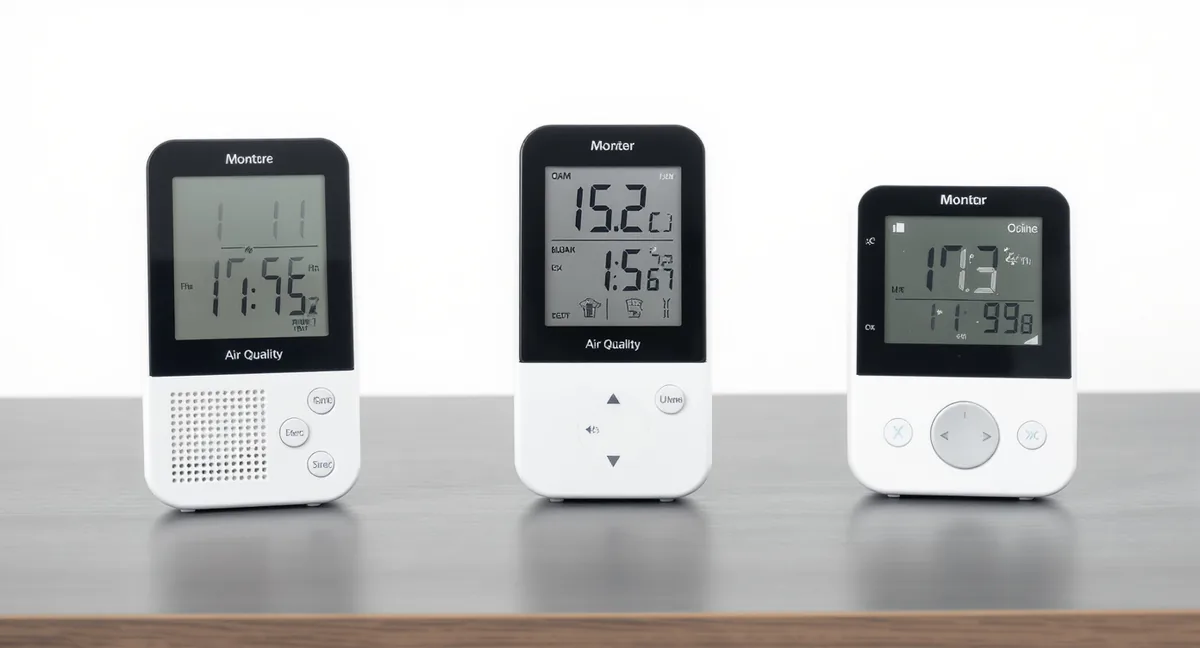
The Amazon Smart Air Quality Monitor is the cheapest way to start monitoring your indoor air. At $50, it measures PM2.5, VOCs, carbon monoxide, temperature, and humidity — and integrates seamlessly with Alexa for voice queries and automations.
But cheap comes with trade-offs. Here is what the Amazon monitor does well, where it falls short, and whether it is worth your $50.
Key Specifications
What It Measures
| Sensor | Range | Accuracy vs. Reference |
|---|---|---|
| PM2.5 | 0-500 µg/m³ | ±15% (acceptable) |
| VOCs | Low/Medium/High | Relative only (no ppm) |
| Carbon Monoxide | 0-1000 ppm | ±10% (good) |
| Temperature | 32-122°F | ±1.8°F (good) |
| Humidity | 20-90% RH | ±3% (acceptable) |
The PM2.5 and CO sensors performed reasonably in our testing — within 15% of our reference Airthings View Plus on most readings. The VOC sensor is the weakest link: it provides only a relative quality indicator (Low/Medium/High) rather than a specific parts-per-million reading.
Notable omission: No CO2 sensor and no radon detection. If you need CO2 monitoring for office ventilation or radon testing for health safety, the Airthings View Plus is the better choice despite costing significantly more.
Alexa Integration — The Main Selling Point
The Amazon monitor has no standalone app and no display. You check air quality exclusively through Alexa:
- "Alexa, what's the air quality?" — Gives you a spoken summary
- Alexa app dashboard — Shows current readings and 24-hour trends
- Routines — Trigger automations based on air quality changes
Example automations:
- Turn on a smart plug (air purifier) when PM2.5 exceeds 12 µg/m³
- Turn on a humidifier when humidity drops below 35%
- Get a notification when CO levels rise
If you already have an Alexa smart home, this integration is genuinely useful. The monitor becomes a trigger for air quality automations that run without your involvement.
If you do not use Alexa, this monitor offers very little. Without the Alexa app, you have no way to view your data.
Accuracy Testing
We ran the Amazon monitor alongside our reference Airthings View Plus for two weeks.
PM2.5 accuracy: The Amazon monitor tracked our reference within ±15% during normal indoor conditions (PM2.5 under 25 µg/m³). During a cooking event that spiked PM2.5 to 80+ µg/m³, the Amazon monitor lagged the Airthings by about 3 minutes on the rise and 5 minutes on the fall. Acceptable for a $50 device, but noticeably less responsive.
VOC accuracy: Unreliable for specific readings. The "High" threshold triggered appropriately during cleaning product use and cooking, but the "Low" baseline was inconsistent compared to the Airthings' specific ppb readings.
Temperature and humidity: Both sensors performed well — within specifications and consistent with our reference.
Design and Setup
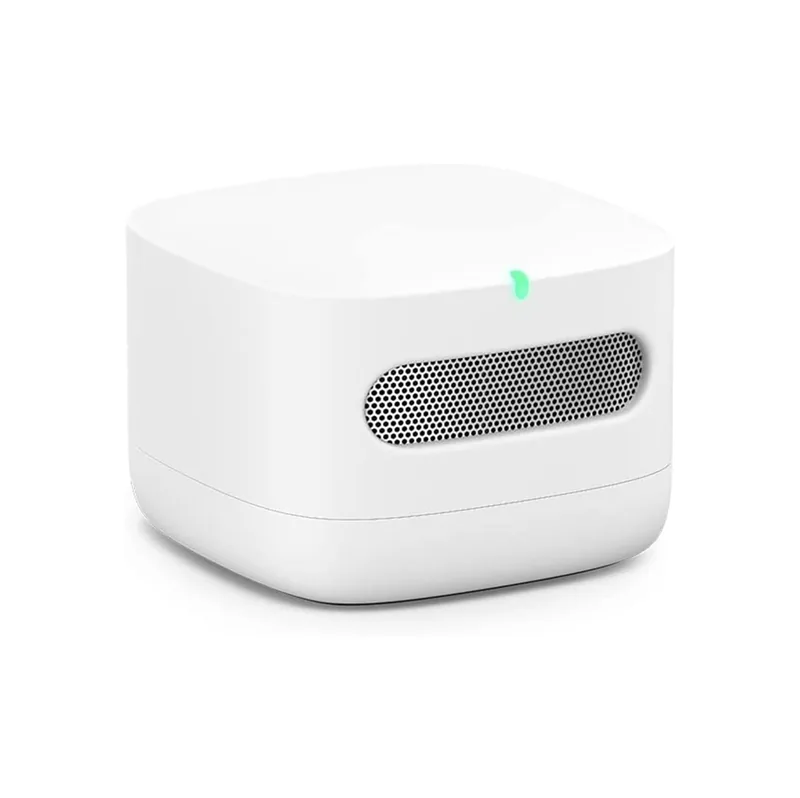
The monitor is a compact white puck (3.4 x 3.4 x 1.6 inches) that sits on any flat surface. It connects via USB-C — no battery option, so it needs a permanent power outlet.
Setup takes about 3 minutes through the Alexa app. Pair, connect to Wi-Fi, done. No calibration needed.
There is no screen or display on the device itself — just a single LED that changes color based on air quality (green/yellow/red). This is a meaningful limitation if you want a quick visual check without asking Alexa.
Running Costs
| Item | Cost | Frequency |
|---|---|---|
| Electricity | < $1/month | USB-C powered |
| Sensor replacement | $0 | None required |
| Annual total | < $12 |
Zero maintenance and near-zero operating cost. This is a significant advantage over the Airthings, which costs $329.99 upfront plus battery replacements.
Pros and Cons
What We Like
- +Very affordable entry point
- +Seamless Alexa integration
- +Compact design
- +Easy setup in minutes
Could Be Better
- −No radon detection
- −No standalone app
- −Requires Alexa ecosystem
- −Less accurate than professional monitors
Who Should Buy This
The Amazon Smart Air Quality Monitor is ideal for:
- Alexa smart home users — the integration is the entire value proposition
- Budget-conscious buyers — best AQ monitor under $100
- Air purifier automation — trigger your purifier based on real-time PM2.5
- First-time air quality monitoring — learn about your indoor air without a big investment
It is NOT ideal for:
- Non-Alexa households — it literally requires Alexa to function
- People who need CO2 or radon monitoring — not available
- Data-focused users — limited historical data, no export, no API
- Precision requirements — VOC readings are relative, not absolute
How It Compares
The Verdict
After extensive research and analysis, here is the AirQualityNest editorial team's verdict.
Bottom Line
4.2/5Amazon Smart Air Quality Monitor
The Amazon Smart Air Quality Monitor is the best $50 you can spend on indoor air awareness — if you use Alexa.
- +Very affordable entry point
- +Seamless Alexa integration
- +Compact design
- +Easy setup in minutes
- −No radon detection
- −No standalone app
- −Requires Alexa ecosystem
- −Less accurate than professional monitors
The Amazon Smart Air Quality Monitor is the best $50 you can spend on indoor air awareness — if you use Alexa. The PM2.5 and CO sensors are accurate enough for home use, and the Alexa automations turn it from a passive monitor into an active air quality management tool.
If you do not use Alexa, skip this entirely. And if you need comprehensive monitoring with CO2, radon, and detailed data history, the Airthings View Plus is worth the premium.
Sources & References
- EPA Air Quality Index (AQI) — Federal air quality measurement standards and index definitions
- WHO Air Quality Guidelines — Global health-based particulate matter and pollutant thresholds
- ASHRAE Standard 62.1 — Ventilation and indoor air quality standards including CO2 thresholds
- Amazon Smart Air Quality Monitor Product Page — Official Amazon product page with specifications and Alexa integration details
Frequently Asked Questions
Does the Amazon Air Quality Monitor work without Alexa?+
No. The Amazon Smart Air Quality Monitor requires the Alexa app and an Alexa account to view readings and set up automations. It has no standalone app and no built-in display beyond a basic color LED.
Can the Amazon Air Quality Monitor detect mold?+
Not directly. It monitors humidity levels, which can indicate mold risk (above 60% humidity promotes mold growth). But it cannot detect mold spores in the air. For that, you need a dedicated mold test kit.
How accurate is the Amazon Air Quality Monitor?+
PM2.5 readings are within ±15% of professional monitors in normal conditions. CO, temperature, and humidity are accurate. VOC readings are relative (Low/Medium/High) rather than precise ppm values, making them less useful for detailed monitoring.
Does the Amazon monitor measure CO2?+
No. It measures carbon monoxide (CO), not carbon dioxide (CO2). These are different gases — CO is a dangerous combustion byproduct, while CO2 indicates ventilation quality. For CO2 monitoring, consider the Airthings View Plus or SAF Aranet4 Home.
Related Reading
Best Air Quality Monitors
See all our tested monitors ranked
Airthings View Plus Review
Our top-rated comprehensive air quality monitor
How to Test Your Home Air Quality
What to test for and how to interpret results
AQI Explained
Understanding air quality readings and what they mean
Aranet4 Home (Awair Replacement)
Gold-standard CO2 monitor with 2+ year battery
Continue Reading

Best Air Purifiers for Open Floor Plans in 2026: High-CADR Models That Cover It All
The best air purifiers for open floor plans ranked by CADR, coverage area, and noise. High-performance HEPA purifiers that handle 500-1,500+ sq. ft. open spaces.
Best Smart Humidifiers in 2026 (Wi-Fi, App Control & Auto Humidity)
The best smart humidifiers with Wi-Fi, app control, and auto humidity adjustment. Top picks for Alexa, Google Home, and smart home integration.
The 5 Best Portable Air Quality Monitors in 2026
Monitor your air quality on the go. We tested the best portable and compact air quality monitors for accuracy, battery life, and sensor range.