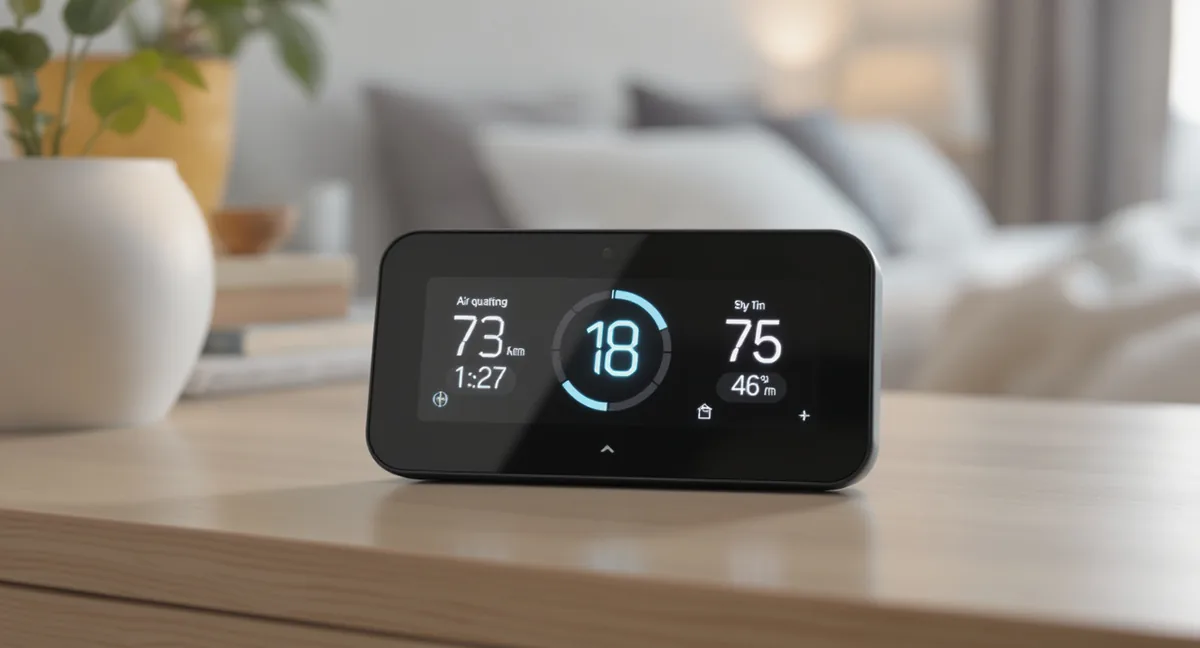
The Awair Element has been discontinued. As of April 2026, the monitor is no longer available on Amazon, and remaining stock from third-party sellers is either overpriced or of questionable provenance. If you came here looking to buy one, do not bother hunting for leftover inventory.
The good news: the SAF Aranet4 Home is available at the same $189 price point and is, in our assessment, the better air quality monitor for most buyers. It trades the Awair's breadth of sensors for significantly deeper accuracy where it matters most — CO2 monitoring — and adds genuine portability that the wall-powered Awair never had.
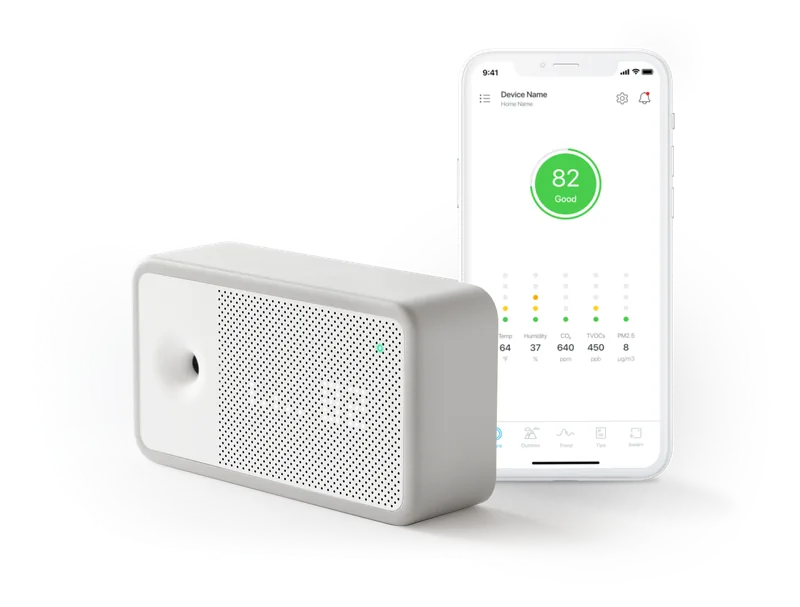
Key Specifications
What You Lose From the Awair Element
The Awair Element measured five parameters: PM2.5, CO2, VOCs, temperature, and humidity. The Aranet4 Home measures four: CO2, temperature, humidity, and air pressure. That means you lose two sensors in the switch:
PM2.5 monitoring is gone. If tracking fine particulate matter is important to you — during wildfire season, while cooking, or in a home near a busy road — you will need a separate device. The Amazon Smart Air Quality Monitor at $70 covers PM2.5 and works well as a companion.
VOC monitoring is gone. The Awair tracked total volatile organic compounds from cleaning products, paint, and off-gassing furniture. If VOC detection is a priority — particularly for new construction or renovation monitoring — consider the Airthings View Plus at $299, which includes both VOC and PM2.5 sensors alongside CO2.
Wi-Fi connectivity is gone. The Awair Element connected to your home Wi-Fi and supported Apple HomeKit, Amazon Alexa, Google Home, and IFTTT automations. The Aranet4 uses Bluetooth only, which limits it to phone app connectivity. No smart home triggers, no remote monitoring from outside your home, no voice assistant queries. If automated routines based on air quality readings are central to your setup, this is the biggest practical loss.
The LED display is gone. The Awair's backlit LED display showed an air quality score readable from across a room, with color-coded indicators that changed in real time. The Aranet4 uses an e-ink display — sharp and always-on, but not backlit. In a dark bedroom, you cannot read it without ambient light.
What You Gain With the Aranet4 Home
The Aranet4 does fewer things than the Awair. It does its core job — CO2 monitoring — better than almost anything on the consumer market.
Legendary CO2 accuracy. The Aranet4 uses a dual-channel NDIR sensor calibrated to within plus or minus 50 ppm. The Awair Element's NDIR sensor was rated at plus or minus 75 ppm. In practical terms, the Aranet4 is the most trusted consumer CO2 monitor available — it is the device that schools, universities, and public health agencies deployed during COVID ventilation assessments. If CO2 accuracy is what you care about, there is nothing better at this price.
2+ year battery life. The Awair Element was USB-C powered — no battery, permanently tethered to an outlet. The Aranet4 runs on two AA batteries for over two years. You can place it in any room without worrying about cable routing, move it between your bedroom and office depending on the day, or toss it in a bag for travel. This is a transformative upgrade in flexibility.
E-ink display. The e-ink screen is always on and consumes almost no power, which is how the Aranet4 achieves its multi-year battery life. The traffic-light color system (green, yellow, red) communicates air quality status at a glance. While it lacks the Awair's backlit vibrancy, it is perfectly readable in any lit environment and never needs to be woken up or tapped.
True portability. At 3.1 x 3.1 x 0.9 inches and roughly 4 ounces, the Aranet4 goes anywhere. Check CO2 in your conference room during a two-hour meeting, monitor your hotel room overnight, or verify that your classroom ventilation system is actually working. The Awair, plugged into a wall, could never do any of this.
Air pressure sensor. A minor addition, but useful for weather-sensitive individuals and for correlating barometric pressure changes with air quality patterns.
CO2 Is the Metric That Matters Most
If you could only monitor one indoor air quality parameter, CO2 is the one to pick. It is the single best real-time indicator of ventilation quality — the factor most directly tied to cognitive function, sleep quality, and general comfort in occupied spaces.
In a closed bedroom with one person, CO2 levels rise from the outdoor baseline of roughly 420 ppm to over 1,000 ppm within an hour. Above 1,000 ppm, research shows measurable declines in cognitive performance. Above 1,500 ppm, headaches and drowsiness become common. The Aranet4's tight accuracy means you can trust its readings to tell you exactly when ventilation is slipping.
PM2.5 and VOCs matter, but they are event-driven — you know when you are cooking, painting, or near wildfire smoke. CO2 buildup is invisible and gradual. A dedicated CO2 monitor with industry-leading accuracy is more useful day-to-day than a multi-sensor device with adequate accuracy across everything.
Running Costs
| Item | Cost | Frequency |
|---|---|---|
| AA batteries | ~$3 | Every 2+ years |
| Sensor replacement | $0 | None required |
| Annual total | < $2 |
The Aranet4 is cheaper to operate than the Awair Element was. No electricity draw, no USB cable to replace.
Pros and Cons
What We Like
- +NDIR sensor is gold standard for CO2 accuracy
- +E-ink display visible from across room
- +Portable and battery-powered
- +App for configuration and data history
Could Be Better
- −CO2 only — no PM2.5 or VOC sensors
- −Bluetooth only, no Wi-Fi
- −No real-time air quality score
- −App is basic
Who Should Buy the Aranet4 Home
The Aranet4 Home is ideal for:
- Remote workers — CO2 monitoring tells you when your office air is stale, and the portable form factor lets you check any room
- Parents — Monitor CO2 in a child's bedroom overnight, then move it to the playroom during the day
- Travelers — Check hotel rooms, Airbnbs, and conference venues
- Anyone who valued the Awair's CO2 feature — You get better accuracy and zero cables
It is NOT ideal for:
- Smart home automation users — No Wi-Fi, no HomeKit, no Alexa integration
- PM2.5 or VOC monitoring — You need a separate device or a different monitor entirely
- Dark room visibility — The e-ink display is not backlit
How It Compares
The Verdict
After extensive research and analysis, here is the AirQualityNest editorial team's verdict.
Bottom Line
4.7/5SAF Aranet4 Home Air Quality Monitor
The Awair Element is discontinued. The SAF Aranet4 Home at the same $189 price is our recommended replacement — its NDIR CO2 sensor is the most accurate in its class, the 2+ year battery eliminates cable clutter, and the portable form factor is a genuine upgrade over the Awair's wall-powered design.
- +Industry-leading CO2 accuracy (NDIR, ±50 ppm)
- +2+ year battery life on AA batteries
- +E-ink display always on, no power needed
- +Truly portable — carry between rooms or travel
- −No PM2.5 or VOC sensors
- −Bluetooth only — no Wi-Fi or smart home integration
- −E-ink display not backlit for dark rooms
The Awair Element was a strong product. Its discontinuation leaves a gap in the multi-sensor, Wi-Fi-connected monitor space. But for the core use case that drove most Awair purchases — knowing when indoor air quality is slipping and when to open a window — the Aranet4 Home does it better, more accurately, and without a power cable.
If you need PM2.5 and VOC coverage alongside CO2, pair the Aranet4 with an Amazon Smart Air Quality Monitor ($70) for a two-device setup that covers more ground than the Awair did alone, for roughly $70 more total. Or step up to the Airthings View Plus ($299) for a single device that monitors seven parameters including radon.
Sources & References
- EPA Air Quality Index (AQI) — Federal air quality measurement standards and index definitions
- WHO Air Quality Guidelines — Global health-based particulate matter and pollutant thresholds
- ASHRAE Standard 62.1 — Ventilation and indoor air quality standards including CO2 thresholds
- SAF Aranet4 Home Product Page — Official manufacturer specifications for the recommended replacement monitor
Frequently Asked Questions
Is the Awair Element still available?+
No. The Awair Element has been discontinued and is no longer available through authorized retailers. We recommend the SAF Aranet4 Home at $189 as the best replacement for CO2-focused air quality monitoring.
What does the Aranet4 Home measure?+
The Aranet4 Home measures CO2, temperature, relative humidity, and atmospheric pressure. It does not measure PM2.5, VOCs, or radon. Its NDIR CO2 sensor is rated at plus or minus 50 ppm — the most accurate in the consumer category.
Does the Aranet4 Home work with smart home systems?+
No. The Aranet4 connects via Bluetooth to its companion phone app only. It does not support Wi-Fi, Apple HomeKit, Amazon Alexa, Google Home, or IFTTT. If smart home integration is a requirement, consider the Airthings View Plus.
How long do the batteries last in the Aranet4?+
The Aranet4 Home runs on two AA batteries for over two years of continuous monitoring. The e-ink display consumes minimal power, which is how it achieves this battery life without any compromise in measurement frequency.
Related Reading
Best Air Quality Monitors
Compare all our tested monitors side by side
Aranet4 Home Review
Our full review of the Aranet4 Home CO2 monitor
Best CO2 Monitors
The best monitors for tracking ventilation quality
How to Test Your Home Air Quality
What to measure and how to interpret your readings
How to Improve Indoor Air Quality
Action steps based on your monitor readings
Continue Reading

Best Air Purifiers for Open Floor Plans in 2026: High-CADR Models That Cover It All
The best air purifiers for open floor plans ranked by CADR, coverage area, and noise. High-performance HEPA purifiers that handle 500-1,500+ sq. ft. open spaces.
Best Smart Humidifiers in 2026 (Wi-Fi, App Control & Auto Humidity)
The best smart humidifiers with Wi-Fi, app control, and auto humidity adjustment. Top picks for Alexa, Google Home, and smart home integration.
The 5 Best Portable Air Quality Monitors in 2026
Monitor your air quality on the go. We tested the best portable and compact air quality monitors for accuracy, battery life, and sensor range.