Formaldehyde is the most common volatile organic compound found in homes — and one of the most dangerous. The International Agency for Research on Cancer (IARC) classifies it as a Group 1 carcinogen, meaning there is sufficient evidence that it causes cancer in humans. Yet it is present in virtually every home, released by furniture, flooring, insulation, cleaning products, and even gas stoves.
Unlike many indoor pollutants, formaldehyde does not settle out of the air on its own. It is a persistent, colorless gas with a sharp odor at high concentrations — but at the levels typically found indoors, you cannot smell it at all. That makes it invisible, continuous, and easy to ignore.
Key Takeaways
- 1Formaldehyde is classified as a Group 1 carcinogen by IARC — the same category as asbestos and benzene — with proven links to nasopharyngeal cancer and leukemia
- 2The largest indoor sources are pressed-wood products (particleboard, plywood, MDF), laminate flooring, insulation, and gas stoves — new construction and renovations dramatically increase levels
- 3The WHO guideline for indoor formaldehyde is 0.1 mg/m³ (0.08 ppm) as a 30-minute average — many newly furnished homes exceed this
- 4Standard HEPA filters do not capture formaldehyde because it is a gas; you need activated carbon filtration or catalytic oxidation technology
- 5Source control (choosing solid wood, airing out new furniture) combined with ventilation and carbon/catalytic filtration is the most effective reduction strategy
Quick Answer
How do I remove formaldehyde from my home?
Remove formaldehyde using three strategies: first, reduce sources by choosing solid wood or exterior-grade plywood, low-formaldehyde insulation, and airing out new furniture outdoors for several days before use. Second, ventilate by opening windows for 15-20 minutes daily, especially after receiving new furniture or completing renovations. Third, run an air purifier with heavy activated carbon (like the Austin Air HealthMate with 15 lbs of carbon) or catalytic oxidation technology (like the Dyson Big Quiet Formaldehyde, which continuously destroys formaldehyde at the molecular level). Monitor levels with a VOC sensor.
What Is Formaldehyde?
Formaldehyde (CH2O) is the simplest aldehyde — a naturally occurring organic compound that is also manufactured on a massive industrial scale. At room temperature it exists as a colorless gas with a pungent, irritating odor at high concentrations. It is highly reactive, water-soluble, and flammable.
Industrially, formaldehyde is used in the production of urea-formaldehyde (UF) and phenol-formaldehyde (PF) resins — the adhesives that bind together particleboard, plywood, MDF, and other composite wood products. These resins slowly break down over time, releasing formaldehyde gas into indoor air through a process called off-gassing. This off-gassing can continue for months or even years after installation.
Formaldehyde belongs to the broader family of volatile organic compounds (VOCs), but it deserves special attention because of its prevalence, persistence, and proven carcinogenicity. While many VOCs are harmful, formaldehyde is one of only a handful classified in IARC's highest-risk category.
Common Sources in Your Home
Formaldehyde enters your home from a surprisingly wide range of sources:
Building Materials and Furniture
- Particleboard and MDF — The largest single source in most homes. The urea-formaldehyde resins in these engineered woods off-gas continuously, especially in the first 1-2 years
- Plywood (interior grade) — Interior-grade plywood uses UF resins with higher emissions; exterior-grade plywood uses phenol-formaldehyde, which emits significantly less
- Laminate flooring — Composite core layers bonded with formaldehyde-based adhesives
- Cabinetry — Kitchen and bathroom cabinets made from particleboard or MDF
- New furniture — Bookshelves, desks, dressers, and bed frames made from pressed wood
- Insulation — Urea-formaldehyde foam insulation (UFFI), widely installed in the 1970s and 1980s, continues to off-gas in older homes
Household Products
- Permanent-press fabrics — Wrinkle-resistant clothing, curtains, and bedding are treated with formaldehyde-releasing resins
- Glues and adhesives — Many construction and craft adhesives contain formaldehyde
- Some paints and coatings — Particularly older or industrial formulas
- Cleaning products — Certain disinfectants and antibacterial cleaners release formaldehyde
- Air fresheners and candles — Synthetic fragrances can react with ozone to produce secondary formaldehyde
Combustion Sources
- Gas stoves and ovens — Burning natural gas produces formaldehyde, particularly during high-heat cooking
- Gas heaters and fireplaces — Unvented combustion appliances are significant emitters
- Tobacco smoke — Cigarette smoke contains formaldehyde alongside dozens of other carcinogens
- Candles and incense — Combustion byproducts include formaldehyde, especially from paraffin candles
Timing Matters
Formaldehyde levels are highest when sources are new. A newly furnished room or recently renovated space can have formaldehyde concentrations 3 to 10 times higher than the same space six months later. Levels also rise with temperature and humidity — summer months and poorly ventilated spaces produce the worst conditions.
Health Effects of Formaldehyde Exposure
Short-Term Effects (Hours to Days)
Even brief exposure to elevated formaldehyde levels can cause:
- Eye irritation — Burning, watering, and redness
- Nose and throat irritation — Stinging sensation, sore throat
- Headaches — Often described as a "chemical headache" distinct from tension headaches
- Skin irritation — Contact dermatitis from formaldehyde-treated fabrics
- Respiratory symptoms — Coughing, wheezing, and chest tightness
- Nausea and fatigue — General malaise, especially in poorly ventilated spaces
These symptoms typically appear at concentrations above 0.1 ppm and worsen as levels increase. Most people can detect the odor of formaldehyde at 0.5-1.0 ppm — well above the threshold where health effects begin.
Long-Term Effects (Months to Years)
Chronic exposure to formaldehyde, even at lower concentrations, carries serious health risks:
- Nasopharyngeal cancer — The IARC classification as a Group 1 carcinogen is based primarily on strong epidemiological evidence linking occupational formaldehyde exposure to cancers of the nasal passages and throat
- Leukemia — Several studies have found elevated leukemia risk among workers with prolonged formaldehyde exposure, though the evidence is characterized as "strong but not sufficient" by IARC
- Chronic respiratory disease — Long-term exposure can cause persistent airway inflammation and reduced lung function
- Sensitization — Repeated exposure can cause formaldehyde sensitivity, where even very low levels trigger symptoms
Who Is Most Vulnerable?
- Infants and young children — Higher breathing rates per body weight mean proportionally greater exposure; developing respiratory and immune systems are more susceptible
- Pregnant women — Some animal studies suggest formaldehyde exposure may affect fetal development
- People with asthma — Formaldehyde is a known asthma trigger and can worsen existing respiratory conditions
- The elderly — Reduced respiratory function makes them more susceptible to irritant effects
- Chemically sensitive individuals — Those already sensitized to formaldehyde can react at concentrations well below guideline levels
Safe Exposure Levels
Multiple health organizations have established guideline limits for indoor formaldehyde:
| Organization | Guideline | Averaging Period | Notes |
|---|---|---|---|
| WHO | 0.1 mg/m3 (0.08 ppm) | 30-minute average | Protects against sensory irritation in the general population |
| EPA | No enforceable standard | — | References the Agency for Toxic Substances and Disease Registry (ATSDR) MRL of 0.04 ppm for chronic exposure |
| OSHA | 0.75 ppm (workplace) | 8-hour TWA | Workplace standard only; not applicable to residential settings |
| California OEHHA | 0.009 mg/m3 (0.007 ppm) | Chronic REL | The most conservative residential guideline |
The WHO guideline of 0.1 mg/m3 (approximately 0.08 ppm) is the most widely referenced standard for residential exposure. To put this in perspective:
- Outdoor air typically contains 0.001-0.02 ppm
- Average U.S. home ranges from 0.01-0.05 ppm
- Newly constructed or renovated homes can reach 0.1-0.5 ppm
- Homes with new particleboard furniture can spike to 0.2-0.4 ppm
Many newly furnished or renovated homes exceed the WHO guideline — especially in the first few months after construction or when new pressed-wood furniture is introduced.
How to Test for Formaldehyde
Passive Badges and Test Kits
Mail-in formaldehyde test kits use passive sampling badges that absorb formaldehyde over a set period (typically 24-96 hours). You mail the badge to a certified lab for analysis.
- Cost: $30-80 per test
- Accuracy: High (lab-analyzed)
- Best for: One-time assessment of a specific room
- Limitation: Provides only a snapshot; does not show fluctuations
Continuous VOC Monitoring
While no affordable consumer device measures formaldehyde specifically, a quality VOC monitor tracks Total Volatile Organic Compounds (TVOCs), which includes formaldehyde. Since formaldehyde is typically the dominant VOC in most homes, TVOC readings serve as a useful proxy — especially for tracking trends after interventions.
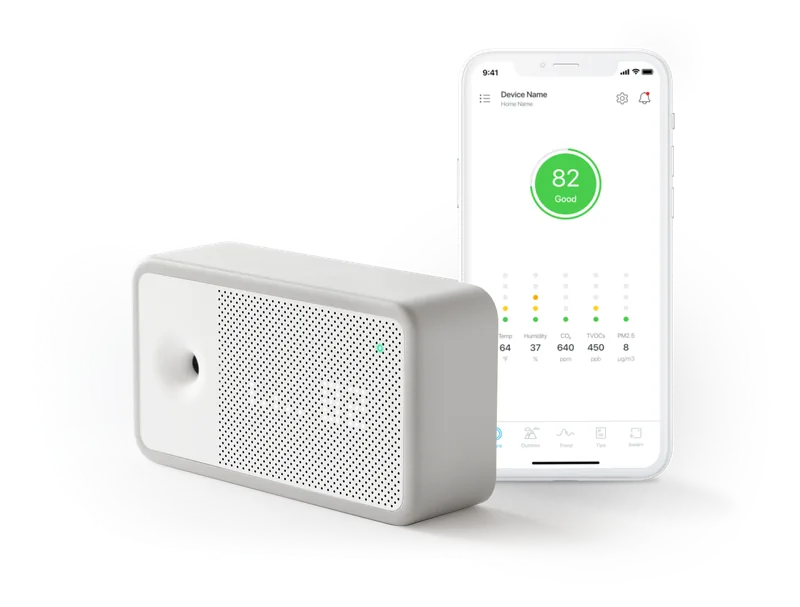
The Awair Element has been discontinued, but the SAF Aranet4 Home at the same $189 price monitors CO2, temperature, humidity, and air pressure with industry-leading accuracy. For TVOC tracking specifically, the Airthings View Plus ($329.99) monitors TVOCs alongside CO2, PM2.5, and radon — giving you real-time visibility into overall air quality including VOC levels. When you bring new furniture home or complete a renovation, watching the TVOC readings spike and (hopefully) fall tells you whether your mitigation efforts are working.
Professional Testing
For suspected formaldehyde problems — such as homes with UFFI insulation, persistent symptoms despite ventilation, or pre-purchase assessments — hire a certified indoor air quality professional. Professional testing uses calibrated instruments and can identify specific compounds rather than just total VOCs.
How to Reduce Formaldehyde in Your Home
The most effective approach combines all three strategies: source control, ventilation, and filtration.
1. Source Control (Highest Impact)
Preventing formaldehyde from entering your air is always more effective than trying to remove it after the fact.
Choose low-emission materials:
- Select solid wood furniture instead of particleboard, MDF, or laminate
- When pressed wood is unavoidable, choose products labeled CARB Phase 2 compliant (California Air Resources Board) or NAF (No Added Formaldehyde) certified
- Use exterior-grade plywood instead of interior grade — the phenol-formaldehyde resins used in exterior plywood emit far less formaldehyde
- Choose low-VOC or zero-VOC paints, stains, and finishes
Reduce emissions from existing sources:
- Seal exposed particleboard edges with polyurethane or laminate to reduce off-gassing
- Air out new furniture in a garage or well-ventilated room for 1-2 weeks before placing it in living spaces, especially bedrooms and nurseries
- Remove or replace old particleboard furniture that continues to off-gas
Minimize combustion sources:
- Use your range hood exhaust fan every time you cook with gas — during and for 15 minutes after
- Avoid unvented gas heaters and fireplaces
- Minimize candle and incense use
2. Ventilation (High Impact)
Diluting formaldehyde with outdoor air is effective and free.
- Open windows for 15-20 minutes daily, creating cross-ventilation where possible
- Ventilate aggressively after renovations — keep windows open as much as practical for the first 2-4 weeks
- Run exhaust fans in kitchens and bathrooms to remove combustion-generated formaldehyde
- Increase ventilation in hot, humid weather — formaldehyde emissions rise significantly with temperature and humidity
3. Air Purification (Essential Complement)
Standard HEPA filters cannot remove formaldehyde because it is a gas, not a particle. You need one of two technologies:
Activated carbon filtration adsorbs formaldehyde molecules onto the carbon's massive internal surface area. Effectiveness depends entirely on carbon weight — thin carbon sheets saturate quickly and become useless, while purifiers with pounds of granular carbon can adsorb formaldehyde for years. See our full carbon filter guide for details.
Catalytic oxidation is a newer approach used in Dyson's Formaldehyde line. A cryptomic catalyst continuously converts formaldehyde into water and CO2 at the molecular level. Unlike carbon, which eventually saturates and needs replacement, the catalyst is not consumed in the reaction and never needs replacing. This makes it particularly effective for the continuous, low-level formaldehyde emissions typical of furnished homes.
4. Environmental Control
Since formaldehyde emissions increase with temperature and humidity:
- Keep indoor temperature moderate — every 5 degrees Celsius increase in temperature roughly doubles formaldehyde emission rates
- Control humidity between 40-50% — lower humidity reduces off-gassing rates
- Run air conditioning in summer to control both temperature and humidity simultaneously
Recommended Products for Formaldehyde Removal
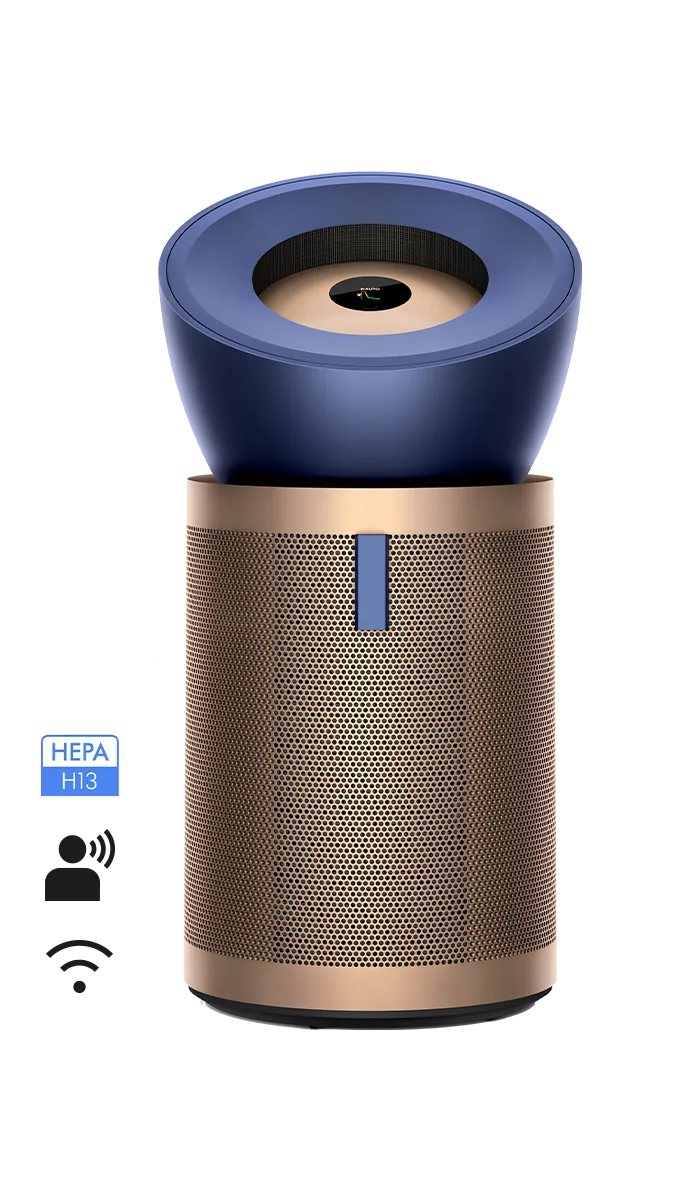
The Dyson Big Quiet Formaldehyde is purpose-built for formaldehyde destruction. Its catalytic oxidation filter uses a cryptomic manganese dioxide catalyst that continuously breaks down formaldehyde into water and CO2 — it does not merely trap formaldehyde, it eliminates it at the molecular level. The catalyst never needs replacement because it is not consumed in the reaction. Combined with a sealed HEPA H13 filter for particles, it covers the full spectrum of indoor pollutants. Its large room coverage and whisper-quiet operation at 434 sq. ft. make it suitable for open-plan living spaces where formaldehyde from flooring and furniture accumulates.
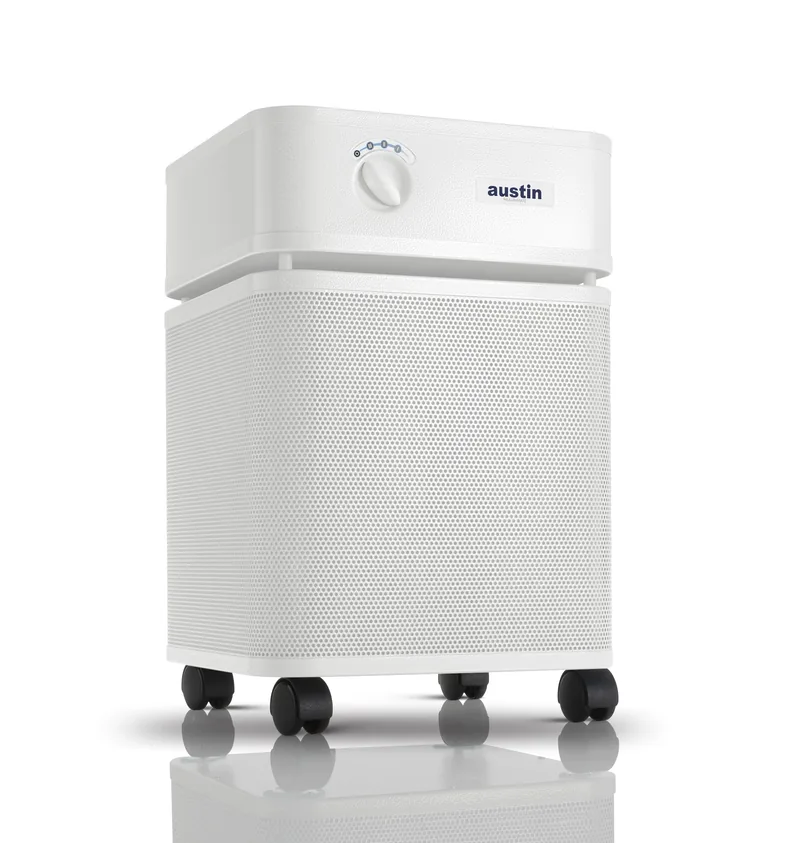
The Austin Air HealthMate takes the opposite approach: 15 pounds of activated carbon and zeolite in a single filter that lasts up to 5 years. This massive carbon bed adsorbs formaldehyde and hundreds of other VOCs, gases, and odors. Where the Dyson excels at targeted formaldehyde destruction, the Austin Air excels at broad-spectrum chemical removal — making it the better choice if you are dealing with multiple VOC sources from a major renovation or new construction. It is the most carbon-heavy consumer air purifier available.
Which Approach Is Better: Carbon or Catalytic?
| Factor | Activated Carbon (Austin Air) | Catalytic Oxidation (Dyson) |
|---|---|---|
| Formaldehyde removal | Adsorbs and traps | Destroys completely |
| Other VOCs | Excellent (broad-spectrum) | Limited (formaldehyde-specific) |
| Filter longevity | 3-5 years (carbon saturates) | Never needs replacement (catalyst) |
| Best for | Multiple chemical sources, renovations | Ongoing formaldehyde from furniture/flooring |
| Maintenance cost | Higher (replacement filters) | Lower (catalyst is permanent) |
For most homes with standard formaldehyde concerns from furniture and flooring, the Dyson's catalytic approach offers a set-and-forget solution. For homes with heavy chemical loads from multiple sources — new construction, renovations, proximity to industrial areas — the Austin Air's 15-pound carbon bed provides the broadest protection.
The Bottom Line
Formaldehyde is a confirmed human carcinogen that is present in nearly every home. It comes from your furniture, your flooring, your cabinets, and your gas stove. You cannot see it, and at typical indoor concentrations, you cannot smell it either. But it is there — and if you have recently renovated, bought new furniture, or live in a home with pressed-wood products, your levels may exceed WHO guidelines.
The good news is that reducing formaldehyde is straightforward. Choose solid wood or CARB Phase 2 products when you buy new furniture. Ventilate aggressively after renovations. Run a purifier with either heavy activated carbon or catalytic oxidation technology. And monitor your VOC levels so you know your efforts are making a measurable difference. Formaldehyde may be invisible, but with the right approach, it does not have to be unavoidable.
Sources & References
- IARC Monographs on the Evaluation of Carcinogenic Risks to Humans, Volume 100F: Formaldehyde — Classifies formaldehyde as Group 1 (carcinogenic to humans) based on sufficient evidence for nasopharyngeal cancer and leukemia
- WHO Guidelines for Indoor Air Quality: Selected Pollutants — Establishes the 0.1 mg/m³ (30-minute average) indoor guideline for formaldehyde
- EPA Facts About Formaldehyde — Overview of formaldehyde sources, health effects, and exposure reduction strategies for consumers
- Agency for Toxic Substances and Disease Registry (ATSDR) — Formaldehyde ToxFAQs — Establishes minimal risk level (MRL) of 0.04 ppm for chronic inhalation exposure
- California Air Resources Board (CARB) Composite Wood Products Regulation — Sets Phase 2 emission standards for particleboard, MDF, and hardwood plywood
This guide was researched and written by the AirQualityNest editorial team. We update our content regularly to reflect the latest products, pricing, and research.
Frequently Asked Questions
How long does formaldehyde off-gas from new furniture?+
Formaldehyde off-gassing from new pressed-wood furniture is highest in the first 2-3 months and decreases significantly over the first year. However, low-level emissions can continue for 3-5 years or longer, depending on the product, temperature, and humidity. To accelerate off-gassing, air out new furniture in a garage or well-ventilated room for 1-2 weeks before placing it in living spaces. Sealing exposed particleboard edges with polyurethane also reduces emissions.
Can air purifiers remove formaldehyde?+
Yes, but only specific types. Standard HEPA filters cannot capture formaldehyde because it is a gas, not a particle. You need either an air purifier with a substantial activated carbon filter (at least several pounds of granular carbon, not a thin carbon sheet) or one with catalytic oxidation technology like the Dyson Formaldehyde series. Carbon adsorbs formaldehyde; catalytic oxidation destroys it by converting it to water and CO2.
Is the formaldehyde in my home dangerous?+
At typical indoor levels (0.01-0.05 ppm), short-term health effects are unlikely for most people. However, the IARC classifies formaldehyde as a Group 1 carcinogen, meaning long-term exposure carries cancer risk at any level. Newly furnished or renovated homes can exceed the WHO guideline of 0.08 ppm, which increases the risk of eye and respiratory irritation. Children, pregnant women, asthmatics, and chemically sensitive individuals are more vulnerable at lower concentrations.
Do gas stoves produce formaldehyde?+
Yes. Burning natural gas produces formaldehyde as a combustion byproduct, along with nitrogen dioxide (NO2) and carbon monoxide (CO). Studies have measured formaldehyde spikes of 0.04-0.1 ppm during gas cooking. Always use your range hood exhaust fan when cooking with gas, run it during cooking and for at least 15 minutes afterward, and open a window if possible. If your range hood recirculates air rather than venting outside, it will not remove combustion gases.
What formaldehyde level is safe for babies?+
There is no officially defined 'safe' level for infants specifically, but experts recommend keeping levels well below the WHO guideline of 0.08 ppm for nurseries and children's rooms. Babies breathe faster relative to body weight and have developing respiratory systems. Choose solid wood cribs and furniture, avoid pressed-wood products in the nursery, air out any new items before use, and run a purifier with carbon or catalytic filtration. See our guide on air purifiers for newborns for nursery-specific recommendations.
Continue Reading
VOCs in Your Home
The broader category of volatile organic compounds and how to reduce them
Activated Carbon Filters Explained
How carbon filters work, weight differences, and what they actually remove
Best Premium Air Purifiers
Top-tier purifiers including models with formaldehyde-specific technology
How to Test Your Home Air Quality
Complete guide to testing and monitoring indoor air quality
Air Purifiers for Newborns
Nursery-safe purifiers and air quality considerations for babies
Continue Reading

Best Air Purifiers for Open Floor Plans in 2026: High-CADR Models That Cover It All
The best air purifiers for open floor plans ranked by CADR, coverage area, and noise. High-performance HEPA purifiers that handle 500-1,500+ sq. ft. open spaces.
Best Smart Humidifiers in 2026 (Wi-Fi, App Control & Auto Humidity)
The best smart humidifiers with Wi-Fi, app control, and auto humidity adjustment. Top picks for Alexa, Google Home, and smart home integration.
The 5 Best Portable Air Quality Monitors in 2026
Monitor your air quality on the go. We tested the best portable and compact air quality monitors for accuracy, battery life, and sensor range.