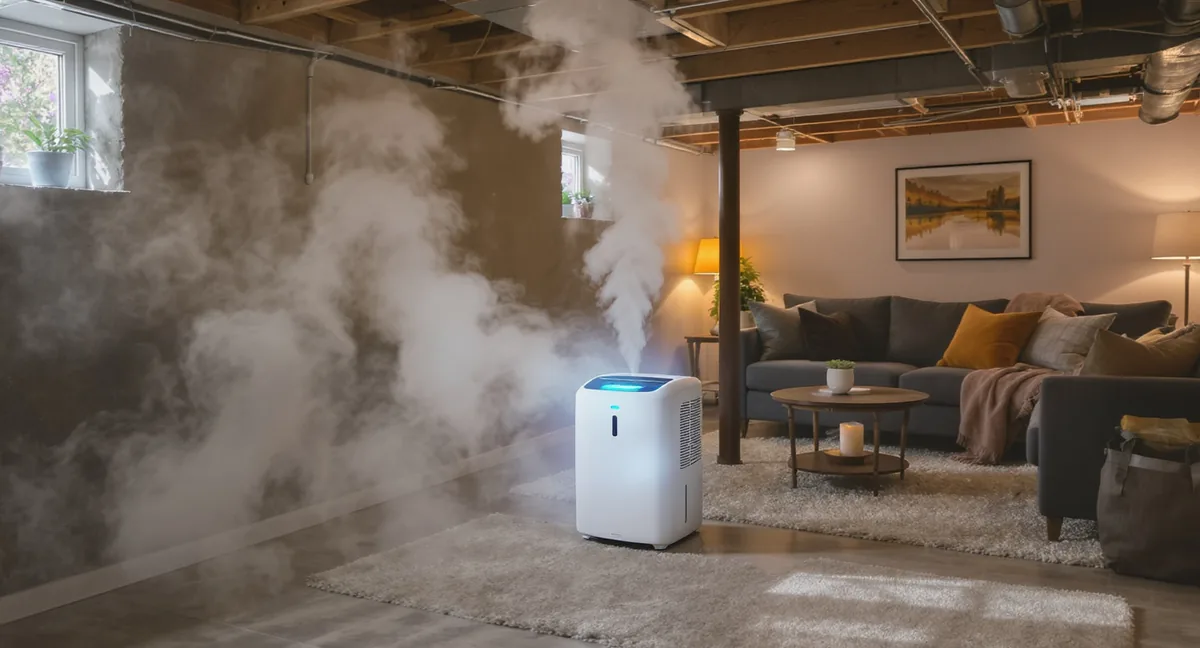
Your basement likely has the worst air quality of any room in your house. Below-grade rooms sit in direct contact with soil, have minimal natural ventilation, and trap moisture that the rest of your home sheds. The result is a concentrated mix of radon gas, mold spores, excess humidity, and volatile organic compounds that seeps upward into your living spaces through what building scientists call the "stack effect."
According to the EPA, the average home's indoor air is already 2 to 5 times more polluted than outdoor air. Basements are often far worse. The good news: every major basement air quality problem has a proven, affordable solution.
Key Takeaways
- 1Basements have worse air quality than upper floors due to ground contact, limited ventilation, moisture intrusion, and radon entry through foundation cracks
- 2The five biggest basement air problems are radon, high humidity and mold, musty odors, VOCs from stored chemicals, and poor ventilation — each requires a different solution
- 3The EPA recommends radon mitigation at or above 4.0 pCi/L — approximately 1 in 15 U.S. homes exceeds this level, with basements being the highest-concentration areas
- 4Ideal basement humidity is 40-50% relative humidity — above 60% triggers mold growth within 24-48 hours on most surfaces
- 5The optimal basement setup combines a dehumidifier for moisture control, a HEPA air purifier for particle and spore removal, and a continuous air quality monitor for radon and VOC tracking
Quick Answer
How do I improve basement air quality?
Address the five main problems in order of health risk: first, test for radon and mitigate if levels exceed 4.0 pCi/L; second, control humidity to 40-50% with a dehumidifier; third, run a HEPA air purifier to capture mold spores and particles; fourth, remove stored chemicals and paints that off-gas VOCs; fifth, improve ventilation by opening windows when weather permits and sealing foundation cracks to block soil gas entry. A continuous air quality monitor lets you track progress.
Why Basements Have Worse Air Quality
Basements are fundamentally different from above-grade rooms, and every difference works against air quality:
Below-grade construction puts walls and floors in direct contact with soil. Soil contains radon gas, moisture, and organic compounds. These migrate through concrete — which is porous despite its appearance — and through every crack, joint, and pipe penetration in the foundation. A poured concrete wall has a water vapor permeability rate of 8 to 15 perms, meaning moisture continuously diffuses through it.
Basements have little or no natural ventilation. Upper floors benefit from operable windows on multiple walls, creating cross-ventilation. Most basements have small, high windows that are often sealed shut or blocked by window wells. Without airflow, pollutants accumulate rather than dissipate.
Cool basement surfaces cause condensation. Basement walls and floors stay cool year-round because they are buffered by surrounding soil. When warm, humid air from upper floors sinks into the basement (warm air holds more moisture), it contacts these cool surfaces and releases its moisture as condensation. This is why basement walls feel damp even when there is no water intrusion.
The stack effect pulls basement air upward through your home. As warm air rises and exits through your upper floors and attic, it creates negative pressure at the lowest level — pulling soil gas, moisture, and basement air upward. An estimated 40% of the air you breathe on your first floor originated in the basement or crawl space. Whatever is in your basement air, you are breathing it throughout the house.
Basements are used for storage and utilities. Paint cans, cleaning products, gasoline containers, adhesives, and solvents are commonly stored in basements. These off-gas VOCs continuously. Water heaters, furnaces, and dryers generate combustion byproducts and heat that compounds air quality issues.
The 5 Biggest Basement Air Quality Problems
| Problem | Health Risk | How to Detect | Solution |
|---|---|---|---|
| Radon | Lung cancer (2nd leading cause in U.S.) | Continuous radon monitor or test kit | Mitigation system; continuous monitoring |
| High humidity / mold | Allergies, asthma, respiratory infections | Hygrometer or air quality monitor (above 60% RH) | Dehumidifier set to 40-50% RH |
| Musty odors | Indicates active mold or mildew | Your nose | Address moisture source + HEPA purifier with carbon filter |
| VOCs | Headaches, irritation, long-term cancer risk | VOC sensor on air quality monitor | Remove stored chemicals; ventilate |
| Poor ventilation | CO2 buildup, pollutant accumulation | CO2 monitor (above 1,000 ppm = inadequate) | Improve airflow; mechanical ventilation |
Problem 1: Radon Gas
Radon is an invisible, odorless, radioactive gas that seeps into basements from the natural decay of uranium in soil. It is the second leading cause of lung cancer in the United States, responsible for an estimated 21,000 deaths per year according to the EPA. Because radon is heavier than air and enters through the foundation, basements typically have the highest concentrations in the home.
How radon enters your basement:
- Cracks in the foundation slab and walls — even hairline fractures are enough
- Gaps around pipes, cables, and utility penetrations
- Construction joints where walls meet the floor
- Sump pits and floor drains
- Porous concrete itself (slow diffusion)
EPA action levels:
| Radon Level (pCi/L) | EPA Recommendation |
|---|---|
| Below 2.0 | Low risk — no action required |
| 2.0 - 3.9 | Consider mitigation; fix if levels can be reduced |
| 4.0 and above | Take action — the EPA recommends mitigation |
Approximately 1 in 15 U.S. homes has radon at or above the 4.0 pCi/L action level. In high-risk regions (the upper Midwest, Appalachia, northern Great Plains), the figure rises to roughly 1 in 3.
The solution: Test first. A continuous radon monitor gives you real-time data and tracks seasonal fluctuations — radon levels often spike in winter when homes are sealed up. If your levels exceed 4.0 pCi/L, a professional sub-slab depressurization system ($800-2,500 installed) reduces radon by 80-99%. Sealing foundation cracks helps as a supplement but is not sufficient on its own.
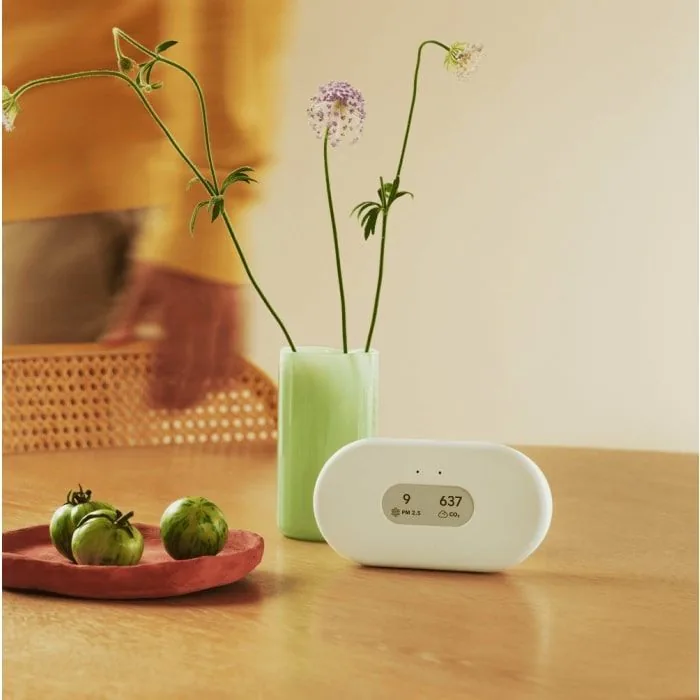
The Airthings View Plus is the best consumer-grade air quality monitor for basements because it tracks radon alongside PM2.5, CO2, VOCs, humidity, and temperature on a single device. Its long-term radon averaging gives you a reliable annual exposure reading — far more useful than a single short-term test. Place it in your basement and check the app from anywhere in your home.
Problem 2: High Humidity and Mold
Excess humidity is the root cause of most basement air quality problems. When relative humidity exceeds 60%, mold begins growing on surfaces within 24 to 48 hours. A single square inch of mold growth can release millions of spores per day into the air.
Why basements are humid:
- Moisture migrates through concrete walls and floors from surrounding soil
- Condensation forms when warm air contacts cool basement surfaces
- Poor drainage allows water to pool against the foundation
- Unvented dryers, water heaters, and sump pits add moisture
- Lack of air circulation prevents moisture from dissipating
Health effects of mold exposure:
- Allergic reactions — sneezing, congestion, eye irritation (affects roughly 25% of the population per CDC estimates)
- Asthma attacks — mold is a well-documented asthma trigger per the EPA
- Respiratory infections — particularly dangerous for immunocompromised individuals
- Mycotoxin exposure — some mold species produce toxic compounds linked to neurological symptoms
The solution: A properly sized dehumidifier is the most effective single investment for basement air quality. Set it to maintain 40-50% relative humidity and run it continuously. For basements up to 1,500 square feet, a 50-pint unit with a built-in pump handles the job — the pump matters because it allows continuous drainage without relying on gravity or manual emptying.
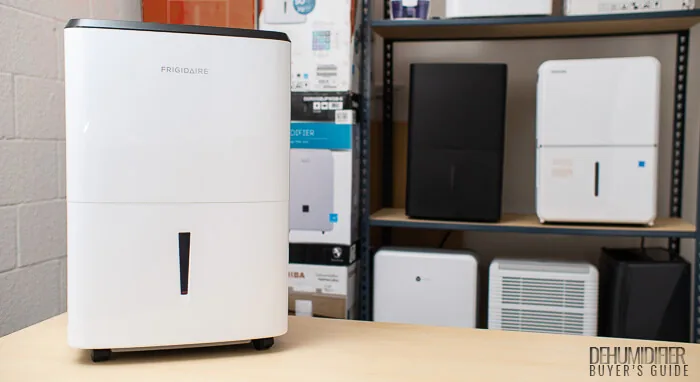
The Frigidaire FFAD5033W1 50-pint dehumidifier is the workhorse choice for basement humidity control. Its built-in pump pushes condensate up to 16.4 feet vertically, so you can drain into a utility sink, floor drain, or out a window without running a hose downhill. Set it to 45%, connect the drain line, and let it run. At 50 pints per day, it handles basements up to 1,500 square feet even in high-humidity conditions.
Problem 3: Musty Odors
That distinctive basement smell — earthy, damp, stale — is not just unpleasant. It is a direct indicator of biological activity you should address. Musty odors are caused by microbial volatile organic compounds (MVOCs), which are chemical byproducts released by actively growing mold and mildew.
If you smell mustiness, mold is actively growing somewhere — possibly behind walls, under carpet, on ceiling tiles, or in areas you cannot see. The odor may be strongest in certain corners or near specific walls where moisture intrusion is worst.
How to eliminate musty basement odors:
- Find and fix the moisture source. Musty smell without moisture control will return no matter what else you do. Use a hygrometer to identify where humidity is highest.
- Run a dehumidifier to maintain 40-50% humidity. Below 50%, mold stops actively growing and MVOC production drops.
- Run a HEPA air purifier with an activated carbon filter. The HEPA catches airborne mold spores (1-30 microns); the carbon filter adsorbs the MVOCs that cause the smell. This combination addresses both the visible particles and the invisible odor compounds.
- Clean affected surfaces with hydrogen peroxide or a commercial mold cleaner. Do not use bleach on porous surfaces — it kills surface mold but does not penetrate deep enough and adds moisture.
- Improve air circulation. Stagnant air allows odor concentrations to build. Even a simple box fan helps keep air moving.
Do not mask the odor with air fresheners. Plug-in fragrances and aerosol sprays add VOCs to an already polluted environment. They cover the smell without addressing the cause, and they introduce their own health risks.
Problem 4: VOCs from Stored Chemicals
Basements are the default storage location for household chemicals: paint cans, stain, polyurethane, adhesives, solvents, gasoline, pesticides, and cleaning products. Every one of these off-gasses volatile organic compounds, even when the container is sealed. A partially sealed paint can left in a basement for months releases a low but continuous stream of VOCs into a space with minimal ventilation.
Common basement VOC sources:
- Leftover paint and stain — formaldehyde, toluene, xylene
- Adhesives and caulk — acetone, toluene, methylene chloride
- Gasoline and fuel — benzene (a known carcinogen), toluene
- Pesticides and herbicides — various organophosphates
- Cleaning products — ammonia, chlorine, various solvents
- New furniture or carpet — formaldehyde from pressed wood and adhesives
The solution:
- Remove what you do not need. Dispose of old paint, unused chemicals, and expired products through your local hazardous waste program.
- Seal what you keep. Ensure every lid is tight. Transfer partially used products to smaller containers to reduce off-gassing surface area.
- Store in a ventilated cabinet or move chemicals to an outdoor shed if possible.
- Monitor VOC levels. An air quality monitor with a VOC sensor (like the Airthings View Plus) alerts you when concentrations rise, so you can ventilate.
Problem 5: Poor Ventilation and Stale Air
Most basements have inadequate ventilation by design. Small windows, concrete walls on three or four sides, and limited connection to HVAC systems create dead-air zones where pollutants accumulate.
When ventilation is poor, CO2 from human breathing (if the basement is occupied), radon from soil, VOCs from stored materials, and humidity from all sources build up with nowhere to go. CO2 levels above 1,000 ppm indicate that ventilation is inadequate and other pollutants are likely concentrated as well.
How to improve basement ventilation:
Passive Ventilation
- Open windows when weather permits. Even 15-20 minutes of cross-ventilation dramatically reduces pollutant concentrations. If your basement has windows on only one side, place a fan in one window blowing outward to create negative pressure that draws fresh air through other openings.
- Keep interior doors open between the basement and upper floors to allow some air exchange through the HVAC system.
- Install window well covers that allow ventilation but block rain and debris.
Mechanical Ventilation
- Extend your HVAC system to include basement supply and return registers. This is the most effective long-term solution for finished basements.
- Install an exhaust fan vented to the outdoors in basement bathrooms or laundry areas.
- Consider an energy recovery ventilator (ERV) or heat recovery ventilator (HRV). These continuously exchange stale indoor air with fresh outdoor air while recovering up to 80% of the energy from the outgoing air. They are particularly effective in tightly sealed homes where simply opening windows is impractical.
- Use a box fan or circulating fan to prevent stagnant air pockets, especially in corners and behind furniture.
The Ideal Basement Air Quality Setup
For a basement that is genuinely safe and comfortable, you need three devices working together — each solving a different piece of the problem.
1. Dehumidifier: Control Moisture at the Source
A dehumidifier set to 40-50% relative humidity prevents mold growth, reduces dust mite populations, eliminates condensation on surfaces, and cuts musty odors at their source. This is the highest-impact single device for basement air quality.
Our pick: Frigidaire FFAD5033W1 50-Pint — built-in pump for continuous drainage, covers up to 1,500 sq. ft., set-and-forget operation.
2. Air Purifier: Remove What Is Already Airborne
A HEPA air purifier captures mold spores, dust, allergens, and fine particles. An activated carbon filter adds musty odor removal and some VOC adsorption. For finished basements used as living space, this is essential.
Our pick: Coway Airmega AP-1512HH — True HEPA + carbon deodorization filter, 233 CADR covers rooms up to 361 sq. ft., low annual filter cost (~$40/year) for always-on operation, eco mode reduces energy consumption during stable conditions.
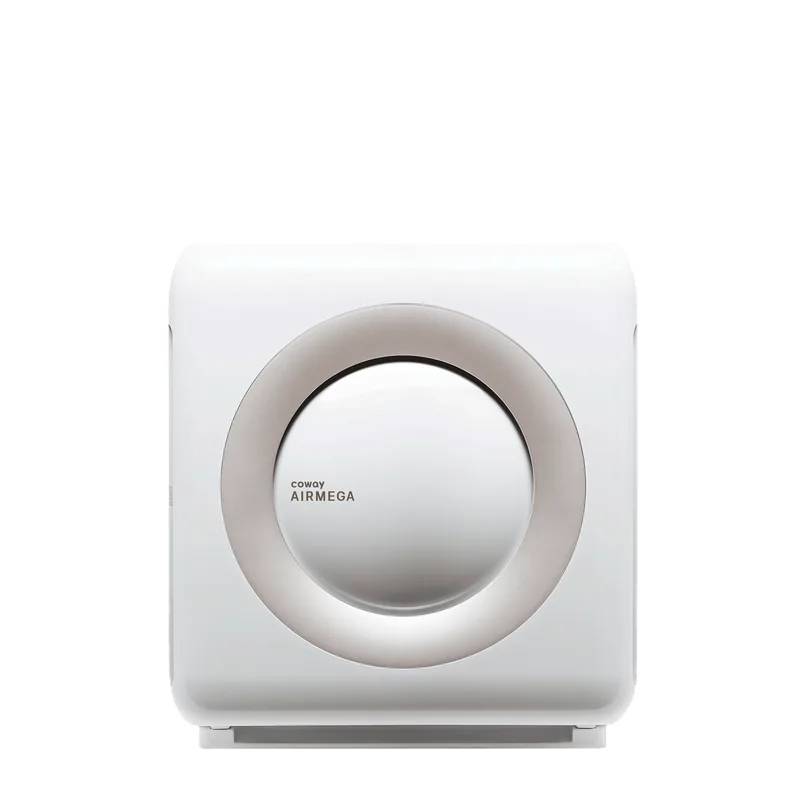
The Coway Airmega AP-1512HH is our top recommendation for finished basements. Its four-stage filtration — pre-filter, deodorization filter, True HEPA, and ionizer — addresses both airborne mold spores and the musty MVOCs that cause basement odors. The auto mode responds to air quality changes in real time, ramping up when particle levels spike and dropping to eco mode when the air is clean. At roughly $40 per year in replacement filters, it is one of the most affordable purifiers to run continuously.
3. Air Quality Monitor: Know What You Are Breathing
Without measurement, you are guessing. A continuous monitor tracks radon (which you cannot detect any other way), humidity, VOCs, CO2, and particulate matter. It tells you whether your dehumidifier and purifier are working, alerts you to radon spikes, and shows you the impact of changes like opening windows or running a dryer.
Our pick: Airthings View Plus — continuous radon tracking, PM2.5, CO2, VOCs, humidity, and temperature. App-based monitoring lets you check basement conditions from anywhere.
How They Work Together
| Device | What It Solves | What It Cannot Solve |
|---|---|---|
| Dehumidifier | Excess moisture, mold prevention, condensation | Radon, airborne particles, VOCs |
| Air purifier | Mold spores, dust, allergens, musty odors (carbon filter) | Humidity, radon, moisture intrusion |
| Air quality monitor | Awareness — tracks all key metrics, alerts to problems | Does not fix anything; only measures |
The dehumidifier prevents the conditions that cause mold. The air purifier catches the spores and particles that are already airborne. The monitor confirms everything is working and catches problems — like a radon spike after a weather change — that neither of the other devices addresses.
Total investment: Approximately $550-650 for all three devices. Running cost is roughly $35-55/month in electricity (dehumidifier is the bulk of this). Compared to mold remediation ($1,500-5,000), radon mitigation after prolonged exposure, or the health costs of chronic mold and radon exposure, this is a cost-effective investment.
Sealing and Ventilation Improvements
Beyond adding devices, structural improvements can permanently reduce the pollutant load in your basement.
Foundation Sealing
Seal visible cracks in foundation walls and the floor slab with hydraulic cement or polyurethane caulk. Focus on:
- The cold joint where the wall meets the floor slab — the most common radon entry point
- Cracks wider than 1/16 inch in walls or floors
- Gaps around pipe and wire penetrations
- The perimeter of sump pit lids (use a gasketed, airtight cover)
Apply waterproofing coating to interior foundation walls if moisture seeps through. Products like Drylok or RadonSeal penetrating sealer reduce moisture vapor transmission through concrete.
Install a vapor barrier over exposed earth in crawl spaces — 6-mil (or thicker) polyethylene sheeting, sealed at the seams and edges. Exposed soil is a massive source of both moisture and radon.
Exterior Drainage
Grade soil away from the foundation so water flows downhill, not toward your basement walls. A slope of at least 6 inches over the first 10 feet from the foundation is the standard recommendation.
Extend downspouts at least 4 feet from the foundation. Downspouts dumping water directly at the base of the wall are a leading cause of basement moisture.
Clean gutters regularly. Overflowing gutters saturate the soil around your foundation.
Ventilation Upgrades
Add or upgrade window well drainage. Window wells that hold water create a constant moisture source against the foundation. Ensure each well has a gravel base and drains away from the house.
Install a bathroom exhaust fan if your basement has a bathroom. Vent it directly to the outdoors, not into the attic or another interior space.
Consider a dedicated basement ventilation system. For basements used as living space, an ERV (energy recovery ventilator) continuously exchanges stale basement air with filtered outdoor air. This dilutes radon, VOCs, and CO2 while recovering heat energy. Installation costs $1,500-3,000 but provides ongoing air quality improvement that no portable device can match.
Product Comparison
This guide was researched and written by the AirQualityNest editorial team. We update our content regularly to reflect the latest products, pricing, and research.
Frequently Asked Questions
Is it safe to sleep in a basement with poor air quality?+
It depends on what pollutants are present. If radon levels exceed the EPA action level of 4.0 pCi/L, sleeping in the basement significantly increases your lung cancer risk because radon exposure is cumulative and you spend 6-8 hours per night breathing basement air. High mold spore counts can trigger asthma attacks and allergic reactions during sleep. Before using a basement as a bedroom, test for radon, measure humidity (should be 40-50%), and run both a dehumidifier and HEPA air purifier. Address any issues before sleeping there regularly.
How quickly can mold grow in a humid basement?+
Mold can begin growing within 24 to 48 hours once relative humidity exceeds 60% and a food source (drywall, wood, carpet, cardboard) is present. Visible colonies can appear within 3 to 12 days under sustained high-humidity conditions. This is why consistent dehumidification is critical — even a few days of elevated humidity during a rainy stretch can start a mold problem. Set your dehumidifier to 45% and run it continuously, not just when you notice dampness.
Do I need both a dehumidifier and an air purifier in my basement?+
They solve different problems. A dehumidifier prevents mold by removing moisture from the air. An air purifier removes mold spores, dust, allergens, and odors that are already airborne. If you can only afford one, start with the dehumidifier — preventing mold growth is higher impact than filtering the spores it produces. But if you use your basement as living space, or if anyone in your household has allergies or asthma, adding a HEPA air purifier provides significant additional benefit.
What radon level is dangerous in a basement?+
The EPA recommends taking action at or above 4.0 pCi/L (picocuries per liter). However, the EPA also states there is no truly safe level of radon — any exposure carries some lung cancer risk. The average indoor level in the U.S. is about 1.3 pCi/L, and the average outdoor level is 0.4 pCi/L. If your basement tests between 2.0 and 3.9 pCi/L, consider mitigation, especially if you spend significant time in the basement. Test with a continuous monitor for the most accurate long-term reading.
Will an air purifier get rid of the musty smell in my basement?+
An air purifier with an activated carbon filter will reduce musty odors significantly, but it will not eliminate them permanently on its own. The musty smell comes from MVOCs (microbial volatile organic compounds) produced by actively growing mold and mildew. The carbon filter adsorbs these compounds from the air, but as long as mold is growing, it keeps producing more. For lasting odor elimination, you need to address the moisture source with a dehumidifier (target 40-50% humidity), clean existing mold, and run the purifier to handle residual spores and odors.
Sources & References
- EPA: A Citizen's Guide to Radon — Radon action levels, health risks, and mitigation guidance — estimates 21,000 lung cancer deaths per year from radon exposure
- EPA: Mold and Moisture — Guidelines on mold prevention, cleanup, and the relationship between humidity and mold growth in residential buildings
- CDC: Mold and Your Health — Health effects of mold exposure including allergic reactions, asthma triggers, and risks for immunocompromised individuals
- EPA: Introduction to Indoor Air Quality — States indoor air is typically 2-5x more polluted than outdoor air; guidance on VOCs, ventilation, and residential air quality
Continue Reading
Best Dehumidifiers for Basement
Our top-rated basement dehumidifiers ranked by performance and value
Radon in Your Home
Complete guide to radon testing, risks, and mitigation systems
Best Air Purifiers for Mold and Mildew
HEPA purifiers that capture mold spores and eliminate musty odors
Do I Need a Dehumidifier?
Signs, tests, and sizing to decide if a dehumidifier is right for your space
How to Test Your Home Air Quality
A complete guide to measuring radon, humidity, PM2.5, and VOCs
Continue Reading

Best Air Purifiers for Open Floor Plans in 2026: High-CADR Models That Cover It All
The best air purifiers for open floor plans ranked by CADR, coverage area, and noise. High-performance HEPA purifiers that handle 500-1,500+ sq. ft. open spaces.
Best Smart Humidifiers in 2026 (Wi-Fi, App Control & Auto Humidity)
The best smart humidifiers with Wi-Fi, app control, and auto humidity adjustment. Top picks for Alexa, Google Home, and smart home integration.
The 5 Best Portable Air Quality Monitors in 2026
Monitor your air quality on the go. We tested the best portable and compact air quality monitors for accuracy, battery life, and sensor range.