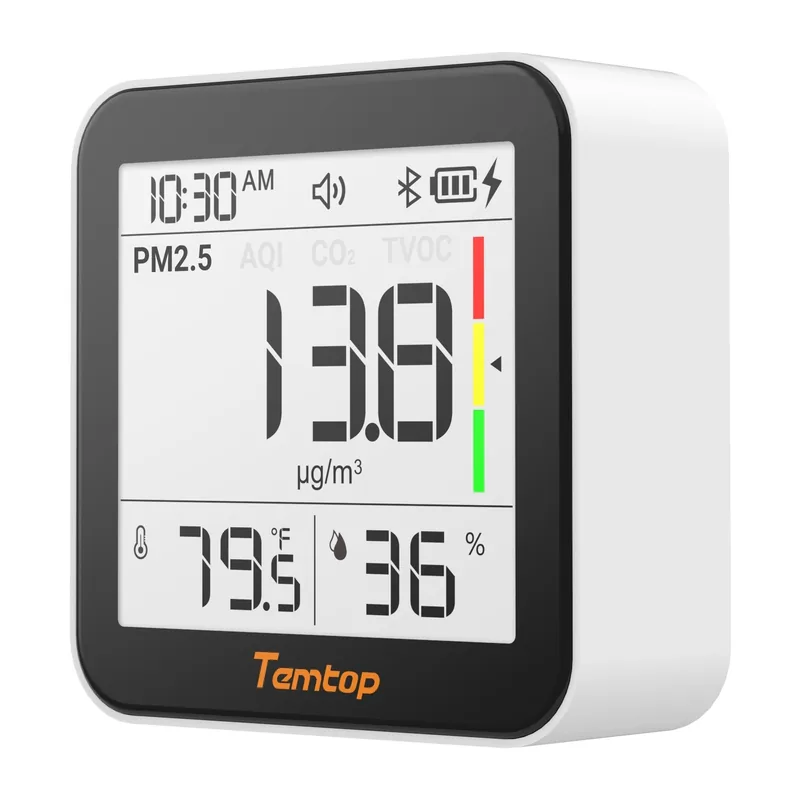
The Temtop M10 has been discontinued. If you are looking for the best portable air quality monitor under $100, its successor — the Temtop M10+ — is available at $99.99 and represents a substantial upgrade in almost every dimension.
The original M10 was our top portable pick for its combination of battery-powered portability, PM2.5 accuracy, and formaldehyde detection at $90. The M10+ takes everything that worked and addresses everything that did not: it doubles the sensor count from three to six, extends battery life from six hours to 60 days, adds app connectivity via Bluetooth, and swaps the color LCD for a quiet e-ink display. The price increase is just $10.
Key Specifications
What Changed: M10 vs. M10+
The M10+ is not a minor refresh. It is a generational leap.
| Feature | Temtop M10 (Discontinued) | Temtop M10+ |
|---|---|---|
| Sensors | PM2.5, HCHO, AQI (3) | PM2.5, CO2, VOC, Temp, Humidity, AQI (6) |
| Battery | ~6 hours continuous | 60 days rechargeable |
| Connectivity | None (standalone) | Bluetooth with companion app |
| Display | 2.8" color LCD | E-ink |
| Data Logging | None | App-based historical data |
| Price | $89.99 | $99.99 |
Three upgrades stand out as transformative.
The Big Upgrade: CO2 and VOC Monitoring
The original M10 measured PM2.5, formaldehyde (HCHO), and a calculated AQI. It was a solid particulate and formaldehyde detector, but it missed the two metrics that matter most for everyday indoor air assessment: CO2 and VOCs.
The M10+ adds both. CO2 monitoring is the single most actionable indoor air quality metric — it tells you in real time whether a room has adequate ventilation. In a closed bedroom, CO2 climbs from the outdoor baseline of roughly 420 ppm to over 1,000 ppm within an hour, causing drowsiness and reduced cognitive function. The M10+ detects this and, through the companion app, can alert you before levels become problematic.
VOC monitoring covers the broad category of volatile organic compounds released by cleaning products, paint, adhesives, and furniture off-gassing. The original M10 tracked only formaldehyde — one specific VOC. The M10+ tracks total VOCs, giving you a wider picture of chemical air quality.
Temperature and humidity sensors round out the six-sensor array. These are standard environmental metrics, but having them on a portable device means you can check conditions in every room of your home without installing separate sensors.
For $10 more than the original M10, you get twice the sensors — including the two most important ones (CO2 and VOC) that previously required spending $189 or more on a stationary monitor.
60-Day Battery: From Spot Checks to Extended Monitoring
The original M10's six-hour battery was designed for spot checks — carry it to a room, take a reading, move on. It worked well for that purpose, but it could not sustain overnight bedroom monitoring, multi-day tracking in a specific room, or travel use without daily charging.
The M10+ runs for 60 days on a single charge. This changes the device from a handheld spot-checker into a genuine portable monitor that can sit on a nightstand for weeks at a time, then move to your office, then travel with you — all on the same charge. The e-ink display is a key enabler: unlike the original's power-hungry color LCD, e-ink draws almost no power between refreshes.
This also means the M10+ can serve as a semi-permanent monitor for spaces where running a cable is impractical — a basement workshop, a detached garage, a nursery, or any room without a convenient outlet. Place it, forget about it for two months, and review the data on your phone whenever you want.
App Connectivity: Data You Can Actually Use
The original M10 had no connectivity of any kind — no Wi-Fi, no Bluetooth, no app, no data export. Readings existed only on the screen in front of you, in the moment you looked at them. If you wanted to track trends over time, you needed a notebook and discipline.
The M10+ connects to a companion app via Bluetooth. This adds:
- Historical data logging — See trends over hours, days, and weeks. Identify patterns like overnight CO2 buildup, cooking-related PM2.5 spikes, or VOC elevation after cleaning.
- Alerts and notifications — Set thresholds for any parameter and receive a phone notification when they are exceeded.
- Data export — Export readings for detailed analysis or sharing with a healthcare provider.
- Multi-device management — If you have multiple M10+ units, manage them from a single app.
This is the feature the original M10 needed most. Air quality monitoring is only useful if you can act on patterns, not just snapshots. The app transforms the M10+ from a curiosity tool into a genuine air quality management device.
E-ink Display: Quiet by Design
The original M10's color LCD was bright and information-dense, but it was also power-hungry and emitted light that could be disruptive in a dark bedroom. The M10+ swaps it for an e-ink display — the same technology used in e-readers and the Aranet4 Home.
E-ink is always on, consumes minimal power, and produces no light emission. For bedroom use — which is one of the most important use cases for a CO2 monitor — this is a meaningful improvement. The screen shows your readings without acting as a nightlight.
The trade-off is reduced visibility in dark environments. Without a backlight, you need ambient light to read the display. In a completely dark room, you will need to use your phone or turn on a light. For most practical purposes, this is a reasonable exchange for 60 days of battery life.
The Portability Advantage — Now Even Better
Everything that made the original M10 useful for portable monitoring is still here, amplified by the longer battery and deeper sensor array:
Room-by-room assessment. Walk through your entire home and get PM2.5, CO2, VOC, temperature, and humidity readings for every space. The original M10 could only tell you about particles and formaldehyde. The M10+ tells you about ventilation (CO2) and chemical exposure (VOC) too.
New apartment walkthrough. Check air quality before signing a lease — now with CO2 readings that reveal whether a unit has adequate ventilation, not just whether there are particles in the air.
Air purifier verification. Map your purifier's effective clean air zone with PM2.5 readings at various distances. The added CO2 sensor also helps you understand whether your room needs fresh air exchange, not just filtration.
Travel. Hotel rooms, Airbnbs, conference venues — the 60-day battery means you never worry about packing a charger for the M10+ specifically. Check CO2 in a poorly ventilated hotel room and know whether to crack a window before sleeping.
Limitations
The M10+ is not without trade-offs:
- Bluetooth only. No Wi-Fi means no remote monitoring from outside Bluetooth range, no smart home integration, and no Alexa or HomeKit triggers. The app requires your phone to be within Bluetooth range to sync data.
- No radon detection. Like the original M10, radon is not part of the sensor package. For radon, you still need the Airthings View Plus or a dedicated test kit.
- E-ink visibility in darkness. The display is not backlit. Bedroom users who want to glance at readings in the dark will need another light source.
- No formaldehyde-specific sensor. The original M10's dedicated HCHO sensor has been replaced by a broader VOC sensor. This is a trade-off: you get wider chemical detection but lose the formaldehyde-specific readings that were useful for monitoring new furniture and renovations.
Who Should Buy the M10+
The Temtop M10+ is ideal for:
- Budget-conscious buyers who want CO2 monitoring — At $100, it is the most affordable 6-in-1 monitor with real CO2 tracking
- Portable monitoring needs — 60-day battery and compact size for room-to-room or travel use
- Bedroom air quality tracking — CO2 monitoring with a quiet e-ink display and weeks of battery life
- First-time air quality monitor buyers — Six sensors cover the parameters that matter most at an accessible price
It is NOT ideal for:
- Smart home automation — No Wi-Fi, no voice assistant integration
- Continuous whole-home monitoring — For a permanent fixed installation, consider the Airthings View Plus or pair the M10+ with an Amazon Smart Air Quality Monitor
- Formaldehyde-specific monitoring — The M10+ uses a general VOC sensor rather than a dedicated HCHO sensor
Pros and Cons
What We Like
- +6-in-1 monitoring including CO2 and VOC
- +E-ink display for quiet bedroom use
- +60-day battery life on single charge
- +App for data history and trends
- +Portable — carry anywhere
Could Be Better
- −No Wi-Fi connectivity
- −No formaldehyde sensor (unlike M10)
- −Bluetooth range limited
- −No smart home integration
How It Compares
The Verdict
After extensive research and analysis, here is the AirQualityNest editorial team's verdict.
Bottom Line
4.4/5Temtop M10+ Air Quality Monitor
The Temtop M10 is discontinued. The M10+ at $99.99 is a dramatic upgrade — doubling the sensor count to six (adding CO2 and VOC), extending battery life from 6 hours to 60 days, and adding app connectivity via Bluetooth. It is the best portable air quality monitor under $100.
- +6-in-1 sensors including CO2 and VOC at $100
- +60-day rechargeable battery (up from 6 hours)
- +Bluetooth app with data logging and alerts
- +E-ink display for quiet bedroom use
- +Compact and truly portable
- −No Wi-Fi or smart home integration
- −No dedicated formaldehyde sensor (general VOC instead)
- −E-ink display not backlit
- −Bluetooth range limits app connectivity
The M10+ is one of the most compelling upgrades in the portable air quality monitor category. For $10 more than the discontinued M10, you get CO2 monitoring that previously required a $189+ stationary device, a battery that lasts weeks instead of hours, and app connectivity that turns snapshots into trends. If you owned and liked the original M10, the M10+ is the obvious next step. If you are new to air quality monitoring and want the most capability per dollar in a portable form factor, start here.
Sources & References
- EPA Air Quality Index (AQI) — Federal air quality measurement standards and index definitions
- WHO Air Quality Guidelines — Global health-based particulate matter and pollutant thresholds
- ASHRAE Standard 62.1 — Ventilation and indoor air quality standards including CO2 thresholds
- Temtop Official Product Page — Official manufacturer specifications for the Temtop M10+ successor monitor
Frequently Asked Questions
Is the Temtop M10 still available?+
No. The Temtop M10 has been discontinued. Its successor, the Temtop M10+ at $99.99, is available and offers significant upgrades including CO2 and VOC sensors, 60-day battery life, and Bluetooth app connectivity.
What sensors does the Temtop M10+ have?+
The M10+ measures six parameters: PM2.5, CO2, VOC, temperature, humidity, and AQI. This is double the original M10's three sensors (PM2.5, HCHO, AQI), with CO2 being the most important addition.
How long does the Temtop M10+ battery last?+
The M10+ battery lasts approximately 60 days on a single charge — a massive improvement over the original M10's 6-hour battery. The e-ink display is the key enabler of this extended battery life.
Does the Temtop M10+ have an app?+
Yes. The M10+ connects to a companion app via Bluetooth for historical data logging, trend charts, threshold alerts, and data export. The original M10 had no connectivity and no data storage capabilities.
Related Reviews
Best Portable Air Quality Monitors
All our tested portable monitors compared
Best Air Quality Monitors Under $100
Budget monitors ranked by value and accuracy
Aranet4 Home Review
The gold standard for CO2 monitoring with 2+ year battery
How to Test Your Home Air Quality
A step-by-step guide to measuring and improving indoor air
Continue Reading

Best Air Purifiers for Open Floor Plans in 2026: High-CADR Models That Cover It All
The best air purifiers for open floor plans ranked by CADR, coverage area, and noise. High-performance HEPA purifiers that handle 500-1,500+ sq. ft. open spaces.
Best Smart Humidifiers in 2026 (Wi-Fi, App Control & Auto Humidity)
The best smart humidifiers with Wi-Fi, app control, and auto humidity adjustment. Top picks for Alexa, Google Home, and smart home integration.
The 5 Best Portable Air Quality Monitors in 2026
Monitor your air quality on the go. We tested the best portable and compact air quality monitors for accuracy, battery life, and sensor range.