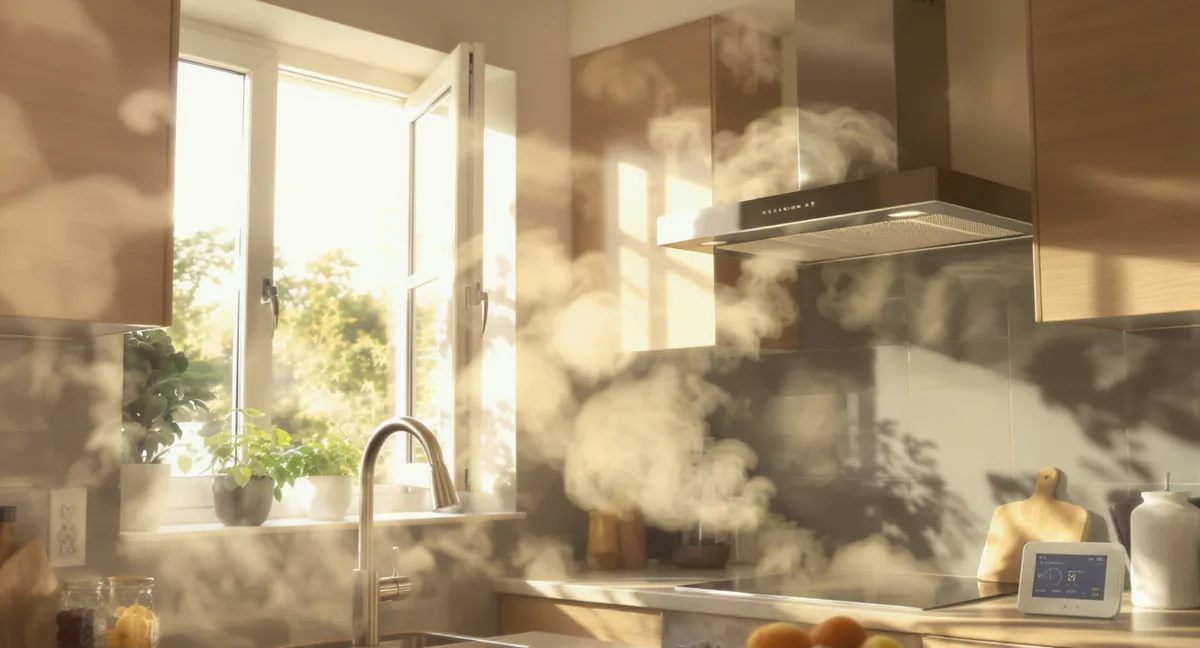
Cooking is one of the largest sources of indoor air pollution in any home. Every time you fry, grill, roast, or sauté, you release a cocktail of fine particulate matter (PM2.5), nitrogen dioxide (NO2), volatile organic compounds (VOCs), and carbon monoxide (CO) into your living space. A single Thanksgiving meal can push indoor PM2.5 levels above what the EPA classifies as "hazardous" for outdoor air — yet most kitchens have inadequate ventilation to deal with it.
The type of stove you cook on, how you ventilate, and whether you run an air purifier all determine how much of that pollution you and your family actually breathe. This guide covers the science, the solutions, and the specific products that make a measurable difference.
Key Takeaways
- 1Cooking generates PM2.5, NO2, VOCs, and CO — indoor PM2.5 during frying or grilling can spike 10 to 20 times above baseline levels within minutes
- 2Gas stoves produce nitrogen dioxide at levels that can exceed EPA outdoor standards inside the home, even with ventilation — a Stanford-led study found NO2 levels frequently surpassing 100 ppb during gas cooking
- 3Ducted range hoods are far more effective than recirculating hoods — but only if you actually turn them on, which studies show most people fail to do consistently
- 4Place an air purifier in the adjacent room or at the kitchen's edge rather than directly next to the stove, where grease and heat can damage filters
- 5Open floor plans spread cooking pollutants across the entire living area — a high-CADR purifier positioned between the kitchen and living space is essential for these layouts
Quick Answer
Does cooking affect indoor air quality?
Yes, significantly. Cooking — especially frying, grilling, and searing — releases fine particulate matter (PM2.5), nitrogen dioxide, VOCs, and carbon monoxide. Gas stoves add combustion pollutants even when no food is being cooked. To protect your air quality, always use a ducted range hood on medium or high while cooking, ventilate for 15-20 minutes afterward, and run a HEPA air purifier in adjacent living spaces to capture pollutants that escape the kitchen.
What Cooking Releases Into Your Air
Cooking produces four major categories of indoor air pollutants. Understanding each one helps you choose the right combination of ventilation and filtration.
PM2.5 — Fine Particulate Matter
PM2.5 refers to particles smaller than 2.5 micrometers in diameter — small enough to penetrate deep into your lungs and enter your bloodstream. Cooking is the single largest indoor source of PM2.5 in most homes.
High-heat methods produce the most PM2.5: Frying, grilling, searing, and stir-frying generate visible smoke and invisible fine particles. Research consistently shows that indoor PM2.5 levels during active cooking can reach 200 to 300 µg/m³ or higher — well above the EPA's 24-hour outdoor standard of 35 µg/m³ and comparable to AQI levels classified as "very unhealthy."
Even lower-heat methods like baking and boiling generate PM2.5, though at significantly lower concentrations. The oils and fats used in cooking are a primary driver — when oil reaches its smoke point, PM2.5 production spikes dramatically.
NO2 — Nitrogen Dioxide
NO2 is a combustion byproduct produced primarily by gas stoves and gas ovens. Unlike PM2.5, which comes from the food and oil, NO2 comes from the flame itself — meaning a gas burner produces NO2 even when boiling water or heating an empty pot.
A major 2022 study led by researchers at Stanford University measured NO2 levels in homes with gas stoves and found that a single gas burner on high can raise indoor NO2 above 100 ppb within minutes — exceeding the EPA's one-hour outdoor standard of 100 ppb. Homes with smaller kitchens and poor ventilation experienced the highest concentrations, with levels remaining elevated for hours after cooking ended.
Long-term NO2 exposure is associated with increased respiratory illness, particularly in children. The same Stanford research contributed to growing evidence linking gas stove use to higher rates of childhood asthma.
VOCs — Volatile Organic Compounds
Cooking oils, fats, and seasonings release volatile organic compounds when heated. These include acrolein, formaldehyde, and polycyclic aromatic hydrocarbons (PAHs) — compounds associated with respiratory irritation and, with chronic exposure, increased cancer risk.
VOCs are gases, not particles, which means HEPA filters do not capture them. Ventilation (exhausting them outdoors) and activated carbon filtration are the only effective removal methods.
CO — Carbon Monoxide
Gas stoves, gas ovens, and charcoal grills produce carbon monoxide from incomplete combustion. While modern gas appliances produce relatively low levels of CO under normal operation, a poorly adjusted burner, a clogged burner port, or using the oven for extended roasting sessions can elevate CO to levels that cause headaches and fatigue. Every kitchen with a gas appliance should have a working CO detector.
Gas vs Electric vs Induction: The Air Quality Difference
The type of stove in your kitchen fundamentally changes your baseline exposure to cooking pollutants.
| Factor | Gas Stove | Electric Coil/Smoothtop | Induction |
|---|---|---|---|
| NO2 production | High — produced by flame itself | None | None |
| CO production | Low to moderate | None | None |
| PM2.5 from cooking | High (flame + food) | Moderate (food only) | Moderate (food only) |
| VOCs from cooking | High | Moderate | Moderate |
| Background emissions | YES — even pilot lights emit NO2 | None | None |
| Air quality impact | Worst overall | Better | Best overall |
Gas Stoves: The Biggest Indoor Air Quality Concern
Gas stoves are unique because they produce pollutants from two separate sources: the food you are cooking and the combustion of natural gas itself. The Stanford-led study found that gas stoves can emit measurable levels of NO2 and even trace amounts of benzene even when turned off, due to minor gas leaks from fittings and connections.
When gas burners are active, the combined load of NO2, CO, PM2.5, and VOCs makes gas cooking the highest-pollutant cooking method by a significant margin. This is compounded in smaller kitchens where the volume of air available for dilution is limited.
If you have a gas stove: Always run your range hood when any burner or the oven is in use. Open a nearby window when possible. Consider placing an air quality monitor near the kitchen to track NO2 and PM2.5 spikes in real time.
Electric Stoves: Better, But Not Clean
Electric stoves eliminate combustion byproducts entirely — no NO2, no CO. However, they still generate significant PM2.5 and VOCs from the food and oils being cooked. A stir-fry on an electric range will produce nearly as much PM2.5 as the same dish on a gas range. The difference is the absence of the gas-combustion layer.
Induction: The Best Option for Air Quality
Induction cooktops produce no combustion byproducts and heat more efficiently, which means less residual heat to overheat oils accidentally. They still generate PM2.5 and VOCs from cooking, because those pollutants come from the food — but the total pollutant load is meaningfully lower than gas. From a pure air quality perspective, induction is the best stove technology available.
Range Hood Effectiveness: The Most Underused Defense
A range hood is the single most important defense against cooking pollutants — more effective than any air purifier because it exhausts pollutants directly outdoors rather than trying to filter them from room air. Yet research consistently shows that most people do not use their range hood, or use it on the lowest setting.
Ducted vs Recirculating Hoods
Ducted hoods vent air through ductwork to the outside of your home. They physically remove pollutants from the kitchen. A properly sized and installed ducted hood captures 60 to 90% of cooking emissions at the source, depending on fan speed and hood design.
Recirculating hoods have no duct to the outside. They pull air through a charcoal filter and blow it back into the kitchen. They reduce odors somewhat but are largely ineffective at removing PM2.5, NO2, and CO. If your hood recirculates, you should treat your kitchen as if it has no hood for ventilation planning purposes.
CFM Requirements
Range hood effectiveness depends on airflow, measured in cubic feet per minute (CFM):
| Stove Type | Minimum CFM | Recommended CFM |
|---|---|---|
| Standard electric | 100 CFM | 200-300 CFM |
| Standard gas | 100 CFM per 10,000 BTU | 300-600 CFM |
| High-output gas | 1 CFM per 100 BTU | 600-1,200 CFM |
Most builder-grade range hoods deliver only 150 to 200 CFM, which is barely adequate for an electric stove and insufficient for gas. If your hood sounds like it is barely moving air, it probably is not.
Why People Do Not Use Their Range Hoods
Studies from Lawrence Berkeley National Laboratory found that fewer than 35% of people use their range hood regularly while cooking. The most commonly cited reasons are noise, forgetting, and the belief that it is unnecessary. This single behavioral change — turning on your range hood every time you cook, on medium or high, and leaving it running for 15 to 20 minutes after you finish — likely has a greater impact on your cooking-related air quality exposure than any product you can buy.
Best practices:
- Turn the hood on before you start cooking, not after smoke appears
- Use medium or high speed for any frying, searing, or grilling — low speed is only adequate for boiling and simmering
- Keep the hood running for 15 to 20 minutes after cooking to clear residual pollutants
- Use the back burners when possible — they are closer to the hood's capture zone
- If you have a recirculating hood, open a window near the stove to provide actual ventilation
Where to Place an Air Purifier for Cooking Pollutants
An air purifier cannot replace a range hood — it filters particles from room air rather than exhausting them outdoors. But it is an essential complement, especially for capturing the PM2.5 that escapes the hood's capture zone and migrates into living spaces.
Placement matters. Do not put your air purifier directly next to the stove. Kitchen heat, grease, and moisture will clog the filter prematurely and can damage the unit. Instead:
- Best position: In the room adjacent to the kitchen or at the boundary between the kitchen and living area. This intercepts pollutants as they spread out of the kitchen.
- Open floor plans: Place the purifier between the cooking area and the seating/living area, approximately 10 to 15 feet from the stove.
- Closed kitchens: Place the purifier just outside the kitchen doorway, in the hallway or dining area.
- Run it on high during cooking and for 30 minutes after, then return to auto or medium for continuous filtration.
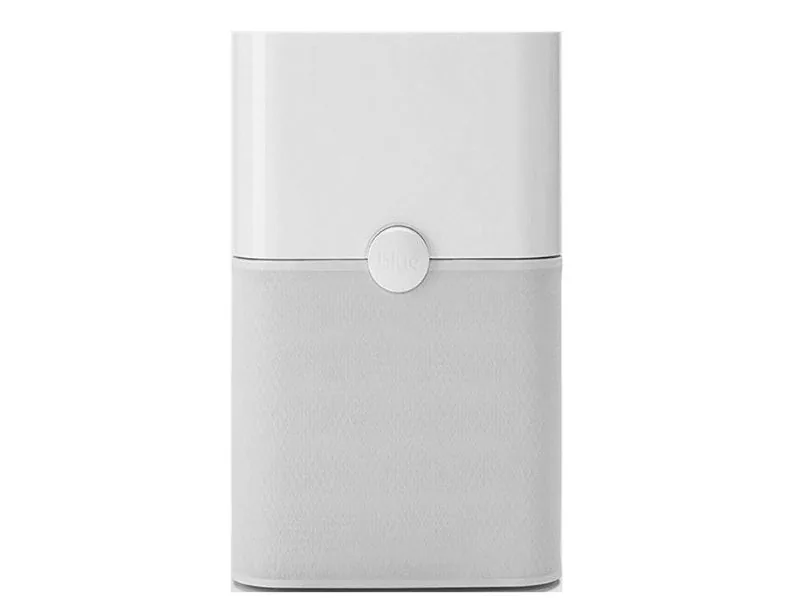
The Blueair Blue Pure 211+ is our top pick for open-concept kitchens and large living areas. Its 350 CADR means it can cycle a large room's air multiple times per hour, which is exactly what you need when cooking pollutants spread across an open floor plan. The combination particle and carbon filter handles both PM2.5 and cooking odors. Reviewers consistently praise its quiet operation even on higher speeds — important because you need to run it on high during active cooking.
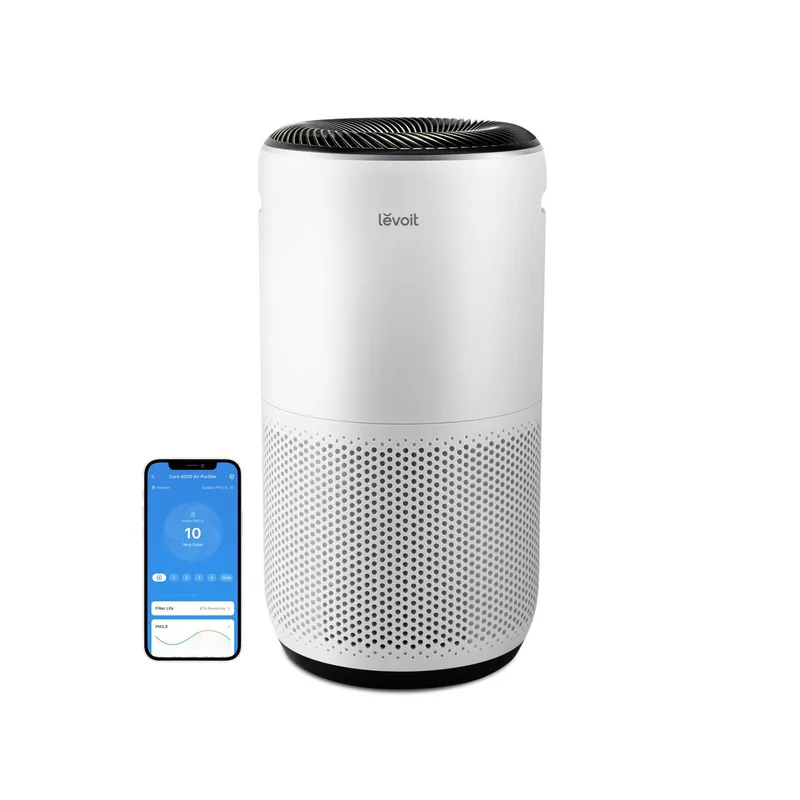
The Levoit Core 400S is an excellent choice for kitchen-adjacent rooms like dining rooms and bedrooms near the kitchen. At $181.95, it delivers strong CADR performance with smart app control, so you can ramp it up from another room when you start cooking. The three-stage filtration with activated carbon effectively captures both cooking particles and the VOCs and odors that HEPA alone cannot handle. Its compact size makes it easy to position at the kitchen boundary without taking up significant floor space.
Open Floor Plan Challenges
Modern open floor plans are great for socializing but terrible for cooking air quality. Without walls and doors to contain pollutants, PM2.5 and NO2 from cooking spread freely into living rooms, dining areas, and even bedrooms on the same floor.
Research has shown that in open-concept homes, cooking pollutants reach every corner of the shared space within 10 to 15 minutes. PM2.5 concentrations in a living room 30 feet from the kitchen can reach 60 to 80% of the peak levels measured directly at the stove.
Strategies for Open Floor Plans
Maximize range hood use. In an open layout, the range hood is even more critical because you have no walls to slow pollutant migration. Run it on the highest tolerable speed for every cooking session.
Position a high-CADR purifier as a barrier. Place a purifier like the Blueair Blue Pure 211+ between the kitchen and living area. This creates an active filtration zone that intercepts particles as they spread. A CADR of at least 300 is recommended for this role — lower-output purifiers cannot keep up with the rate of pollutant dispersion in open spaces.
Open a window on the far side of the living area. This creates a pressure gradient that helps pull cooking air toward the range hood rather than letting it settle into the living space.
Close bedroom doors. Even in an open-concept main floor, keeping bedroom doors closed during cooking prevents PM2.5 from settling into the rooms where you sleep.
Monitor the Spread
An air quality monitor positioned in your living area — away from the kitchen — gives you real-time visibility into how effectively your ventilation and filtration strategy is working. You should see PM2.5 spike in the kitchen during cooking and, if your strategy is working, remain relatively stable in the living area.
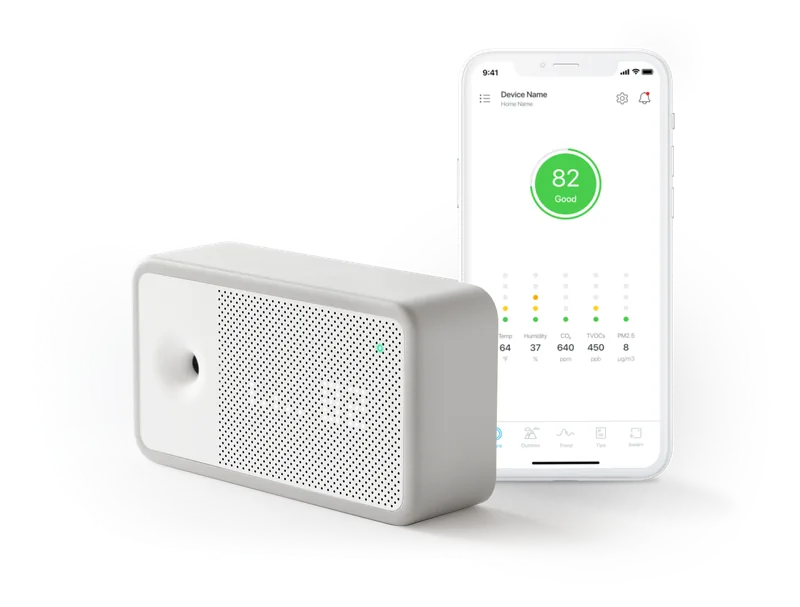
An air quality monitor with PM2.5 tracking is particularly useful for cooking air quality assessment. The Amazon Smart Air Quality Monitor ($50) with Alexa integration can trigger your purifier automatically when PM2.5 spikes during cooking, while the Airthings View Plus ($329.99) provides the most comprehensive monitoring including PM2.5, CO2, and VOCs. Place a monitor in your living room or dining area and watch what happens when you cook. You will quickly learn which cooking methods, ventilation settings, and purifier speeds actually keep your air clean — and which leave your entire living space filled with fine particles.
Holiday and Heavy Cooking Strategies
Thanksgiving, holiday dinners, large family meals, and summer grilling sessions push cooking pollutants to extreme levels. Multiple burners running simultaneously, extended oven use, frying, and roasting combine to create sustained PM2.5 spikes that can last for hours.
A study by the Finnish Meteorological Institute found that preparing a multi-course holiday meal can generate indoor PM2.5 levels exceeding 200 to 400 µg/m³ for extended periods — levels that the EPA would classify as "very unhealthy" to "hazardous" if measured outdoors.
Your Heavy Cooking Checklist
Before cooking:
- Replace air purifier filters if they are more than 75% through their expected life — a partially loaded filter loses CADR when you need it most
- Verify your range hood is working properly
- Open windows in the kitchen and at least one window in a distant room to create cross-ventilation
- Turn on your air purifier on high in the adjacent living area
- Close bedroom doors
During cooking:
- Run the range hood on high for the entire cooking session — not just when you see smoke
- If multiple burners are active, prioritize the back burners (closer to the hood intake)
- Avoid opening the oven door repeatedly to check food — each opening releases a burst of hot, particle-laden air
- If deep-frying (turkey, etc.), do it outdoors. Indoor deep-frying generates extreme PM2.5 and is a fire risk
After cooking:
- Keep the range hood running for at least 20 to 30 minutes after the last burner is turned off
- Keep the air purifier on high for another 30 to 60 minutes, then return to auto
- Leave at least one window cracked for an additional hour if weather permits
- Check your air quality monitor — PM2.5 should return to baseline (under 12 µg/m³) within 1 to 2 hours if your strategy is effective
Recommended Products
For effective cooking air quality management, you need two things: strong filtration in adjacent living spaces and real-time monitoring to verify your approach is working.
How to choose:
- Large open floor plans (400+ sq. ft.): The Blueair Blue Pure 211+ delivers the highest CADR at 350, making it the best choice for intercepting cooking pollutants across large open spaces.
- Kitchen-adjacent rooms (200-350 sq. ft.): The Levoit Core 400S offers strong performance with smart controls at a lower price point. Its app integration lets you ramp up filtration from another room when cooking starts.
- General-purpose all-rounder: The Coway Airmega AP-1512HH at $229 remains one of the best values in air purification. Its auto mode responds to PM2.5 spikes from cooking automatically, making it a reliable set-and-forget option for the room closest to your kitchen.
The Bottom Line
Cooking is unavoidable — cooking pollutants are not. The most impactful change you can make costs nothing: turn on your range hood every time you cook, use medium or high speed, and leave it running for 15 to 20 minutes after you finish. If your hood recirculates rather than venting outdoors, open a window.
Layer an air purifier in your adjacent living space to catch what the hood misses. If you have an open floor plan, invest in a high-CADR unit like the Blueair Blue Pure 211+ and position it between the kitchen and living area. And if you cook with gas, an air quality monitor will show you exactly how much PM2.5 your stove produces — data that often motivates better ventilation habits or a future switch to induction.
You do not need to stop cooking to breathe clean air. You just need to ventilate and filter with intention.
This guide was researched and written by the AirQualityNest editorial team. We update our content regularly to reflect the latest products, pricing, and research.
Frequently Asked Questions
Are gas stoves bad for indoor air quality?+
Gas stoves produce significantly more indoor air pollution than electric or induction stoves. They generate nitrogen dioxide (NO2) and carbon monoxide from the combustion of natural gas — pollutants that electric and induction stoves do not produce at all. A Stanford-led study found that gas burners can push indoor NO2 above EPA outdoor safety thresholds within minutes. If you cook with gas, always use a ducted range hood and consider placing an air quality monitor near the kitchen to track NO2 and PM2.5 levels.
Do air purifiers help with cooking smoke and odors?+
Yes, but with limitations. A True HEPA air purifier effectively captures cooking-generated PM2.5 — the fine particles that make up visible cooking smoke. For cooking odors and VOCs like acrolein, you need an activated carbon filter in addition to HEPA. However, an air purifier is a complement to ventilation, not a replacement. A range hood exhausts pollutants outdoors; a purifier recirculates and filters room air. Use both together for the best results.
Where should I place an air purifier if my kitchen is open to the living room?+
Place the air purifier between the kitchen and the living or seating area, approximately 10 to 15 feet from the stove. This positions it to intercept cooking pollutants as they migrate from the kitchen into the living space. Do not place the purifier directly next to the stove — heat, grease, and moisture will damage the filter and the unit. Choose a purifier with a CADR of at least 300 for open floor plans, and run it on high during cooking.
How long should I run my range hood after cooking?+
Run your range hood for at least 15 to 20 minutes after you finish cooking. PM2.5 and NO2 levels remain elevated well after burners are turned off because particles and gases are still dispersing through the kitchen. For heavy cooking sessions like holiday meals or frying, extend the post-cooking ventilation to 30 minutes. Leaving the hood running while you eat dinner after cooking is a simple habit that makes a significant difference.
Is cooking with an air fryer better for indoor air quality than frying on the stove?+
Air fryers generally produce less PM2.5 than open stovetop frying because the cooking chamber is enclosed and uses circulating hot air rather than submerging food in oil. However, air fryers still generate some PM2.5 and VOCs, especially at high temperatures. They are better for air quality than stovetop frying but not emission-free. Ventilation remains important — run your range hood or open a window when using an air fryer, particularly for fatty foods.
Sources & References
- Stanford University — Methane and NOx Emissions from Natural Gas Stoves — Found that gas stoves emit NO2 at levels that can exceed EPA outdoor standards indoors, contributing to an estimated 12.7% of childhood asthma cases attributable to gas stove use
- EPA — Indoor Air Quality and Cooking — Documents PM2.5 and pollutant generation from cooking activities; states indoor air is typically 2-5x more polluted than outdoor air
- WHO — Household Air Pollution and Health — Identifies cooking as a major source of household air pollution globally, with health effects including respiratory illness and cardiovascular disease
- Lawrence Berkeley National Laboratory — Range Hood Use Study — Found that fewer than 35% of people regularly use their range hood while cooking; documented the pollutant reduction effectiveness of ducted vs. recirculating hoods
- EPA — Nitrogen Dioxide and Indoor Air — Establishes outdoor NO2 standards (100 ppb one-hour) and documents indoor sources including gas stoves, kerosene heaters, and tobacco smoke
Related Reading
Best Air Purifiers for Cooking Odors
Top-rated purifiers for eliminating cooking smoke and kitchen odors
VOCs in Your Home
Sources, health risks, and removal strategies for volatile organic compounds
How to Improve Indoor Air Quality
The complete guide to cleaner air using source control, ventilation, and filtration
Activated Carbon Filters Explained
How carbon filters adsorb gases and odors that HEPA cannot capture
Best Air Purifiers for Large Rooms
High-CADR purifiers for open floor plans and large living spaces
Continue Reading
Best Air Purifiers for Open Floor Plans in 2026: High-CADR Models That Cover It All
The best air purifiers for open floor plans ranked by CADR, coverage area, and noise. High-performance HEPA purifiers that handle 500-1,500+ sq. ft. open spaces.
Best Smart Humidifiers in 2026 (Wi-Fi, App Control & Auto Humidity)
The best smart humidifiers with Wi-Fi, app control, and auto humidity adjustment. Top picks for Alexa, Google Home, and smart home integration.
The 5 Best Portable Air Quality Monitors in 2026
Monitor your air quality on the go. We tested the best portable and compact air quality monitors for accuracy, battery life, and sensor range.