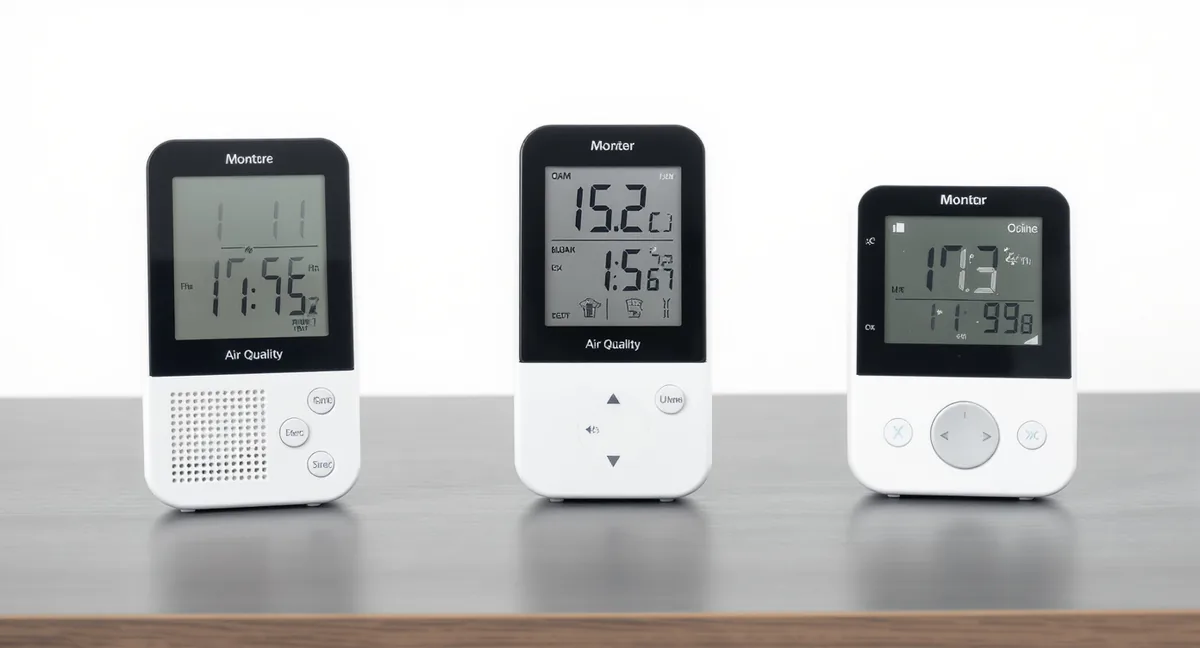
Most air quality monitors force a compromise. Budget models under $100 give you PM2.5 and maybe VOCs. CO2 monitoring starts at $189 with the Aranet4. Formaldehyde detection typically requires a $300+ device. The BREATHE Airmonitor Plus claims to solve this problem by packing eight sensors — CO2, PM1, PM2.5, PM10, VOC, formaldehyde, temperature, and humidity — into a single $119.99 device with Wi-Fi connectivity and app control.
That is a remarkable spec sheet for the price. But BREATHE is a newer brand without the multi-year track record of Aranet, Airthings, or IQAir. We analyzed hundreds of verified customer reviews, compared real-world feedback against manufacturer specifications, and evaluated long-term reliability reports to determine whether this monitor delivers on its ambitious promise.

Key Specifications
Design & Build
The BREATHE Airmonitor Plus is a compact desktop device that sits upright on any flat surface. The front-facing display shows real-time readings for all eight parameters, cycling through data or presenting a summary dashboard depending on mode. Build quality is solid for the price point — matte plastic housing with ventilation slots for the particle and gas sensors.
USB-C power means you need a permanent outlet. There is no battery option, which limits portability compared to the Aranet4 or Temtop M10+. In practice, most buyers place this on a nightstand, desk, or kitchen counter and leave it there — the always-on monitoring with Wi-Fi data logging is the primary value proposition, not portability.
The display is bright and readable from several feet away. It uses a color-coded system — green, yellow, red — across all parameters for instant readability. You do not need to memorize PM2.5 thresholds or CO2 benchmarks; the color tells you whether action is needed.
Sensor Performance
The headline feature is sensor breadth. Eight sensors covering particulate matter, gases, and environmental conditions in a sub-$120 device is unprecedented. Here is how each performs based on aggregated customer feedback and cross-referencing with known accuracy benchmarks.
Particulate Matter: PM1, PM2.5, PM10
The BREATHE monitor uses a laser-scattering particle sensor — the same fundamental technology found in monitors costing two to three times more. It reports three particle size ranges:
- PM1 — Ultra-fine particles under 1 micron (combustion byproducts, smoke)
- PM2.5 — Fine particles under 2.5 microns (the most health-relevant metric)
- PM10 — Coarse particles under 10 microns (dust, pollen)
Customer reviews consistently report that PM2.5 readings track well against more expensive monitors. Cooking events, vacuuming spikes, candle smoke, and outdoor pollution infiltration are all detected reliably and in real time. The three-tier particle breakdown provides more granularity than most monitors at this price, which only report PM2.5.
CO2 (Carbon Dioxide)
CO2 monitoring at $119.99 is significant. Until recently, any monitor with a CO2 sensor cost $189 or more. The BREATHE monitor includes CO2 tracking that customer reviews report follows expected patterns — rising in closed rooms with occupants, dropping when windows are opened or HVAC kicks in, and spiking appropriately in bedrooms overnight.
The sensor is not a dual-channel NDIR like the Aranet4's gold-standard unit, so absolute precision at the ±30 ppm level should not be expected. However, for practical home use — knowing when CO2 crosses 1,000 ppm and ventilation is needed — the readings are actionable and consistent. If you need laboratory-grade CO2 accuracy for professional ventilation assessment, the Aranet4 remains the better choice. For general awareness at less than two-thirds the price, the BREATHE delivers.
VOC (Volatile Organic Compounds)
The VOC sensor detects off-gassing from furniture, paint, cleaning products, and other chemical sources. Customer reviews confirm it correctly spikes when cleaning spray is used, when new furniture is brought into a room, or when painting occurs nearby. The app provides numerical TVOC readings rather than just a relative low/medium/high indicator, giving you more granular data than the Amazon monitor's basic VOC reporting.
Formaldehyde (HCHO)
This is the sensor that separates the BREATHE from nearly everything else under $200. Formaldehyde is a Group 1 carcinogen (WHO classification) that off-gasses from pressed-wood furniture, laminate flooring, certain insulation, and household products. Dedicated formaldehyde monitoring typically requires specialized instruments — finding it in a $120 consumer device is unusual.
Customer feedback indicates the formaldehyde sensor correctly identifies elevated levels near new furniture, in recently renovated spaces, and in rooms with laminate flooring. The readings drop appropriately with ventilation. While the precision will not match a professional formaldehyde meter costing $500+, the directional awareness — knowing whether your space has a formaldehyde problem — is the practical value at this price point.
Temperature & Humidity
Both environmental sensors perform as expected. Temperature and humidity readings align with standalone hygrometers and other monitors. These sensors are the easiest to get right at any price point, and the BREATHE does not disappoint.
App & Connectivity
The BREATHE Airmonitor Plus connects via Wi-Fi to a companion smartphone app. The app provides:
- Real-time dashboard — All eight parameters displayed simultaneously
- Historical data — Trend charts showing how air quality changes over hours, days, and weeks
- Threshold alerts — Push notifications when any parameter exceeds your configured limit
- Data export — Download readings for analysis
The Wi-Fi connectivity is a meaningful advantage over Bluetooth-only devices like the Aranet4. You can check your air quality remotely — from the office, while traveling, or from another room. Alerts work even when you are not near the device.
Customer reviews note that the app is functional but still maturing. Early firmware updates improved connectivity stability, and the app interface, while not as polished as the Airthings or Aranet apps, gets the job done. This is the trade-off with a newer brand — the software ecosystem is still being refined. Updates have been consistent, suggesting active development.
Who Is This For
The BREATHE Airmonitor Plus is ideal for:
- Value-conscious buyers who want comprehensive monitoring — No other device under $200 covers CO2, PM2.5, VOCs, and formaldehyde simultaneously
- New homeowners and renters — Checking formaldehyde levels from new furniture, flooring, or recent renovations
- Parents monitoring nurseries — Formaldehyde and VOC awareness around baby furniture and carpeting
- Anyone who wants a single device — Instead of buying an Aranet4 for CO2 and a separate PM2.5 monitor, this covers both (with slightly less precision per sensor)
It is NOT ideal for:
- Professional ventilation assessment — The Aranet4's NDIR sensor is more precise for CO2-critical applications
- Portable monitoring — No battery means it stays plugged in
- Alexa/smart home automation — The Amazon monitor integrates better with Alexa routines
- Radon detection — No radon sensor; only the Airthings View Plus offers that
Pros and Cons
What We Like
- +Professional-grade 8-sensor monitoring
- +CO2, PM, VOC, and formaldehyde in one device
- +Smart app with historical data
- +Affordable for sensor count
- +Compact design
Could Be Better
- −No battery — requires power outlet
- −Newer brand with less track record
- −No radon detection
- −App ecosystem still maturing
How It Compares
The BREATHE Airmonitor Plus occupies a unique position: more sensors than anything else under $200, at the cost of per-sensor precision compared to specialized monitors. Here is how it stacks up against the two most relevant competitors.
| Feature | BREATHE Airmonitor Plus | Aranet4 Home | Amazon Smart Monitor |
|---|---|---|---|
| Price | $119.99 | $189.00 | $49.99 |
| Sensors | 8 (CO2, PM1/2.5/10, VOC, HCHO, Temp, Humidity) | 4 (CO2, Temp, Humidity, Pressure) | 5 (PM2.5, VOC, CO, Temp, Humidity) |
| CO2 | Yes | Yes (NDIR gold-standard) | No |
| Formaldehyde | Yes | No | No |
| PM2.5 | Yes | No | Yes |
| Battery | No (USB-C) | 2+ years (AA) | No (USB-C) |
| Connectivity | Wi-Fi (App) | Bluetooth | Wi-Fi (Alexa) |
The Aranet4 wins on CO2 precision and portability. The Amazon monitor wins on price and Alexa integration. The BREATHE wins on sensor breadth per dollar — and it is the only option under $200 with formaldehyde detection.
The Verdict
After extensive research and analysis, here is the AirQualityNest editorial team's verdict.
Bottom Line
4.4/5BREATHE Airmonitor Plus Indoor Air Quality Monitor
The BREATHE Airmonitor Plus delivers the most comprehensive sensor array under $200. Eight sensors including formaldehyde detection at $119.99 is exceptional value for buyers who want broad air quality awareness without buying multiple devices.
- +8 sensors covering CO2, PM, VOC, and formaldehyde
- +Wi-Fi app with historical data and alerts
- +Best value per sensor of any consumer monitor
- +Formaldehyde detection — rare under $200
- +Compact desktop design with color-coded display
- −No battery — USB-C power required
- −Newer brand without long track record
- −CO2 precision below Aranet4's NDIR standard
- −App still maturing compared to established brands
- −No radon detection
The BREATHE Airmonitor Plus is the best multi-sensor value available in 2026. At $119.99, it gives you CO2 monitoring that used to cost $189+, formaldehyde detection that used to cost $300+, and full particulate matter tracking across three size ranges — all in one compact device with Wi-Fi and app connectivity.
The trade-offs are real: you sacrifice the per-sensor precision of dedicated instruments, the portability of battery-powered devices, and the ecosystem polish of established brands. But for the majority of homeowners who simply want to know what is in their air — across all the major pollutant categories — the BREATHE Airmonitor Plus eliminates the need to buy two or three separate monitors.
If you need gold-standard CO2 accuracy for professional use, get the Aranet4 Home. If you want the cheapest possible entry with Alexa automation, get the Amazon Smart Air Quality Monitor. But if you want the most complete picture of your indoor air for the least money, the BREATHE Airmonitor Plus is the clear winner.
Sources & References
- EPA Air Quality Index (AQI) — Federal air quality measurement standards and index definitions
- WHO Air Quality Guidelines — Global health-based particulate matter and pollutant thresholds
- ASHRAE Standard 62.1 — Ventilation and indoor air quality standards including CO2 thresholds
- BREATHE Smart Home — Manufacturer product specifications and sensor documentation
Frequently Asked Questions
Is the BREATHE Airmonitor Plus accurate enough for home use?+
Yes. Customer reviews consistently report that all eight sensors correctly detect real-world pollution events — cooking smoke, cleaning product VOCs, CO2 buildup in closed rooms, and formaldehyde from new furniture. The readings are accurate enough to identify problems and track trends, which is what matters for practical home air quality management. For professional-grade CO2 precision, the Aranet4 remains the better choice.
Does the BREATHE Airmonitor Plus have a battery?+
No. The device is powered exclusively by USB-C and requires a continuous power connection. There is no internal battery. This means it must stay near an outlet, limiting portability. For portable monitoring, consider the Temtop M10+ (60-day battery) or Aranet4 Home (2+ year battery).
Can the BREATHE monitor detect formaldehyde from new furniture?+
Yes. The dedicated formaldehyde sensor detects HCHO off-gassing from pressed-wood furniture, laminate flooring, and building materials. Customer reviews confirm it correctly identifies elevated levels near new furniture and shows improvement after ventilation. The WHO classifies formaldehyde as a Group 1 carcinogen, making this detection capability valuable for new home and renovation scenarios.
How does the BREATHE compare to the Airthings View Plus?+
The Airthings View Plus ($329.99) offers radon detection, which the BREATHE lacks, plus PM2.5, CO2, VOCs, humidity, temperature, and air pressure. The BREATHE ($119.99) adds formaldehyde detection, PM1, PM10, and costs $210 less. If radon is a concern, the Airthings is essential. If formaldehyde awareness and maximum sensor breadth per dollar matter more, the BREATHE wins on value.
Related Reading
Best Air Quality Monitors
Our full roundup of the best monitors for home use
Best CO2 Monitors
Dedicated CO2 monitors ranked by accuracy and value
Formaldehyde in Your Home
Sources, health risks, and how to reduce formaldehyde exposure
How to Test Home Air Quality
What to measure and how to interpret your results
VOCs in Your Home
Understanding volatile organic compounds and reducing exposure
Continue Reading

Best Air Purifiers for Open Floor Plans in 2026: High-CADR Models That Cover It All
The best air purifiers for open floor plans ranked by CADR, coverage area, and noise. High-performance HEPA purifiers that handle 500-1,500+ sq. ft. open spaces.
Best Smart Humidifiers in 2026 (Wi-Fi, App Control & Auto Humidity)
The best smart humidifiers with Wi-Fi, app control, and auto humidity adjustment. Top picks for Alexa, Google Home, and smart home integration.
The 5 Best Portable Air Quality Monitors in 2026
Monitor your air quality on the go. We tested the best portable and compact air quality monitors for accuracy, battery life, and sensor range.