Key Takeaways
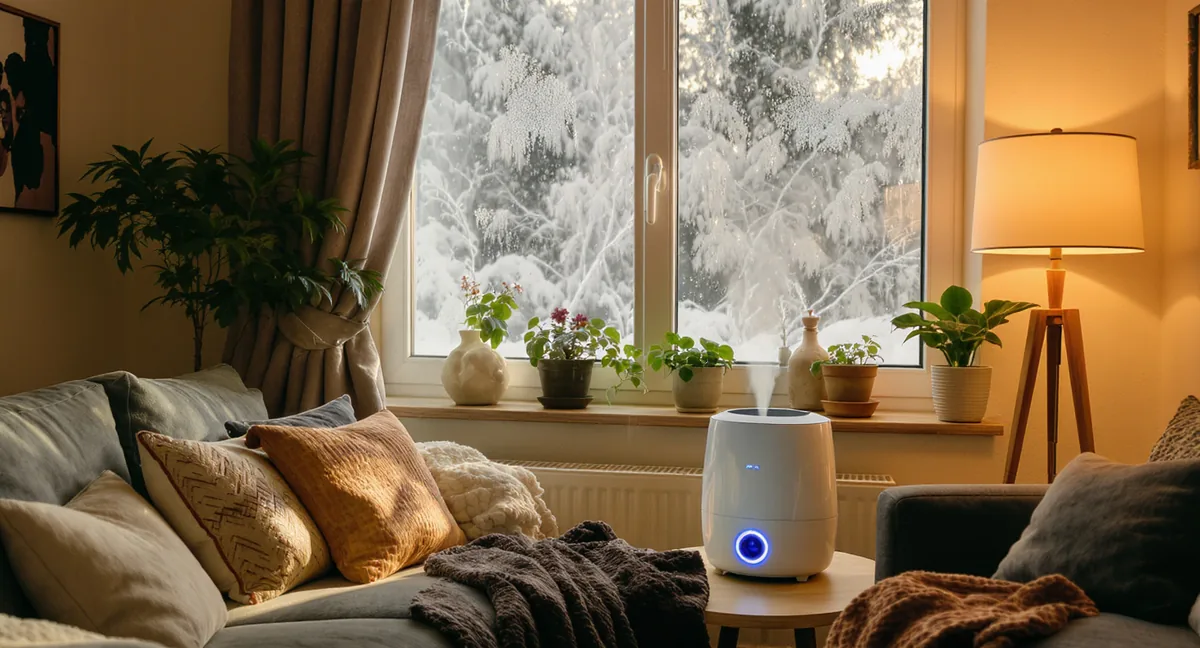
- 1Winter heating systems can drop indoor humidity to 15-25%, well below the EPA-recommended 30-50% range
- 2Low humidity causes dry skin, nosebleeds, cracked lips, respiratory irritation, and increased susceptibility to colds and flu
- 3Evaporative humidifiers prevent white dust; ultrasonic models are quieter; warm mist kills more waterborne bacteria
- 4A whole-house humidifier covers up to 3,600 sq. ft., while portable units work best for single rooms and bedrooms
- 5Clean your humidifier every 3-7 days in winter to prevent bacteria and mold from growing in the tank
Quick Answer
What is the best way to fix dry air in winter?
The most effective solution is a humidifier sized to your room. For a single bedroom, a portable ultrasonic or evaporative humidifier ($30-90) will bring humidity from the typical winter low of 15-25% up to the healthy 30-50% range. For whole-house coverage, a console evaporative humidifier ($150-200) can treat up to 3,600 sq. ft. Pair it with a $10 hygrometer to monitor your levels. Non-humidifier tricks — like leaving the bathroom door open after a shower or placing houseplants around the home — help at the margins but cannot replace a dedicated humidifier when winter air is severely dry.
Why Winter Air Is So Dry
Two forces conspire to make winter indoor air uncomfortably dry. Understanding both helps explain why the problem is so persistent — and why simply turning down the thermostat rarely fixes it.
Cold Air Holds Less Moisture
This is basic physics. The amount of water vapor air can hold depends on its temperature. At 70°F, a cubic meter of air can hold about 18 grams of water. At 30°F, that same volume holds only about 4 grams. When freezing outdoor air enters your home through normal air exchange — through window seals, door gaps, and ventilation intake — it arrives nearly bone-dry. Even at 100% relative humidity, 20°F air contains almost no moisture in absolute terms.
Heating Systems Strip Remaining Humidity
Your furnace or heating system makes the problem worse. Forced-air heating takes that already-dry incoming air and heats it rapidly, which drops the relative humidity even further. Heating cold air from 30°F to 70°F without adding any moisture can reduce relative humidity to 10-15% — dryer than the Sahara Desert, which averages around 25%.
The result: by mid-January in cold climates, indoor humidity in homes with forced-air heating regularly sits between 15% and 25%. That is well below the 30% minimum recommended by the EPA and the American Society of Heating, Refrigerating, and Air-Conditioning Engineers (ASHRAE).
Radiant heating (baseboard, radiator, or in-floor) dries the air less aggressively than forced air because it does not blow dry air through ducts. But it still heats the air, lowering relative humidity. No heating system adds moisture — they all make dryness worse to varying degrees.
Health Effects of Dry Winter Air
When indoor humidity drops below 30%, your body starts paying a price. These effects accumulate throughout heating season, and many people attribute them to "winter" rather than recognizing that their indoor air is the culprit.
Dry, cracked skin and lips. Your skin is your body's largest organ, and it loses moisture to the surrounding air through evaporation. In very dry air, this happens faster than your skin can replenish moisture. Hands, knuckles, and lips are especially vulnerable because the skin there is thinner. Moisturizers help temporarily, but they are treating the symptom, not the cause.
Nosebleeds. The mucous membranes lining your nasal passages dry out and crack in low humidity. This is the most common cause of winter nosebleeds, particularly in children. The Mayo Clinic notes that dry indoor air is a leading trigger.
Respiratory irritation. Your airways rely on a thin layer of mucus to trap and expel pathogens, dust, and irritants. Dry air thins this protective mucus layer, leaving your respiratory system more exposed. This can cause a persistent dry cough, sore throat, or a scratchy feeling when breathing — especially upon waking.
Increased cold and flu transmission. Research from Yale University demonstrated that influenza virus survives longer and transmits more efficiently in low-humidity environments. A separate study published in PNAS found that mice exposed to dry air had impaired mucociliary clearance and a weakened immune response. The practical takeaway: dry air makes you more likely to catch — and stay sick with — respiratory infections.
Static electricity. While more annoying than dangerous, constant static shocks are a telltale sign of very low humidity (usually below 25%). Static can also damage sensitive electronics and cause clothing to cling uncomfortably.
Damage to your home. Hardwood floors shrink and develop gaps between boards. Wood furniture joints loosen and crack. Paint chips more easily. Musical instruments go out of tune. These are not cosmetic issues — they represent real structural damage that costs money to repair.
The Ideal Winter Humidity Range
The EPA and ASHRAE recommend maintaining indoor relative humidity between 30% and 50%. Within that range, here is how to think about the numbers:
| Humidity Level | Assessment | Recommendation |
|---|---|---|
| Below 20% | Severely dry | Humidifier essential — health and home damage likely |
| 20-30% | Too dry | Humidifier strongly recommended — symptoms noticeable |
| 30-40% | Acceptable | Comfortable for most people; good for winter |
| 40-50% | Ideal | Optimal for health, comfort, and home preservation |
| Above 50% | Too humid for winter | Risk of condensation on cold windows; reduce output |
For winter specifically, aim for 35-45%. Going above 50% in winter can cause condensation on cold windows, which leads to water damage and mold growth on window frames. Some dermatologists recommend the higher end of the range (40-50%) for skin health, but be cautious about exceeding 45% when outdoor temperatures are below freezing — watch your windows for condensation and dial back if you see it.
A basic digital hygrometer ($10-15 at any hardware store) is the most important tool you can own. Without one, you are guessing. Place it at breathing height in the room you spend the most time in, and check it several times per day for a few days to understand your home's humidity patterns.
Humidifier Types Compared
Not all humidifiers work the same way, and the differences matter for comfort, maintenance, safety, and the annoying "white dust" problem.
Ultrasonic (Cool Mist)
How it works: A metal diaphragm vibrates at ultrasonic frequencies, breaking water into a fine cool mist that is dispersed into the air.
Pros: Near-silent operation (many run at 26-30 dB), no filter to replace, energy efficient, affordable.
Cons: Can produce white dust — fine mineral particles from tap water that settle on furniture and electronics. Using distilled or demineralized water eliminates this, but adds ongoing cost.
Best for: Bedrooms where silence is critical, single-room use, budget-conscious buyers.
Evaporative
How it works: A fan blows air over a wet wick filter. Water evaporates naturally into the airstream. Only pure water vapor enters the air — minerals stay trapped in the wick.
Pros: No white dust whatsoever, self-regulating (output naturally slows as humidity rises), cannot over-humidify a room.
Cons: Wick filters need replacement every 1-2 months ($8-15 each), slightly louder than ultrasonic due to the fan, no warm mist option.
Best for: Homes with hard water, people who do not want to buy distilled water, families with children (no burn risk), anyone concerned about white dust on electronics.
Warm Mist (Steam)
How it works: A heating element boils water, producing steam that cools slightly before being released. The boiling process kills waterborne bacteria and mold spores.
Pros: Slightly warmer output feels pleasant in cold rooms, boiling kills most pathogens in the water, no white dust.
Cons: Burn risk (the unit contains boiling water), higher energy consumption, can overshoot target humidity, not recommended for nurseries or homes with young children or pets.
Best for: Adult bedrooms, homes where added warmth is welcome, people concerned about waterborne bacteria.
Console / Whole-House Evaporative
How it works: A larger version of the evaporative design with a high-capacity tank (3-4+ gallons) and a more powerful fan. Sits on the floor like a small cabinet and can humidify an entire floor or small home.
Pros: Covers 1,000-3,600+ sq. ft. from a single unit, no white dust, self-regulating, built-in humidistat for automatic control.
Cons: Larger footprint, wick filters need regular replacement, louder than portable units, heavier and less portable.
Best for: Open-concept homes, whole-floor or whole-house humidification, anyone tired of managing multiple portable units.
Quick Comparison
| Feature | Ultrasonic | Evaporative | Warm Mist | Console/Whole-House |
|---|---|---|---|---|
| Noise | Very quiet (26-30 dB) | Moderate (fan-based) | Quiet (gentle bubbling) | Moderate to loud |
| White dust | Yes (with tap water) | No | No | No |
| Filter cost | None | $8-15 every 1-2 months | None | $15-25 every 1-2 months |
| Safety | Cool to touch | Cool to touch | Burn risk (hot water) | Cool to touch |
| Coverage | 250-750 sq. ft. | 400-700 sq. ft. | 200-500 sq. ft. | 1,000-3,600 sq. ft. |
| Energy use | Low | Low | Higher | Moderate |
| Best for | Bedrooms | Families, hard water | Adult bedrooms | Whole home |
Our Top Humidifier Picks for Winter
We evaluated these humidifiers based on thousands of verified customer reviews, focusing on real-world winter performance: runtime, noise levels during sleep, ease of cleaning, and how well they maintain consistent humidity through cold nights.
Best Overall: Levoit LV600S
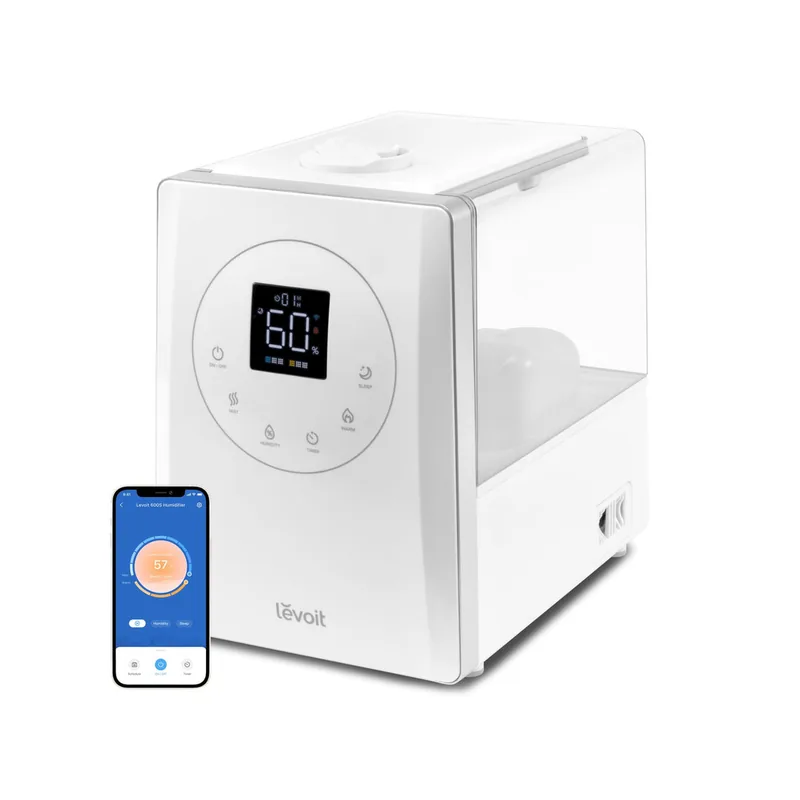
The Levoit LV600S earns our top recommendation for winter use because it addresses every pain point that matters during heating season. Its 1.5-gallon tank runs up to 50 hours on low, meaning you can go two full days without refilling — a major advantage when you are running it nonstop from November through March. Both warm and cool mist options let you choose based on comfort preference, and the smart app with auto mode maintains your target humidity without constant manual adjustment.
Customers consistently praise the LV600S for quiet overnight operation and the auto mode's ability to hold humidity at a set level. At $109.99, it covers rooms up to 753 sq. ft. — large enough for most bedrooms, living rooms, and open-plan spaces.
Why it wins for winter: The combination of warm mist (pleasant in cold rooms), marathon runtime, and smart auto mode makes it the most set-and-forget option for all-winter use.
Best Evaporative (No White Dust): Honeywell HEV685W
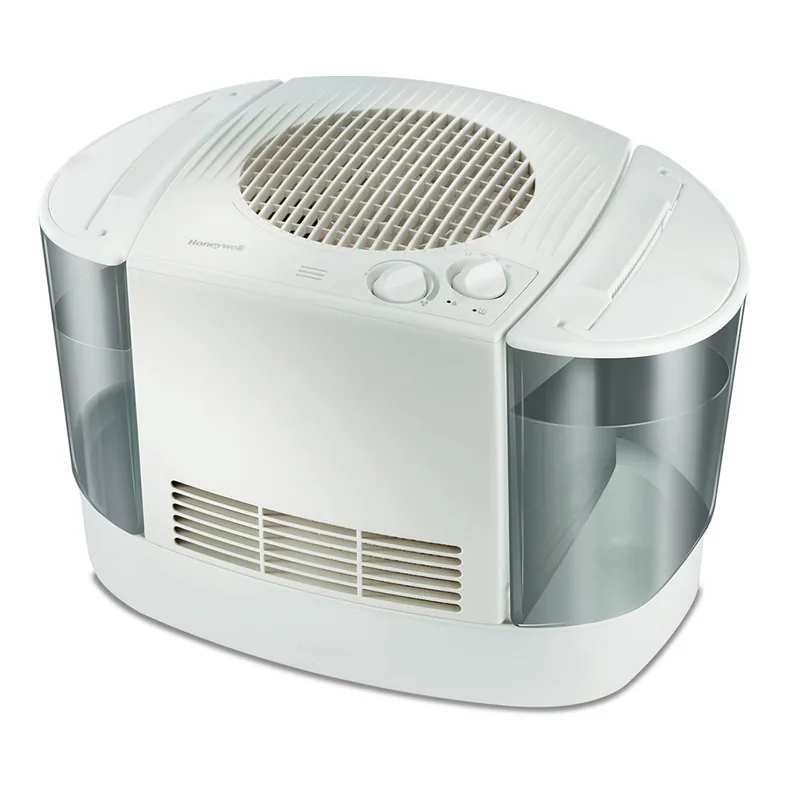
If white dust is your dealbreaker — and it should be if you have dark furniture, electronics, or sensitive respiratory conditions — the Honeywell HEV685W is the answer. Its evaporative design means only pure water vapor enters the air. Minerals from your tap water stay trapped in the wicking filter, so there is zero white dust on your surfaces.
The top-fill design makes refilling painless. You lift the lid and pour water in from the top rather than flipping the tank upside down over a basin. Customers with hard water especially appreciate this model, since it eliminates the mineral dust problem that plagues ultrasonic humidifiers without requiring you to buy distilled water.
The trade-off: wicking filters need replacement every 1-2 months (about $10 each), and there is no warm mist option. But for households that prioritize clean surfaces and easy maintenance, this is the best evaporative humidifier available.
Longest Runtime for Overnight: Dreo 6L Smart Humidifier
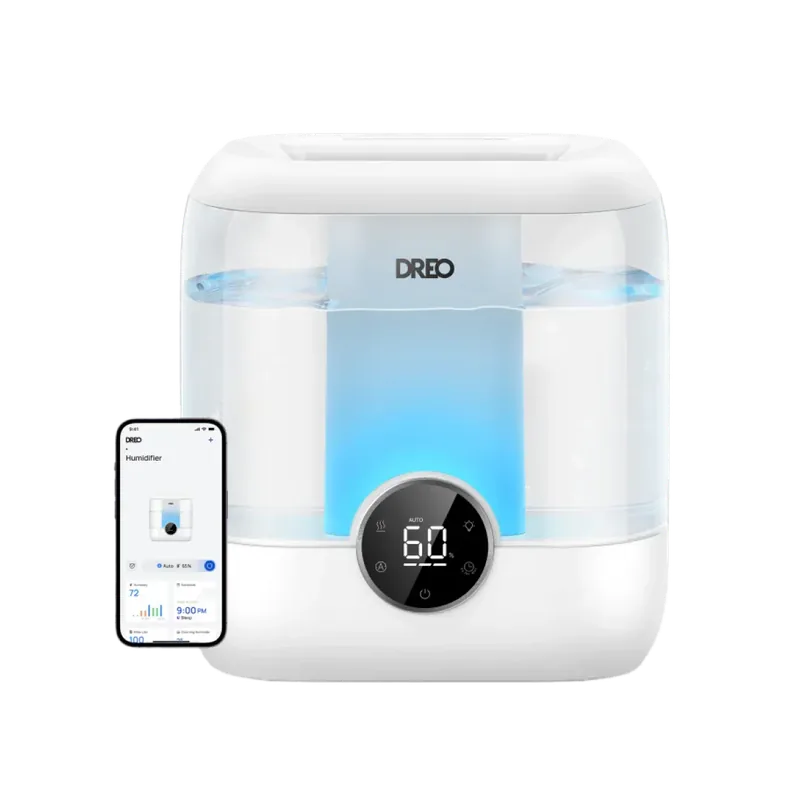
The Dreo 6L delivers a class-leading 60 hours of runtime — the longest of any portable humidifier we have reviewed. For winter bedroom use, this is significant. You fill the 1.6-gallon tank on Sunday evening and it runs through Wednesday without a refill. No midnight wake-ups to a bone-dry room because the tank ran out at 3 AM.
At just 28 dB on its lowest setting, the Dreo is also among the quietest humidifiers you can buy. App control with scheduling lets you program it to ramp up overnight when heating systems run hardest and your nasal passages are most vulnerable. At $89.99, it is also the most affordable smart humidifier in our roundup.
The trade-off: Like all ultrasonic models, it may produce white dust if you use tap water in a hard-water area. Use distilled or demineralized water to avoid this.
Best Whole-House Solution: AIRCARE MA1201
For homes where managing multiple portable humidifiers feels like a chore, the AIRCARE MA1201 eliminates the problem entirely. This console-style evaporative humidifier covers up to 3,600 sq. ft. — enough for an entire floor of a typical home or a complete small-to-medium house. Its 3.6-gallon tank runs up to 36 hours, and the digital humidistat automatically adjusts output to maintain your target humidity.
Because it is evaporative, there is no white dust and no risk of over-humidification — output naturally tapers as the room reaches your set level. At $139.99, it costs less than buying two or three portable units and eliminates the hassle of managing them separately.
Best for: Homeowners with open floor plans, anyone running three or more portable humidifiers, and people who want centralized humidity control without a whole-home HVAC installation.
Head-to-Head Comparison
Room-by-Room Humidity Strategy
Different rooms have different humidity needs and different constraints. Here is how to approach each one.
Bedroom
Priority: Overnight humidity for sleep quality, quiet operation, long runtime.
Your bedroom is where dry air does the most damage. You spend 7-9 hours breathing heated, dry air through your nose and mouth. This is why you wake up with a dry throat, chapped lips, and congested sinuses in winter.
Best approach: Place a quiet humidifier (ultrasonic or evaporative) on a nightstand or dresser at least 3 feet from the bed, aimed away from your face. Set it to 40-45% humidity. Choose a model with a tank large enough to run all night without refilling — at least 1 gallon for 8 hours of sleep.
Our pick: The Dreo 6L, for its 60-hour runtime and 28 dB noise floor. Fill it once and forget it for days.
Nursery or Child's Room
Priority: Safety (no burn risk), consistent humidity, quiet operation.
Pediatricians consistently recommend cool-mist humidifiers for nurseries. Warm-mist models contain boiling water and pose a burn risk if knocked over. The American Academy of Pediatrics recommends cool mist only for infants and young children.
Best approach: Use a cool-mist ultrasonic or evaporative humidifier. Place it on a stable surface at least 3 feet from the crib, where the child cannot reach it or pull it down. Set humidity to 40-50%. Clean it every 3 days — children are more susceptible to bacteria that can grow in a neglected humidifier tank.
Our pick: The Honeywell HEV685W. Evaporative means no white dust (important in a room where a baby is breathing the air), no burn risk, and it is self-regulating so it cannot over-humidify.
Living Room or Open-Plan Space
Priority: Coverage for a large area, aesthetic appearance, minimal maintenance.
Living rooms and great rooms are larger and harder to humidify effectively with small portable units. You need either a larger portable humidifier or a whole-house console.
Best approach: For rooms under 750 sq. ft., a single Levoit LV600S handles the job. For open-plan layouts or rooms exceeding 800 sq. ft., the AIRCARE MA1201 whole-house unit is a better fit. Place the humidifier away from walls and curtains to allow even mist distribution.
Our pick: The Levoit LV600S for standard living rooms. The AIRCARE MA1201 for open-concept spaces above 800 sq. ft.
Whole House
Priority: Centralized control, minimal unit management, even humidity distribution.
If you are running three or more portable humidifiers throughout your house, it is time to consider a whole-house solution. You have two options:
- Console humidifier (like the AIRCARE MA1201) — a floor-standing unit that covers up to 3,600 sq. ft. Place it centrally and let it distribute moisture through your home's natural air circulation.
- HVAC-integrated humidifier — a bypass or fan-powered unit installed into your existing ductwork. This is a permanent installation that requires professional setup ($200-500 plus the unit), but it is fully automatic and invisible.
For most homeowners, a console unit is the practical first step. It requires no installation, costs less, and can be moved or stored in summer.
Winter Humidifier Maintenance
A dirty humidifier is worse than no humidifier at all. Stagnant water breeds bacteria and mold, which the humidifier then disperses into your air as a fine mist. During winter, when you are running the unit daily for months, maintenance is critical.
Weekly Cleaning (Every 3-7 Days)
- Empty the tank completely and rinse with clean water
- Wipe the tank interior with a solution of 1 teaspoon white vinegar per gallon of water, or use the manufacturer's recommended cleaning solution
- Scrub the base and mist outlet where mineral deposits accumulate
- Rinse thoroughly — no vinegar residue should remain
- Air dry all components before reassembling
Deep Cleaning (Every 2 Weeks)
- Soak the tank in a solution of 1 tablespoon white vinegar per gallon of water for 30 minutes
- Scrub mineral deposits with a soft brush (an old toothbrush works well for small areas)
- Disinfect by wiping all surfaces with a 3% hydrogen peroxide solution — this kills bacteria and mold that vinegar misses
- Rinse thoroughly and air dry
Filter Maintenance (Evaporative Models Only)
Evaporative humidifiers like the Honeywell HEV685W and AIRCARE MA1201 use wicking filters that trap minerals and need regular replacement:
- Rinse the filter under cold water weekly to extend its life
- Replace the filter every 1-2 months, or sooner if you notice reduced output or discoloration
- Never use bleach or soap on wicking filters — they absorb chemicals that will then be released into your air
- Using distilled water extends filter life but is not required with evaporative models
Mineral Buildup Prevention
- Use distilled or demineralized water in ultrasonic humidifiers to prevent white dust
- Use a demineralization cartridge if your model supports one
- Tap water is fine for evaporative models — the wick filter traps minerals naturally
- Hard water areas will see faster mineral buildup regardless of humidifier type
End-of-Season Storage
When you shut down your humidifier in spring:
- Clean and disinfect all components thoroughly
- Dry every part completely — no moisture should remain
- Replace the filter so a fresh one is ready for next fall
- Store in a dry location in the original box or a sealed bag
Non-Humidifier Ways to Add Moisture
A dedicated humidifier is the most effective solution, but these supplemental strategies help at the margins — and some are free.
Leave the bathroom door open after showering. A hot shower generates significant steam. Leaving the door open lets that moisture disperse into adjacent rooms rather than being vented outside by the exhaust fan. This works best for nearby bedrooms and hallways.
Boil water on the stove or use a stovetop kettle. Cooking, boiling pasta water, or simmering a pot of water on the stove releases steam into your kitchen and surrounding areas. Adding cinnamon sticks or citrus peels makes it double as an air freshener. This is an old-fashioned but genuinely effective method for kitchens and open-plan living spaces.
Place bowls of water near heat sources. Setting shallow bowls of water on or near radiators, baseboard heaters, or floor vents allows the heat to accelerate evaporation. This adds a small but measurable amount of moisture to the immediate area.
Air-dry laundry indoors. Hanging wet clothes on a drying rack inside the house releases moisture as the clothes dry. This is common in European homes and is an effective dual-purpose solution — you save energy on the dryer and add humidity to your air.
Houseplants. Plants release moisture through transpiration — a process where water travels from the roots through the plant and evaporates from the leaves. Grouping several plants together creates a localized humidity boost. Spider plants, Boston ferns, peace lilies, and areca palms are particularly effective. However, the total moisture output from houseplants is modest — they supplement a humidifier but cannot replace one in a severely dry home.
Seal air leaks. Every draft of cold outdoor air entering your home brings dry air with it. Weatherstripping around doors and windows, caulking gaps, and insulating your attic reduce the volume of dry air infiltration. This does not add moisture, but it slows the rate at which your home loses it.
Important caveat: None of these methods can reliably raise humidity from 15% to 40%. They are supplements, not substitutes. If your winter humidity is consistently below 25%, you need a humidifier.
This guide was researched and written by the AirQualityNest editorial team. We update our content regularly to reflect the latest products, pricing, and research.
Frequently Asked Questions
How do I know if my house is too dry in winter?+
The most reliable method is a digital hygrometer ($10-15), which displays your exact humidity percentage. Place it at breathing height in the room you spend the most time in. If it consistently reads below 30%, your air is too dry. Physical symptoms also tell the story: dry, cracked skin that does not improve with moisturizer; frequent nosebleeds; waking up with a sore, dry throat; static electricity shocks on doorknobs and blankets; and gaps appearing between hardwood floor boards. If you notice two or more of these symptoms during heating season, low humidity is almost certainly the cause.
What humidity level should I set my humidifier to in winter?+
Set your humidifier to maintain 40-45% relative humidity. This keeps you well within the EPA-recommended 30-50% range while leaving a margin below 50% to prevent condensation on cold windows. In very cold weather (below 10°F outside), you may need to reduce your target to 35-40% because the large temperature difference between indoor and outdoor air makes condensation more likely. Watch your windows — if you see water droplets forming on the glass, reduce the humidity setting by 5%.
Is it safe to run a humidifier all night while sleeping?+
Yes, and it is actually when you need it most. You spend 7-9 hours breathing heated, dry air while sleeping, which is why you wake up with a dry throat and congested sinuses. Use a humidifier with an auto-shutoff feature (virtually all modern models include this) and a tank large enough to run through the night — at least 1 gallon for 8 hours. Set it to 40-45% on auto mode so it maintains a consistent level rather than over-humidifying. Place it at least 3 feet from the bed, aimed away from your face, to prevent moisture from collecting on bedding.
Can a humidifier make you sick?+
A clean humidifier will not make you sick. A dirty one absolutely can. When water sits stagnant in the tank, bacteria and mold can grow and then be dispersed into your air as a fine mist. This can trigger flu-like symptoms, respiratory irritation, and allergic reactions — a condition sometimes called 'humidifier fever.' The prevention is simple: empty and rinse the tank daily, perform a thorough cleaning with vinegar every 3-7 days, and never let water sit in the tank for more than 48 hours without use. Also replace wicking filters on evaporative models every 1-2 months.
Should I use tap water or distilled water in my humidifier?+
It depends on the type. For ultrasonic humidifiers, use distilled or demineralized water to prevent white dust — the fine mineral particles that settle on furniture and electronics. Tap water minerals get atomized along with the water and are released into your air. For evaporative humidifiers (like the Honeywell HEV685W or AIRCARE MA1201), tap water is fine because the wicking filter traps minerals naturally. Only pure water vapor is released. If you have an ultrasonic model and do not want to buy distilled water, consider switching to an evaporative model to eliminate the white dust problem entirely.
Sources & References
- EPA — Indoor Air Quality: Humidity — Recommends maintaining indoor relative humidity between 30-50% to minimize health risks, structural damage, and biological contaminant growth
- Mayo Clinic — Humidifiers: Ease Skin, Breathing Symptoms — Recommends 30-50% indoor humidity for respiratory comfort and notes that dry air can worsen asthma, nosebleeds, and skin conditions
- ASHRAE Standard 55 — Thermal Environmental Conditions for Human Occupancy — Establishes the 30-60% acceptable relative humidity range for occupied indoor environments and thermal comfort
- Kudo et al. — Low ambient humidity impairs barrier function and innate resistance against influenza infection (PNAS, 2019) — Yale University study demonstrating that low humidity impairs mucociliary clearance and innate immune defense against influenza in mice
Related Reading
Humidity and Health: Finding Your Ideal Level
Deep dive into how humidity affects respiratory health, immune function, and comfort
Humidifier vs Dehumidifier: Which One Do You Need?
How to determine which device solves your specific humidity problem
Best Humidifiers
Our top humidifier picks for every budget and room size
Best Evaporative Humidifiers
Top evaporative models ranked — no white dust, self-regulating output
Best Warm Mist Humidifiers
Top warm mist humidifiers for bedrooms and cold-weather comfort
Continue Reading

Best Air Purifiers for Open Floor Plans in 2026: High-CADR Models That Cover It All
The best air purifiers for open floor plans ranked by CADR, coverage area, and noise. High-performance HEPA purifiers that handle 500-1,500+ sq. ft. open spaces.
Best Smart Humidifiers in 2026 (Wi-Fi, App Control & Auto Humidity)
The best smart humidifiers with Wi-Fi, app control, and auto humidity adjustment. Top picks for Alexa, Google Home, and smart home integration.
The 5 Best Portable Air Quality Monitors in 2026
Monitor your air quality on the go. We tested the best portable and compact air quality monitors for accuracy, battery life, and sensor range.