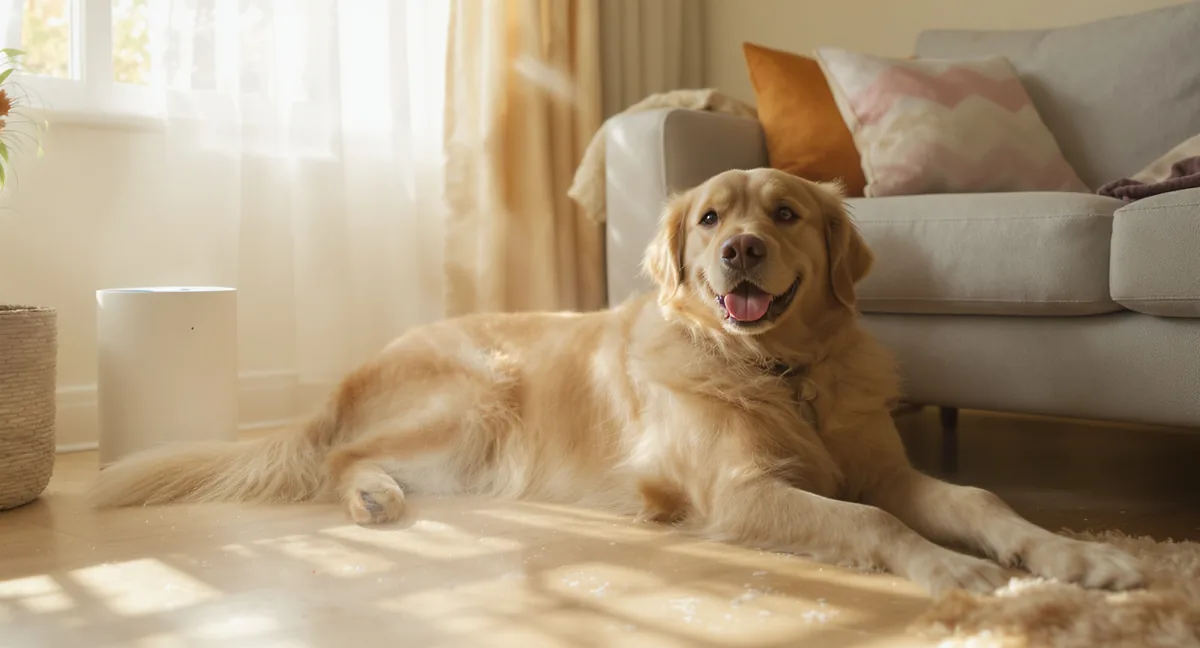
Living with pets means living with a constant stream of allergens that most people never see. Pet dander is not just fur or hair — it is microscopic flakes of skin protein that become airborne, cling to every surface, and trigger allergic reactions in roughly 30% of Americans with allergies. Cat allergens have been detected in homes that have never housed a cat, simply because visitors carried them in on their clothing.
This guide breaks down the science behind pet-related air quality problems and walks you through practical, room-by-room strategies to manage dander, odors, and allergens — whether you are a lifelong pet owner, a multi-pet household, or someone trying to coexist with allergies.
Key Takeaways
- 1Pet dander proteins (Fel d 1 from cats, Can f 1 from dogs) are 2.5-10 microns in size and remain airborne for hours — a True HEPA filter captures 99.97% of these particles before they settle on surfaces
- 2HEPA filtration alone does not address pet odors — you need an activated carbon filter to absorb volatile organic compounds from dander, saliva, urine, and litter boxes
- 3A washable pre-filter is essential in pet homes because pet hair clogs HEPA filters prematurely, reducing lifespan from 12 months to as few as 6 months without one
- 4Multi-pet households benefit more from two or three smaller purifiers placed strategically than a single large unit — focus on where pets sleep, litter box areas, and main living spaces
- 5Maintaining 40-50% indoor humidity helps keep dander from becoming airborne while preventing mold growth that compounds air quality issues in pet homes
Quick Answer
What is the best way to improve air quality in a home with pets?
Combine a True HEPA air purifier with an activated carbon filter and a washable pre-filter — HEPA captures dander particles, carbon absorbs odors, and the pre-filter catches hair before it clogs the main filter. Place the purifier in the room where your pet spends the most time, clean the pre-filter weekly, and complement it with regular vacuuming using a HEPA-equipped vacuum. For multi-pet homes, use multiple purifiers positioned near each pet's primary resting area rather than one large unit in the center of your home.
The Science of Pet Dander
Pet dander is not what most people think it is. It is not fur, and it is not hair. Dander consists of microscopic flakes of dead skin that every warm-blooded animal sheds continuously. What makes these tiny particles so problematic is the allergenic proteins they carry.
Cat allergens center around a protein called Fel d 1, produced primarily in the sebaceous glands and saliva. When cats groom themselves, they spread Fel d 1 across their fur. As their skin naturally sheds, these protein-coated flakes become airborne. Fel d 1 is remarkably persistent — it remains biologically active in indoor environments for months and has been detected at measurable levels in homes, schools, and offices that have never housed a cat. According to the National Institutes of Health, Fel d 1 particles are typically 2.5 microns in diameter, small enough to remain suspended in the air for extended periods and penetrate deep into the lungs when inhaled.
Dog allergens are dominated by a protein called Can f 1, found in saliva, dander, and urine. Dogs produce allergens differently than cats — a significant portion comes from saliva that dries on the fur and flakes off as the coat sheds. Dog dander particles tend to be slightly larger than cat dander, ranging from 5 to 10 microns, which means they settle faster but are still easily disturbed by foot traffic, vacuuming, or the dog itself moving around the room.
Why dander behaves differently from dust. Regular household dust settles relatively quickly. Pet dander, because of its irregular shape and low mass, stays airborne far longer. It also carries an electrostatic charge that causes it to cling tenaciously to upholstery, clothing, walls, and ductwork. This combination of airborne persistence and surface adhesion is why pet allergens accumulate so rapidly and why simply cleaning surfaces is never enough to control them. You need active air filtration to capture particles while they are suspended.
Where Pet Odors Actually Come From
Pet odor is a separate problem from dander, and it requires a separate solution. Understanding the sources helps you target them effectively.
Dander itself has a smell. The same skin oils that carry allergenic proteins also produce a distinctive odor as they oxidize. This is the baseline "pet smell" that builds up gradually in homes with animals — it is subtle day-to-day but immediately noticeable to visitors.
Saliva and grooming residue contribute significantly to both cat and dog odors. When saliva dries on fur and then becomes airborne as the coat sheds, it carries volatile organic compounds that contribute to the overall scent. Dog saliva in particular contains bacteria that produce odor-causing compounds as they break down organic material.
Urine and litter boxes are the most concentrated odor sources in pet homes. Cat urine contains urea, which breaks down into ammonia — a sharp, persistent gas that standard air filtration struggles to remove. Litter boxes compound the problem by creating a moist environment where bacteria thrive, producing additional volatile compounds. Even well-maintained litter boxes emit a detectable ammonia plume that spreads throughout the surrounding area.
Wet dog smell has a specific chemical explanation. Dog fur harbors naturally occurring yeasts and bacteria. When fur gets wet, water displaces volatile compounds that these microorganisms produce, releasing them into the air all at once. The result is a concentrated burst of micro-organic volatile compounds — the unmistakable "wet dog" smell that can linger for hours.
Why HEPA Alone Is Not Enough for Pets
True HEPA filters excel at capturing particles — they remove 99.97% of airborne particles at 0.3 microns, which includes all pet dander. But pet ownership creates a three-part air quality challenge that requires a three-part solution.
HEPA handles dander but not odors. Gaseous odor compounds are molecular-scale — far too small for HEPA's physical fiber mesh to capture. A HEPA-only purifier will reduce your allergen load significantly, but your home will still smell like pets.
Activated carbon handles odors. Carbon filtration works through adsorption, a chemical process where gas molecules bond to the carbon's surface. Quality activated carbon filters effectively absorb the volatile organic compounds responsible for pet odors, including ammonia from urine and the bacterial byproducts in wet dog smell. The amount of carbon matters — a thin carbon sheet does very little, while a substantial carbon bed provides meaningful odor reduction.
Pre-filters protect your investment. Pet hair and large dander clumps will clog a HEPA filter months ahead of schedule if they reach it directly. A washable pre-filter acts as a first line of defense, capturing hair and large particles before they reach the HEPA and carbon stages. In a pet home, cleaning the pre-filter weekly can double the effective life of your main filters.
The ideal pet-home purifier combines all three stages: a washable pre-filter for hair and large particles, True HEPA for dander and fine allergens, and activated carbon for odors. All four purifiers recommended below include this complete three-stage approach.
Best Air Purifiers for Pet Owners
Best Smart Value for Pet Owners: Levoit Core 400S
The Levoit Core 400S earns the top spot for pet owners thanks to its strong filtration, smart features, and excellent price. Its True HEPA H13 filter and activated carbon layer address all three pillars of pet air quality: hair, dander, and odors. With 256 CADR, 403 sq. ft. coverage, and a laser PM2.5 sensor that drives an intelligent auto mode, it adapts to the fluctuations in particle levels that are constant in pet homes — a dog shaking off after a walk, a cat grooming on the couch, or a litter box in use.
What sets the Core 400S apart is its smart integration. The VeSync app provides real-time PM2.5 readings, historical air quality charts, and schedule-based automation. You can set it to ramp up during high-activity hours and run quiet overnight. Alexa and Google Assistant voice control adds hands-free convenience when you are settled in with pets on the couch.
Customer reviews consistently praise its quiet operation at 24 dB on low — quiet enough that noise-sensitive dogs and cats are unbothered. The auto mode responds quickly when air quality drops, which reviewers note happens noticeably when cooking or when pets are active. At $181.95, it is one of the best values in the smart purifier category.
Best Premium Pick: Rabbit Air MinusA2
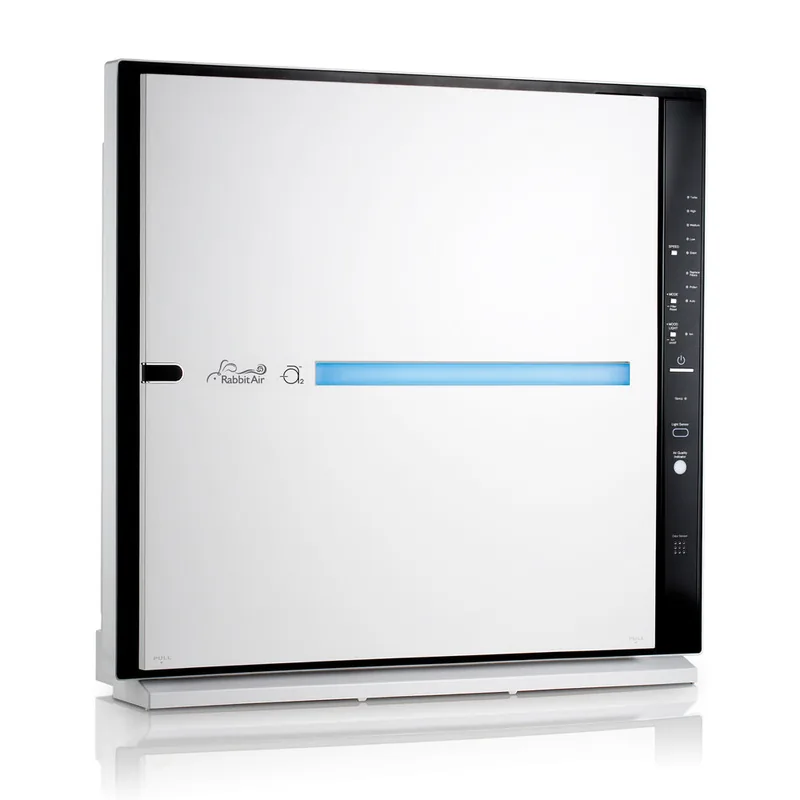
The Rabbit Air MinusA2 offers something no other purifier in this list does: a customizable filter panel specifically designed for pet allergens. When ordering, you choose from specialized filter modules — the Pet Allergy filter targets Fel d 1 and Can f 1 proteins with enhanced adsorption media that goes beyond standard HEPA.
The 5-stage filtration system (pre-filter, medium filter, BioGS HEPA, customized filter, and charcoal-based carbon filter) is the most thorough pet-air solution available. Its wall-mountable design keeps the unit off the floor and away from curious pets, and at 20.8 dB on its lowest setting, it is nearly silent.
The tradeoff is price. At $608.99, it costs more than twice the Levoit Vital 200S. But the 18-24 month filter lifespan partially offsets the upfront cost, and for allergy sufferers in multi-cat or multi-dog homes, reviewers consistently report that the MinusA2 delivers a noticeable difference compared to standard HEPA-and-carbon purifiers.
Best Budget for Pet Owners: Levoit Vital 200S
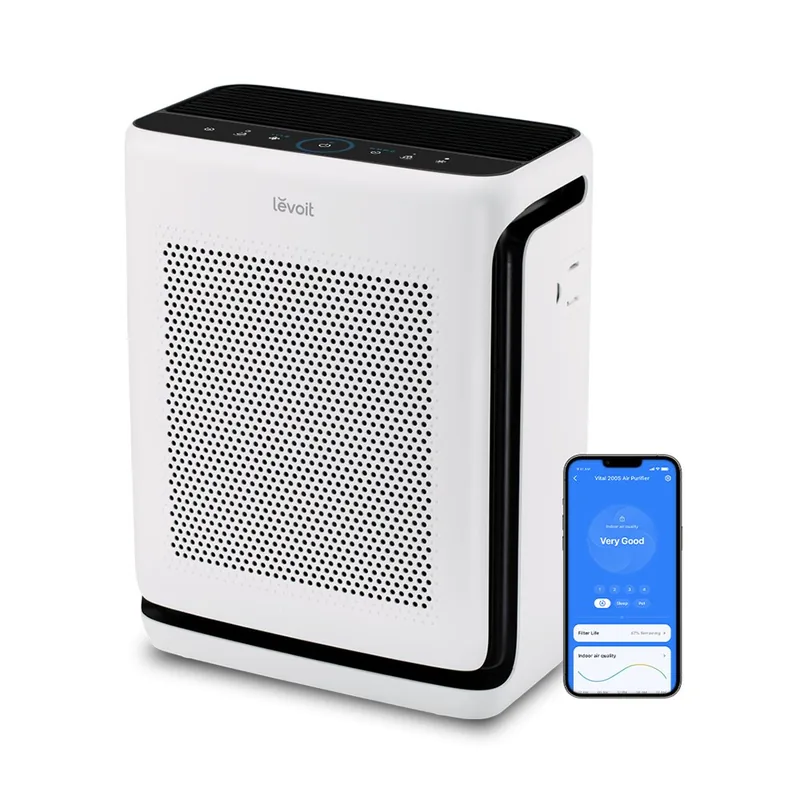
At $169.99, the Levoit Vital 200S delivers strong value for pet owners. Its standout feature is a dedicated Pet Mode accessible through the VeSync app, which increases fan speed and filtration intensity to handle the higher particle loads that pets generate. The PM2.5 laser sensor powering the auto mode detects real-time changes in air quality — reviewers note that it responds within seconds when a cat uses the litter box or a dog comes in from outside.
The side air intake design means you can place the Vital 200S flat against a wall without sacrificing airflow, which is a practical advantage in rooms where floor space competes with pet beds, food bowls, and scratching posts.
With coverage up to 380 sq. ft. and True HEPA H13 filtration, it handles bedrooms and mid-size living rooms comfortably. The 23 dB low setting is quiet enough for a pet's sleeping area. For multi-pet households, two Vital 200S units ($340 total) can cover separate zones more effectively than a single premium purifier.
Side-by-Side Comparison
The Winix 5510 ($179.99) deserves mention for pet owners specifically because of its PlasmaWave technology, which breaks down odor-causing compounds at a molecular level — a meaningful advantage for persistent pet smells that carbon alone cannot fully resolve. Its washable carbon pre-filter also keeps ongoing costs lower than competitors. One important caveat: if you have pet birds, disable PlasmaWave entirely, as birds have extremely sensitive respiratory systems and trace ozone levels can be harmful.
Room-by-Room Strategy for Pet Homes
The most effective approach to pet air quality is not one big purifier in the center of the house — it is strategic placement in the rooms that matter most.
Where Your Pet Sleeps
This is your highest priority. Pets shed the most dander while resting because prolonged contact with bedding creates friction that releases skin particles. Place a purifier within 6-8 feet of your pet's bed or preferred sleeping spot, with the intake facing toward the sleeping area. If your pet sleeps in your bedroom, position the purifier between the pet bed and your own bed to create a clean-air zone where you breathe.
Litter Box Area
The litter box is the most concentrated odor source in any cat home. Position a purifier with a strong carbon filter within 8-10 feet of the litter box, but not so close that the fan disturbs the litter. The Levoit Vital 200S works well here — its side intake and compact footprint fit into the bathroom or laundry room corners where litter boxes typically live, and the Pet Mode handles the ammonia spikes that occur after use.
Main Living Space
This is where you, your pets, and your guests spend the most time together. A purifier with higher CADR works best here to handle the continuous dander generation from pet activity. The Levoit Core 400S with its 256 CADR and 403 sq. ft. coverage handles living rooms and open kitchens well, and its auto mode responds to real-time particle changes from pet activity. Place it on the floor — pet dander is heavier than typical dust and concentrates in the lower 3 feet of a room.
Entryway or Mudroom
If your dog goes outside regularly, the entryway is where outdoor allergens (pollen, mold spores) arrive on the coat. A smaller purifier near the entry catches the initial burst of particles that occur when a dog shakes off. This also reduces the amount of outdoor allergens that make it deeper into your home.
Multi-Pet Households: Scaling Your Approach
Each additional pet multiplies your dander and odor load, but the relationship is not linear — two cats do not produce exactly twice the allergens of one. The allergen load increases at a diminishing rate because some particles overlap and settle on each other. That said, multi-pet homes face meaningfully higher air quality challenges.
Two to three pets: A single high-CADR purifier in your main living space plus a budget unit near the primary sleeping or litter area will handle most situations. The Levoit Core 400S paired with a Levoit Vital 200S ($272 total) covers both needs.
Four or more pets: Consider a purifier in every room where pets spend significant time. Three Levoit Vital 200S units ($270 total) can cover a bedroom, a living room, and a litter box area more effectively than a single premium unit, because localized filtration captures particles closer to the source.
Multiple species (dogs and cats together): Dogs and cats produce different allergen profiles. Cat allergens are smaller and stay airborne longer, while dog allergens are larger and settle faster but re-launch easily with activity. This combination makes a pre-filter even more critical — dog hair will clog a HEPA filter rapidly if it is not caught first.
Maintenance in Pet Homes
Pet homes require more aggressive purifier maintenance than pet-free environments. Cutting corners on maintenance means your purifier's effectiveness drops long before the filter indicator light tells you.
Pre-filter: clean weekly. Pet hair accumulates on pre-filters fast. Remove the pre-filter every 7 days, shake it out or rinse it (if washable), and let it dry completely before reinstalling. Neglecting this step forces hair through to the HEPA filter, shortening its lifespan by 30-50%.
HEPA filter: inspect monthly, replace earlier if needed. Manufacturer timelines assume average household conditions. In homes with multiple pets, HEPA filters may need replacement at 6-8 months instead of the rated 12 months. Visual inspection helps — if the filter appears uniformly gray and airflow feels noticeably weaker, it is time to replace regardless of what the indicator says.
Carbon filter: replace on schedule or sooner. Carbon filters have a finite adsorption capacity. Once the carbon is saturated, it stops absorbing odors entirely — there is no gradual decline, just a point where it stops working. If you notice pet odors returning despite the purifier running, the carbon filter is likely spent. In homes with litter boxes or multiple dogs, plan on replacing carbon filters at the shorter end of the manufacturer's recommended range.
Vacuum around the purifier weekly. Pet hair collects near purifier intakes like lint around a dryer vent. Vacuuming the area around and behind the purifier prevents hair from being pulled into the intake and clogging the pre-filter faster than normal.
Living with Pet Allergies: Strategies for Coexistence
The question allergists hear most often is: "Do I have to get rid of my pet?" For most people, the answer is no — but it requires a comprehensive approach that goes beyond simply buying an air purifier.
Create an allergen-free zone. Designate at least one room — ideally the bedroom — as a pet-free space. Keep the door closed and run a HEPA purifier continuously. This gives your immune system 8 hours of low-allergen recovery time during sleep, which can dramatically reduce daytime symptoms.
Wash hands after petting. Fel d 1 and Can f 1 transfer readily from animal fur to your hands and then to your eyes, nose, and mouth. Washing hands with soap and water after contact reduces allergen transfer to mucous membranes where reactions occur.
Bathe pets regularly. Bathing dogs weekly and cats every 4-6 weeks (if tolerated) can reduce airborne allergen levels by 40-80%, according to research published in the Journal of Allergy and Clinical Immunology. The effect is temporary — allergen levels return to baseline within a few days — but consistent bathing keeps levels lower on average.
Use HEPA vacuum cleaners. A standard vacuum recirculates fine dander particles through its exhaust, making the air quality worse immediately after vacuuming. A vacuum with a sealed HEPA filtration system captures and retains dander particles instead of redistributing them. Vacuum upholstered furniture, pet beds, and rugs at least twice a week.
Wash pet bedding weekly in hot water. Temperatures above 130 degrees Fahrenheit denature allergen proteins and kill dust mites that feed on dander. Washing pet beds, blankets, and removable couch covers weekly in hot water significantly reduces the allergen reservoir in your home.
Consider hard flooring. Carpet acts as a dander reservoir, trapping allergens deep in the fibers where vacuuming removes only the surface layer. Hard flooring (wood, tile, laminate) allows dander to be wiped up completely rather than embedded. If removing carpet is not practical, frequent steam cleaning helps reduce embedded allergens.
Humidity Control for Pet Owners
Humidity plays a dual role in pet air quality that many owners overlook.
Too dry (below 30% RH): Low humidity causes pet skin to dry out and shed more dander. It also makes existing dander lighter and more likely to become airborne. Winter heating season often drops indoor humidity below 25%, which is why many pet owners notice their allergies worsen in winter despite spending less time outdoors.
Too humid (above 50% RH): High humidity promotes dust mite populations and mold growth — both of which compound pet allergen problems. Dust mites feed on pet dander, so pet homes already provide an abundant food source; adding moisture creates ideal breeding conditions.
The target range is 40-50% relative humidity. A hygrometer (available for under $10) helps you monitor levels. Use a humidifier in winter dry months and a dehumidifier in humid summers to stay within range. This sweet spot minimizes dander generation while discouraging dust mites and mold.
Sources & References
- Asthma and Allergy Foundation of America — Pet Allergies — Overview of pet allergen proteins, prevalence data, and management recommendations for pet allergy sufferers
- National Institutes of Health — Indoor Allergens — Research on Fel d 1, Can f 1 proteins and their persistence in indoor environments
- U.S. EPA — Guide to Air Cleaners in the Home — EPA guidance on portable air cleaner effectiveness for residential allergen and particulate control
- American College of Allergy, Asthma and Immunology — Pet Allergy Management — Clinical guidance on living with pet allergies, including environmental control strategies and allergen reduction techniques
- Journal of Allergy and Clinical Immunology — Airborne Concentrations of Allergens — Peer-reviewed research on airborne allergen particle sizes, behavior, and reduction strategies in domestic settings
This guide was researched and written by the AirQualityNest editorial team. We update our content regularly to reflect the latest products, pricing, and research.
Frequently Asked Questions
Can I keep my pet if I have pet allergies?+
In most cases, yes. A combination of HEPA air purification, allergen-free bedroom zones, regular pet bathing, HEPA vacuuming, and surface cleaning can reduce allergen exposure enough for many allergy sufferers to coexist comfortably with their pets. Consult an allergist about immunotherapy (allergy shots or sublingual tablets), which can reduce sensitivity to pet allergens over time. Complete allergen elimination is not necessary — reducing exposure below your symptom threshold is the practical goal.
Do air purifiers remove pet odors?+
HEPA filters alone do not remove odors — they capture particulate matter like dander and hair but cannot trap gaseous odor compounds. You need an activated carbon filter to adsorb the volatile organic compounds responsible for pet smells. Look for purifiers with substantial carbon beds rather than thin carbon sheets. The Levoit Core 400S and Rabbit Air MinusA2 both include carbon filtration effective enough to noticeably reduce pet odors in customer reviews.
How often should I clean my air purifier pre-filter if I have pets?+
Weekly. Pet hair accumulates on pre-filters much faster than in pet-free homes. Remove the pre-filter, shake it out or rinse it (if washable), and let it dry completely before reinstalling. This single maintenance step can extend your HEPA filter's lifespan by 30-50% and maintain proper airflow. If you have multiple pets or heavy-shedding breeds, every 5 days is even better.
Is one large air purifier better than multiple small ones for a multi-pet home?+
Multiple smaller purifiers placed strategically outperform a single large unit in most pet homes. Dander and odors concentrate near their sources — where pets sleep, litter boxes, and entryways. A purifier positioned close to each source captures particles before they spread throughout the house. Two Levoit Vital 200S units at $180 total cover more ground effectively than most single units at twice the price.
Are air purifiers safe for dogs, cats, and birds?+
HEPA air purifiers using mechanical filtration are completely safe for dogs and cats. However, if you have pet birds, avoid any purifier with ionization, PlasmaWave, UV-C, or ozone-producing features. Birds have extremely sensitive respiratory systems — even trace ozone levels that are harmless to mammals can be dangerous to birds. Stick to pure mechanical HEPA filtration for bird-safe operation.
Related Reading
Best Air Purifiers for Pet Hair
Our top picks ranked for pet hair and dander removal
Best Air Purifier for Pets
Detailed comparison of the best purifiers for dog and cat owners
What Is a HEPA Filter?
How HEPA filtration works and why it matters for pet dander
How to Reduce Dust in Your Home
Practical strategies that complement air purification in pet homes
Activated Carbon Filters Explained
Why carbon filtration is essential for pet odor control
Continue Reading

Best Air Purifiers for Open Floor Plans in 2026: High-CADR Models That Cover It All
The best air purifiers for open floor plans ranked by CADR, coverage area, and noise. High-performance HEPA purifiers that handle 500-1,500+ sq. ft. open spaces.
Best Smart Humidifiers in 2026 (Wi-Fi, App Control & Auto Humidity)
The best smart humidifiers with Wi-Fi, app control, and auto humidity adjustment. Top picks for Alexa, Google Home, and smart home integration.
The 5 Best Portable Air Quality Monitors in 2026
Monitor your air quality on the go. We tested the best portable and compact air quality monitors for accuracy, battery life, and sensor range.