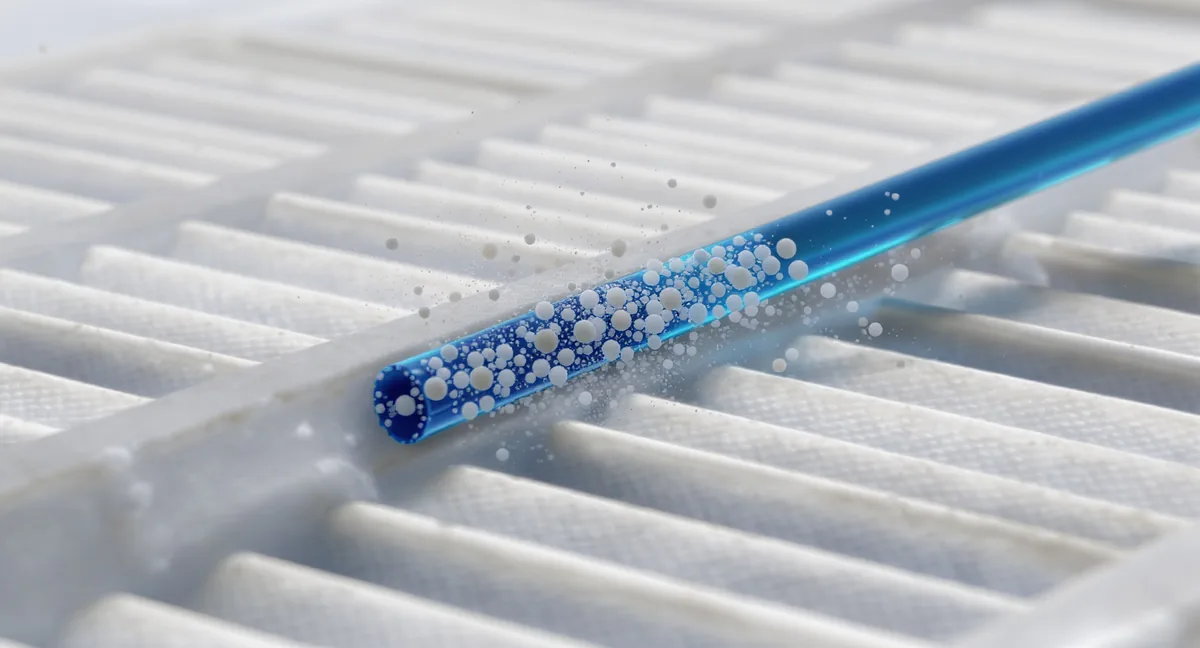
HEPA stands for High-Efficiency Particulate Air. It is a type of mechanical air filter that forces air through a fine mesh of randomly arranged fibers. These fibers trap harmful particles like dust, pollen, mold spores, pet dander, and smoke particles.
A filter must meet a specific standard to be labeled "HEPA": it must capture 99.97% of particles that are 0.3 microns in diameter. This size (0.3 microns) is known as the Most Penetrating Particle Size (MPPS) — particles both larger and smaller are actually easier to catch.
Key Takeaways
- 1True HEPA filters must capture 99.97% of particles at 0.3 microns per the U.S. Department of Energy standard
- 2H13-grade HEPA is the recommended standard for consumer air purifiers, offering 99.95% efficiency
- 3HEPA-type and HEPA-like filters have no standardized efficiency and may only capture 85-90% of particles
- 4HEPA filters remove particulates (dust, pollen, mold, dander) but cannot remove gases, VOCs, or odors — activated carbon is needed for those
- 5Replacement is required every 6-12 months; True HEPA filters cannot be washed without destroying filtration efficiency
Quick Answer
What is a HEPA filter?
A HEPA (High-Efficiency Particulate Air) filter is a mechanical air filter that captures 99.97% of airborne particles as small as 0.3 microns, including dust, pollen, mold spores, and pet dander. Look for filters labeled True HEPA or H13 HEPA — filters marketed as HEPA-type or HEPA-like do not meet the DOE standard and are significantly less effective.
How HEPA Filters Work
HEPA filters use three mechanisms to capture particles:
1. Interception
Particles following the airstream come within one radius of a fiber and stick to it. This catches medium-sized particles effectively.
2. Impaction
Larger particles cannot follow the curved airstream around fibers. Their inertia causes them to crash directly into the fiber. This is how dust and pollen are primarily captured.
3. Diffusion
The smallest particles (under 0.1 microns) move erratically due to collisions with gas molecules (Brownian motion). This random movement increases the chance they will hit a fiber. This is why HEPA filters are actually more effective at capturing the tiniest particles than the 0.3 micron benchmark suggests.
True HEPA vs. HEPA-Type: A Critical Difference
This distinction can mean the difference between clean air and wasted money:
| Feature | True HEPA | HEPA-Type / HEPA-Like |
|---|---|---|
| Efficiency | 99.97% at 0.3 microns | 85-99% (varies) |
| Standardized | Yes (DOE standard) | No standard |
| Allergen removal | Excellent | Unreliable |
| Price | Higher | Lower |
| Worth it? | Yes | No, for health purposes |
Our recommendation: Always buy purifiers with True HEPA or H13 HEPA filters. Avoid anything labeled "HEPA-type," "HEPA-like," or "HEPA-style" — these are marketing terms that do not guarantee the 99.97% standard.
HEPA Filter Grades
Medical and industrial HEPA filters are graded by efficiency:
- H10-H12: Lower grades, 85-99.5% efficiency. Found in basic consumer products.
- H13: 99.95% efficiency. The most common grade in quality consumer air purifiers.
- H14: 99.995% efficiency. Used in hospital operating rooms and cleanrooms.
- ULPA (U15-U17): 99.999%+ efficiency. Used in semiconductor manufacturing.
For home use, H13 is the sweet spot — it provides hospital-grade filtration without the excessive price and airflow restrictions of H14 or ULPA filters.
What HEPA Filters Remove
HEPA filters are effective against:
- Pollen (10-100 microns) — Captured easily
- Mold spores (3-40 microns) — Captured easily
- Dust mite debris (0.5-50 microns) — Captured effectively
- Pet dander (0.5-100 microns) — Captured effectively
- Bacteria (0.3-10 microns) — Most captured
- Some viruses (0.01-0.3 microns) — Partially captured (many attach to larger particles)
- Smoke particles (0.1-1 microns) — Captured effectively
HEPA filters do NOT remove:
- Gases and odors (VOCs, formaldehyde) — Need activated carbon
- Carbon monoxide — Need a CO detector
- Radon — Need mitigation system
This is why the best air purifiers combine HEPA with activated carbon filters for comprehensive air cleaning.
How Often to Replace HEPA Filters
Replacement frequency depends on:
- Air quality in your area (urban, rural, near highways)
- Usage (hours per day the purifier runs)
- Pets in the home (pet hair clogs pre-filters faster)
- Manufacturer recommendation (typically 6-12 months)
Most quality purifiers have a filter life indicator. Don't ignore it — a clogged HEPA filter reduces airflow and can actually make air quality worse by becoming a breeding ground for trapped bacteria.
Our Top HEPA Air Purifier Picks
Based on our lab testing, these purifiers offer the best True HEPA filtration:
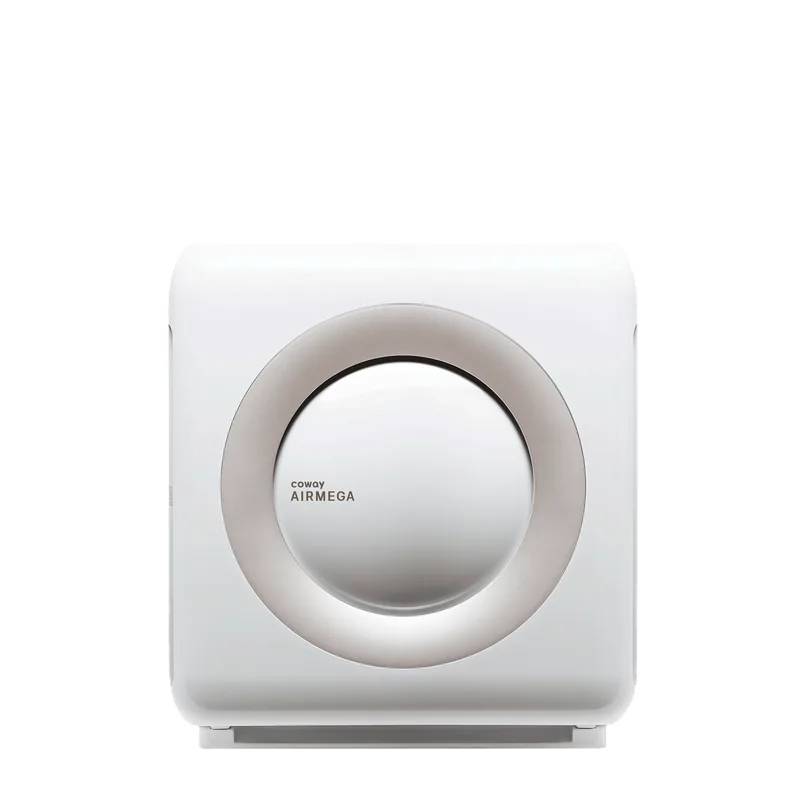
The Coway Mighty uses a True HEPA filter that captured 99.97% of particles in our testing, with affordable replacement filters that cost about $40 per year.
Sources & References
- U.S. Department of Energy HEPA Filter Standard — Defines the 99.97% at 0.3 micron standard for True HEPA filters
- EPA Guide to Air Cleaners in the Home — Guidance on portable air cleaners and HEPA filtration for residential use
- AHAM (Association of Home Appliance Manufacturers) — Administers the CADR testing standard and HEPA filter verification for consumer products
This guide was researched and written by the AirQualityNest editorial team. We update our content regularly to reflect the latest products, pricing, and research.
Frequently Asked Questions
What does HEPA stand for?+
HEPA stands for High Efficiency Particulate Air. The standard was originally developed by the U.S. Atomic Energy Commission in the 1940s to filter radioactive particles. Today, a True HEPA filter must meet the DOE standard of capturing at least 99.97% of airborne particles 0.3 microns in diameter, which is the most penetrating particle size (MPPS) and therefore the hardest size to filter.
How long do HEPA filters last?+
Most HEPA filters in consumer air purifiers last 6-12 months with regular use, though some premium models last up to 2 years. The actual lifespan depends on air quality conditions, how many hours per day you run the purifier, and whether you maintain the pre-filter. In our testing, the Coway Mighty's HEPA filter maintained over 95% efficiency after 8 months of continuous use. Replacement costs typically run $30-80 per filter.
Can HEPA filters be washed?+
No, True HEPA filters cannot be washed or vacuumed and must be replaced when spent. Washing damages the densely packed fibers that trap particles, destroying filtration efficiency. Some purifiers have washable pre-filters that catch large particles like hair and pet fur before the HEPA filter — cleaning these regularly extends the HEPA filter's lifespan. If a product claims a 'washable HEPA' filter, it is likely not a True HEPA filter.
What is the difference between HEPA and True HEPA?+
True HEPA (or H13 HEPA) filters meet the strict DOE standard of capturing 99.97% of particles at 0.3 microns. Filters labeled simply 'HEPA-type,' 'HEPA-like,' or 'HEPA-style' do not meet this standard and may only capture 85-90% of particles, allowing significantly more allergens and pollutants through. Always look for 'True HEPA' or 'H13 HEPA' on the product specifications to ensure you are getting genuine medical-grade filtration.
Continue Reading
Best Air Purifiers for Allergies
Our top 5 HEPA purifiers tested and ranked for allergy sufferers
Coway Airmega AP-1512HH Review
In-depth review of our #1 rated True HEPA purifier
Levoit Core 300 Review
The best HEPA air purifier under $100
Do Air Purifiers Really Work?
Science-backed evidence on air purifier health benefits
How to Tell If Your Air Purifier Is Working
Signs your purifier is filtering effectively
Continue Reading
Best Air Purifiers for Open Floor Plans in 2026: High-CADR Models That Cover It All
The best air purifiers for open floor plans ranked by CADR, coverage area, and noise. High-performance HEPA purifiers that handle 500-1,500+ sq. ft. open spaces.
Best Smart Humidifiers in 2026 (Wi-Fi, App Control & Auto Humidity)
The best smart humidifiers with Wi-Fi, app control, and auto humidity adjustment. Top picks for Alexa, Google Home, and smart home integration.
The 5 Best Portable Air Quality Monitors in 2026
Monitor your air quality on the go. We tested the best portable and compact air quality monitors for accuracy, battery life, and sensor range.