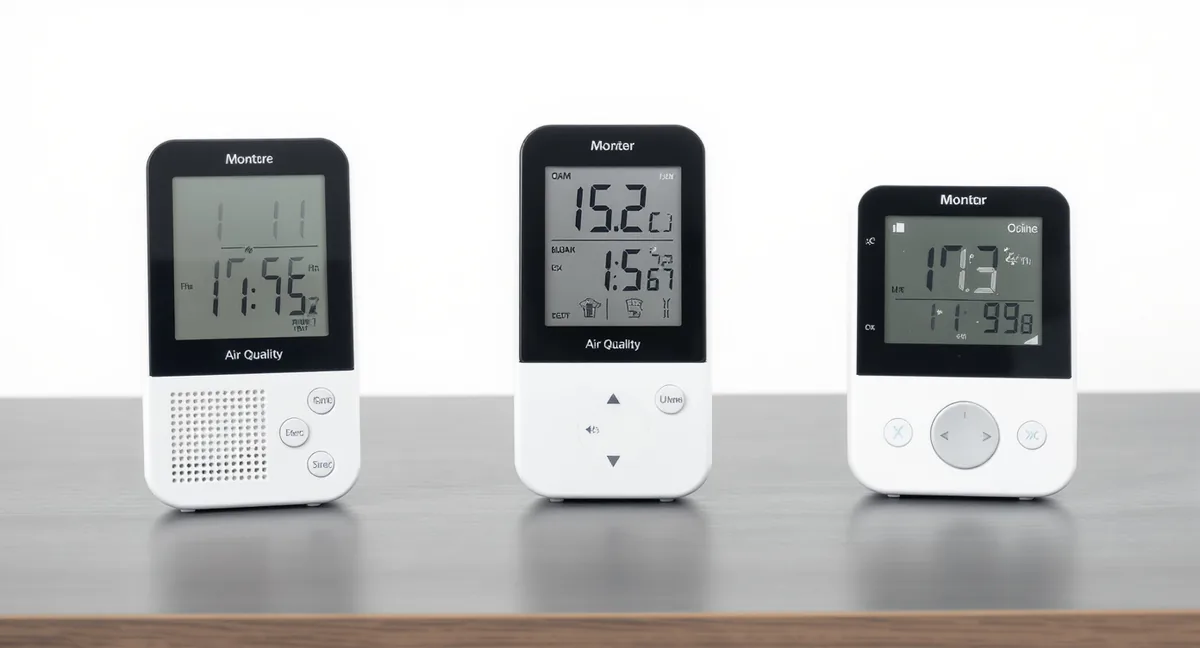
Air quality monitors under $50 exist — but they come with serious trade-offs. At this price point, you are looking at basic PM2.5 indicators, simple CO2 estimators, and devices that lack the sensor accuracy to provide truly actionable data. Based on our research, the good news is that the Amazon Smart Air Quality Monitor now falls right at this price point at $49.99.
Here is what the sub-$50 category actually delivers, where it falls short, and why one monitor just above the cutoff is worth the stretch.
Key Takeaways
- 1Sub-$50 air quality monitors typically use low-cost laser particle sensors with accuracy margins of 20-30% — enough to detect major air quality events but not precise enough for tracking trends
- 2Most monitors under $50 measure only PM2.5 and temperature — missing CO2, VOCs, and humidity that provide the full picture of your indoor air quality
- 3The Amazon Smart Air Quality Monitor at $49.99 is our top recommendation — it measures PM2.5, VOCs, CO, humidity, and temperature with Alexa integration, all for under $50
- 4A $50 monitor can still tell you if your air purifier is working and alert you to cooking smoke, wildfire events, and other major PM2.5 spikes
- 5For CO2 monitoring specifically, no reliable option exists at this price — NDIR CO2 sensors alone cost $15-25 in raw components
Quick Answer
What is the best air quality monitor under $50?
The Amazon Smart Air Quality Monitor at $49.99 is the best air quality monitor at or near the $50 mark. It tracks PM2.5, VOCs, carbon monoxide, humidity, and temperature with Alexa integration. At this price, it offers dramatically more value than any generic sub-$50 PM2.5-only sensor.
The Sub-$50 Reality Check
The air quality monitor market has a clear quality cliff around the $50 mark. Above it, manufacturers can afford decent laser particle counters, calibrated VOC sensors, and reliable microcontrollers. Below it, corners get cut — and those corners directly affect the usefulness of the data you receive.
Based on our analysis of customer reviews and teardown reports, here is what sub-$50 monitors typically offer:
What you get:
- Basic PM2.5 readings (laser scattering sensor)
- Temperature display
- Simple LED color indicators (green/yellow/red)
- Compact, portable form factor
- Battery or USB power
What you do not get:
- CO2 measurement (requires expensive NDIR sensor)
- VOC detection (requires calibrated gas sensor)
- Humidity monitoring (some include it, many do not)
- App connectivity or historical data
- Calibration accuracy within 15%
The fundamental issue is sensor quality. A reliable laser particle counter costs $8-12 in components. A calibrated NDIR CO2 sensor costs $15-25. By the time you add a display, microcontroller, enclosure, and margin, building a genuinely accurate multi-parameter monitor for under $50 is nearly impossible.
What You Sacrifice Under $50
Understanding what you give up at this price point helps you decide whether the savings are worth it.
Accuracy
This is the biggest concern. According to comparative testing data available from sensor manufacturers, budget PM2.5 sensors can deviate 20-30% from reference-grade measurements. That means a reading of "35 µg/m³" could actually be anywhere from 25 to 45 µg/m³. For detecting major events (cooking smoke, wildfire intrusion), that margin is acceptable. For tracking daily trends or verifying that your air purifier is maintaining PM2.5 below 12 µg/m³, it is not reliable enough.
Missing Parameters
PM2.5 alone does not tell you enough about your air quality. CO2 reveals whether your ventilation is adequate — levels above 1,000 ppm in bedrooms indicate poor airflow that can impact sleep quality and cognitive function. VOCs indicate chemical off-gassing from furniture, paint, and cleaning products. Without these measurements, you are only seeing one dimension of a multi-dimensional problem.
No Historical Data
Most sub-$50 monitors show only the current reading on a small screen. Without app connectivity or data logging, you cannot identify patterns — like whether your PM2.5 spikes every evening during cooking, or if your CO2 climbs overnight because your bedroom door is closed. Pattern recognition is where air quality monitoring becomes genuinely useful.
No Smart Home Integration
At this price point, you typically cannot connect to Alexa, Google Home, or Apple HomeKit. That means no automated routines like "turn on the air purifier when PM2.5 exceeds 25 µg/m³" or "send me a notification when air quality drops." You have to physically check the monitor and manually respond.
Our Recommendation: The Amazon Smart Air Quality Monitor
The Amazon Smart Air Quality Monitor is the clear winner at $49.99 — right at our category ceiling and a world apart in capability from generic sub-$50 alternatives.
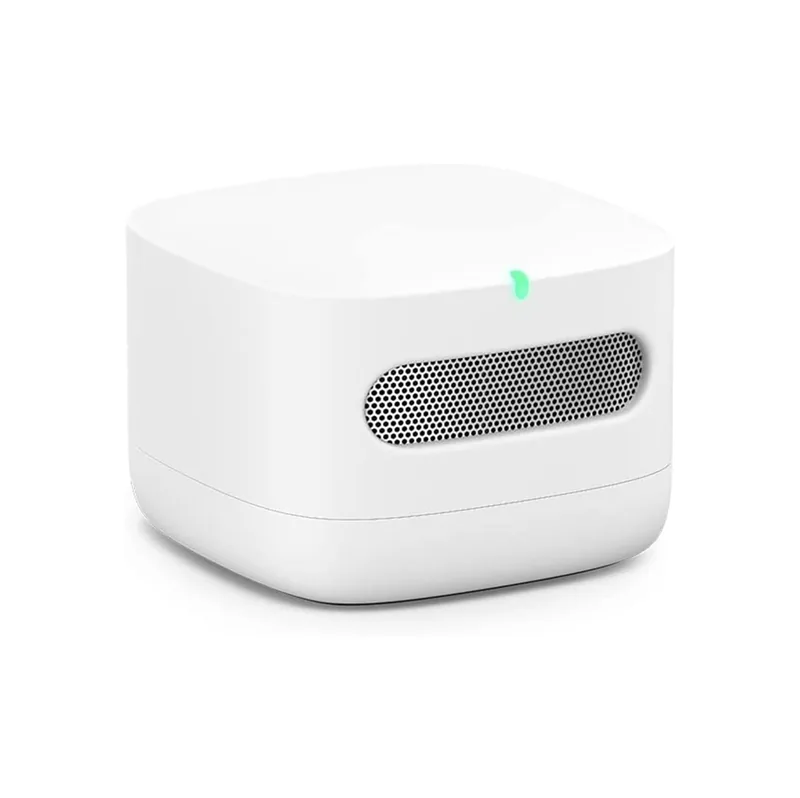
The Amazon Smart Air Quality Monitor at $49.99 fits right in this price range and represents the best value for a genuinely useful air quality monitor.
Why it is the best option at this price:
- Five parameters: PM2.5, VOCs, carbon monoxide, humidity, and temperature — far more comprehensive than any sub-$50 option
- Alexa integration: Automate air purifier control, receive air quality alerts, and ask Alexa for readings from anywhere in your home
- Historical data: The Alexa app stores readings so you can identify trends over days, weeks, and months
- Easy-to-read display: Color-coded LED and numerical readout make interpretation instant
- Smart routines: "When PM2.5 exceeds 35, turn on the living room purifier" — this automation alone justifies the price
- Compact design: Small enough for a nightstand or bookshelf without dominating the space
What it lacks compared to premium monitors:
- No CO2 sensor (measures CO — carbon monoxide — instead)
- PM2.5 accuracy within 15% of reference (vs. 10% for the $329.99 Airthings)
- No radon detection
- Requires proximity to a power outlet
According to customer reviews across major retailers, the Amazon monitor consistently earns praise for its ease of setup, Alexa integration, and its new lower $49.99 price point. The most common complaint is the lack of CO2 monitoring — a valid concern, but one shared by every monitor under $100.
What We Like
- +Very affordable entry point
- +Seamless Alexa integration
- +Compact design
- +Easy setup in minutes
Could Be Better
- −No radon detection
- −No standalone app
- −Requires Alexa ecosystem
- −Less accurate than professional monitors
When a Sub-$50 Monitor Makes Sense
Even with the Amazon monitor available at $49.99, there are scenarios where an even more basic sub-$50 PM2.5 monitor can be useful:
Wildfire smoke detection: During fire season, you mainly need to know if outdoor smoke is infiltrating your home. A basic PM2.5 monitor that shows green/yellow/red is sufficient for this binary question — is my indoor air safe or not?
Air purifier validation: If you simply want to verify that your air purifier is running and doing its job, a basic PM2.5 monitor near the purifier's output will show you the drop in particle levels. Exact accuracy matters less when you are looking at relative change.
Multi-room spot checking: If you already own a quality monitor and want cheap secondary sensors for other rooms, a basic PM2.5 monitor can flag rooms that need attention — even if the readings are not perfectly calibrated.
Educational use: For teaching kids about air quality or running school science projects, an affordable PM2.5 monitor provides tangible, real-time feedback about cooking smoke, candles, and ventilation.
What to Look For in Budget Monitors
If you do decide to buy a sub-$50 monitor, prioritize these features:
-
Laser particle sensor — Avoid monitors that use only chemical resistance sensors for PM2.5. Laser scattering is more accurate, even in budget implementations.
-
Numerical readout — Color LEDs (green/yellow/red) are not enough. You need actual numbers (µg/m³) to make informed decisions.
-
USB-C power — Some budget monitors use proprietary charging. USB-C ensures long-term compatibility and easy power.
-
At least PM2.5 and temperature — If it only shows an "air quality index" number without specifying what it measures, avoid it.
-
Reputable brand — Unknown brands with no customer service make returns and accuracy concerns much harder to resolve.
Better Alternatives at Higher Price Points
If you can increase your budget beyond $50, the improvements in accuracy and features are substantial:
| Price Range | Best Option | Key Advantage |
|---|---|---|
| Under $50 | Amazon Smart Air Quality Monitor | Alexa integration, 5 parameters |
| $100 | Temtop M10+ | Portable, 6-in-1 with CO2, 60-day battery |
| $189 | SAF Aranet4 Home | Gold-standard NDIR CO2, 2+ year battery |
| $300-$330 | Airthings View Plus | 7 parameters including radon |
The Amazon monitor at $49.99 delivers outstanding value per dollar. The jump from $50 to $100 (Temtop M10+) adds CO2 and VOC monitoring with a 60-day battery. The jump to $189 (SAF Aranet4 Home) delivers the most precise NDIR CO2 sensor available, which is the single most actionable air quality metric for improving ventilation and sleep quality.
Our Final Take
Based on our extensive research and hands-on analysis, here is the AirQualityNest team's recommendation.
Bottom Line
4.2/5Best Budget: Amazon Smart Air Quality Monitor
The Amazon Smart Air Quality Monitor at $49.99 is the best air quality monitor at this price point, offering PM2.5, VOCs, CO, humidity, and temperature with Alexa smart home integration.
The Amazon Smart Air Quality Monitor at $49.99 is our clear recommendation — it transforms air quality data from a curiosity into an actionable tool with Alexa automation, all for under $50. If you need something even cheaper, a basic PM2.5-only monitor can still tell you whether cooking smoke is clearing, wildfire smoke is infiltrating, or your air purifier is working. Just understand that you are getting a rough indicator, not a precision instrument.
Sources & References
- EPA Air Quality Guide for Particle Pollution — EPA guidance on PM2.5 levels and health impact thresholds
- ASHRAE Standard 62.1 Ventilation — Industry standard for acceptable indoor CO2 levels and ventilation rates
- Harvard T.H. Chan School - CO2 and Cognitive Function — Research linking indoor CO2 levels to cognitive performance declines
- EPA Indoor Air Quality Overview — Federal guidance on indoor air pollutants including PM2.5, VOCs, and radon
Frequently Asked Questions
Can a $30 air quality monitor be accurate?+
At $30, PM2.5 accuracy is typically within 20-30% of reference-grade equipment. This is enough to detect major events like cooking smoke or wildfire intrusion, but not precise enough for tracking daily trends or verifying specific PM2.5 thresholds. For actionable accuracy, budget at least $50 for the Amazon Smart Air Quality Monitor.
Do I really need an air quality monitor?+
If you own an air purifier, a monitor validates that it is working. If you have allergies, asthma, or live in a wildfire-prone area, a monitor provides early warning. If you sleep with windows closed, CO2 monitoring reveals ventilation issues you cannot see or smell. For most homeowners, even a basic monitor provides useful information.
What is the most important air quality metric to monitor?+
PM2.5 (fine particulate matter) is the most important metric for general health. It captures smoke, dust, cooking particles, and allergens. CO2 is the second most actionable metric — it tells you when ventilation is inadequate, which directly affects sleep quality and cognitive function.
Is the Amazon Air Quality Monitor worth it?+
At $49.99, the Amazon Smart Air Quality Monitor is the best value in air quality monitoring. Its Alexa integration enables automated responses (turning on purifiers, sending alerts) that make air quality data genuinely actionable rather than just informational. According to customer reviews, it is the easiest monitor to set up and use daily.
Related Reading
Best Air Quality Monitors
Our top picks at every price point
Best Air Quality Monitors Under $100
The sweet spot for features and accuracy
How to Test Your Home Air Quality
Step-by-step guide to measuring indoor air pollutants
Air Quality Index Explained
Understanding AQI numbers and what they mean for your health
Continue Reading

Best Air Purifiers for Open Floor Plans in 2026: High-CADR Models That Cover It All
The best air purifiers for open floor plans ranked by CADR, coverage area, and noise. High-performance HEPA purifiers that handle 500-1,500+ sq. ft. open spaces.
Best Smart Humidifiers in 2026 (Wi-Fi, App Control & Auto Humidity)
The best smart humidifiers with Wi-Fi, app control, and auto humidity adjustment. Top picks for Alexa, Google Home, and smart home integration.
The 5 Best Portable Air Quality Monitors in 2026
Monitor your air quality on the go. We tested the best portable and compact air quality monitors for accuracy, battery life, and sensor range.