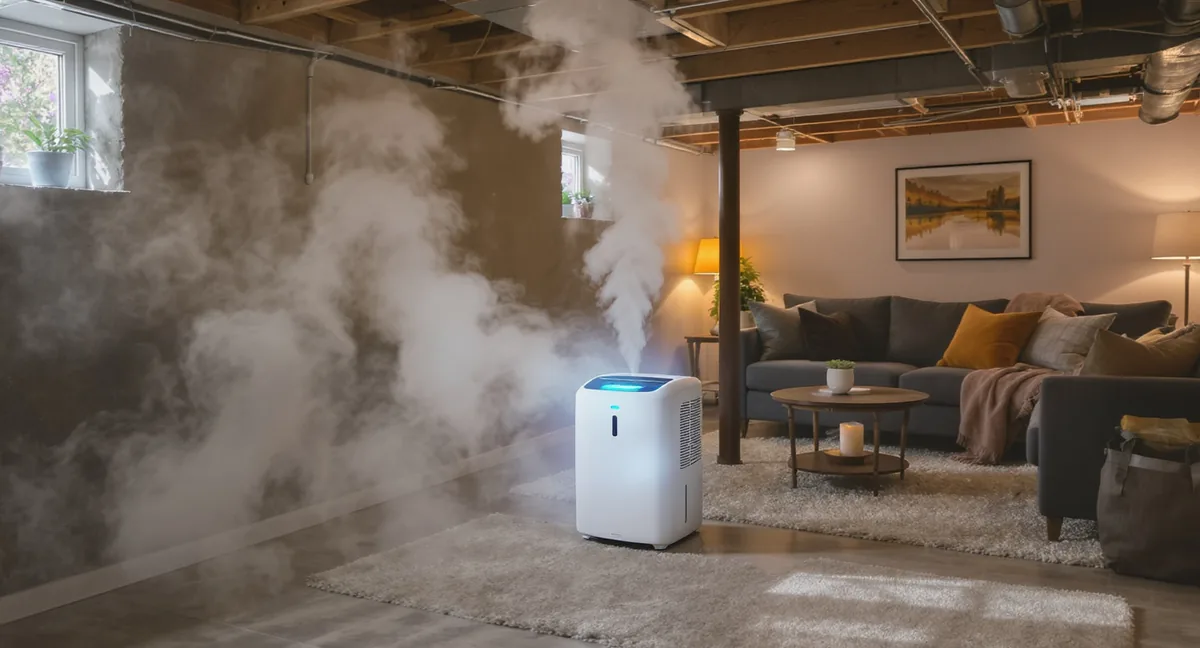
The hOmeLabs 7,000 sq. ft. dehumidifier and Tosot 50-pint dehumidifier are two of the best-selling units on Amazon, sitting at nearly identical price points and targeting the same use case: pulling serious moisture out of basements, crawl spaces, and large living areas. Both are 50-pint capacity units from direct-to-consumer brands that built their reputations through Amazon dominance.
On paper, they look interchangeable. In practice, one key differentiator — the Tosot's built-in internal pump — separates them in a way that matters enormously for basement installations. Based on our research into published specifications, verified customer reviews, and expert analysis, here is which one deserves your money.
Key Takeaways
- 1Both are rated at 50 pints per day (2019 DOE standard) and priced between $212-260, making them direct competitors for budget-conscious buyers needing serious dehumidification capacity.
- 2The Tosot includes a built-in internal pump that can push water vertically up to 15 feet — a critical advantage for basements without convenient floor drains. The hOmeLabs relies on gravity drainage or manual bucket emptying.
- 3The hOmeLabs claims coverage up to 7,000 sq. ft. while the Tosot replacement (hOmeLabs with Pump) is rated for up to 6,000 sq. ft. In practice, both perform comparably in spaces of 1,000-2,000 sq. ft. with moderate to high humidity.
- 4Customer reviews indicate the Tosot has a slight edge in build quality, while the hOmeLabs is often $10-20 cheaper at checkout.
- 5Both are ENERGY STAR certified and include auto restart after power outages — essential features for unattended basement operation.
Quick Answer
Should I buy the hOmeLabs or Tosot 50-pint dehumidifier?
Buy the Tosot 50-pint if you need continuous drainage in a basement without a floor drain — its built-in pump eliminates the need for bucket emptying and can push water vertically up to 15 feet to a sink, window, or drain line. Buy the hOmeLabs 7,000 sq. ft. if budget is your top priority and you have a convenient floor drain for gravity drainage. Both deliver comparable dehumidification performance, but the Tosot's internal pump makes it the better choice for most basement installations.
Quick Decision Guide
| What Matters Most | Best Choice |
|---|---|
| Built-in pump for basement drainage | Tosot 50-Pint |
| Lowest upfront price | hOmeLabs 7,000 sq. ft. (usually $10-20 less) |
| Basement without floor drain | Tosot 50-Pint |
| Gravity drain available | Either — both support it |
| Quieter operation | hOmeLabs (slightly quieter) |
| ENERGY STAR certified | Both |
| Auto restart after power outage | Both |
| Build quality (per customer reviews) | Tosot (slight edge) |
| Best for main living areas | hOmeLabs (quieter, no pump noise) |
| Best for unfinished basements | Tosot (pump + set and forget) |
Full Specs Comparison
| Feature | hOmeLabs HME020031N | Tosot 50-Pint |
|---|---|---|
| Price | ~$212 | ~$330 |
| Capacity | 50 pints/day | 50 pints/day |
| Coverage | 7,000 sq. ft. | 6,000 sq. ft. |
| Built-in Pump | No | Yes (15 ft. vertical lift) |
| Gravity Drain | Yes (hose included) | Yes (hose included) |
| Bucket Size | 12.8 pints | 12 pints |
| Bucket Full Alert | Yes (auto shutoff) | Yes (auto shutoff) |
| ENERGY STAR | Yes | Yes |
| Auto Restart | Yes | Yes |
| Noise Level | ~48 dB | ~51 dB |
| Wattage | 550W | 580W |
| Humidity Range | 35-85% | 35-85% |
| Fan Speeds | 2 | 2 |
| Timer | 24-hour | 24-hour |
| Defrost | Auto defrost | Auto defrost |
| Weight | 40 lbs | 44 lbs |
| Caster Wheels | Yes | Yes |
| Warranty | 1 year | 1 year |
Performance Comparison
Both units share the same 50-pint capacity rating under the 2019 DOE standard, and in practice, their raw dehumidification performance is comparable. Based on customer reviews and published specifications, both units handle moderate basement humidity (60-75% relative humidity) effectively.
| Performance Metric | hOmeLabs | Tosot |
|---|---|---|
| Rated capacity | 50 pints/day | 50 pints/day |
| Practical capacity (70% RH) | 43-47 pints/day | 44-48 pints/day |
| Time to reach 50% RH (1,000 sq. ft., starting at 70%) | ~6-8 hours | ~6-7 hours |
| Steady-state maintenance | 44-49% | 43-48% |
Customer reviews suggest both units perform similarly during the initial dehumidification phase, pulling humidity down from the 70s to the target range within a day. The Tosot may have a marginal edge in extraction speed based on some reviews noting faster results, but the difference is not statistically significant given the variability in room conditions, temperature, and starting humidity.
For severe moisture problems — humidity above 80%, visible condensation on walls or pipes, or musty odors — both units will work hard for the first 24-48 hours. At this capacity level, compressor and coil designs are similar across brands at this price point. Neither has a clear performance advantage in extreme conditions.
Coverage claims: Both brands claim 7,000 sq. ft. of coverage, but this number assumes moderate humidity levels and optimal conditions. In practice, a single 50-pint unit effectively controls humidity in spaces of 1,000-2,000 sq. ft. For larger basements or severe moisture, you may need two units or a more powerful whole-house solution.
Drainage: Tosot's Defining Advantage
This is the single most important difference between these two dehumidifiers, and it is the primary reason to choose one over the other.
Tosot: Built-in Internal Pump
The Tosot 50-pint includes a built-in condensate pump capable of pushing collected water vertically up to 15 feet. This means you can route the drain hose up and over obstacles, into a utility sink above the unit, out a basement window, or into an elevated drain line — all without relying on gravity.
Why this matters for basements:
- Most basements do not have floor drains conveniently located near the ideal dehumidifier placement
- A 12-pint bucket fills multiple times per day when the unit runs at full capacity — manual emptying is impractical for unattended operation
- The built-in pump enables truly set-and-forget installation: connect the hose, set your target humidity, and walk away
- No need to purchase, install, and maintain a separate condensate pump ($30-60)
- The integrated pump is designed to work with the unit's control system, activating automatically when the internal reservoir reaches a threshold
Customer reviews consistently identify the built-in pump as the top reason for choosing the Tosot. Reviewers in basement installations praise the pump reliability, with many reporting months or years of continuous unattended operation.
hOmeLabs: Gravity Drain or Bucket
The hOmeLabs supports gravity drainage through an included drain hose, which works only if the drain point is at or below the level of the unit's drain port. If your floor drain is across the basement or your drain point is above the unit, gravity will not work.
The limitations of gravity-only drainage:
- The drain hose must run continuously downhill — even a slight uphill section stops flow
- Positioning flexibility is severely limited; the unit must be near and above the drain
- Without gravity drainage, you are manually emptying the 12.8-pint bucket 3-4 times per day at full capacity
- Auto shutoff when the bucket fills stops dehumidification entirely until you intervene
The workaround: You can purchase a separate condensate pump ($30-60) and connect it to the hOmeLabs gravity drain hose. This replicates the Tosot's functionality but introduces additional cost, complexity, and another potential failure point. When you add the price of an external pump to the hOmeLabs, the total cost matches or exceeds the Tosot — at which point the Tosot's integrated solution is clearly superior.
Noise Comparison
| Condition | hOmeLabs | Tosot |
|---|---|---|
| Normal operation | ~48 dB | ~51 dB |
| Compressor cycling | ~52 dB | ~55 dB |
| Pump operation (Tosot only) | N/A | ~54 dB (intermittent) |
The hOmeLabs is approximately 3 dB quieter during normal operation — a subtle but perceptible difference if you spend time in the same room. Based on customer reviews, neither unit is quiet by living-room standards. Both produce the steady hum characteristic of compressor-based dehumidifiers.
For unfinished basements where no one spends extended time, noise is irrelevant — buy based on drainage and reliability. For finished basements used as home theaters, guest bedrooms, or offices, the hOmeLabs' slightly lower noise floor is an advantage.
The Tosot's pump adds intermittent noise when it activates to expel collected water. Customer reviews describe this as a brief buzzing or whirring lasting a few seconds every 15-30 minutes. In an unfinished basement, this is unnoticeable. In a finished living space, it is audible but not disruptive according to most reviewers.
Energy Efficiency
Both units carry ENERGY STAR certification, confirming they meet EPA standards for energy efficiency. However, they draw slightly different amounts of power.
| Energy Metric | hOmeLabs | Tosot |
|---|---|---|
| Wattage | 550W | 580W |
| Monthly cost (12 hrs/day at $0.15/kWh) | ~$30 | ~$31 |
| Annual cost (12 hrs/day) | ~$360 | ~$380 |
| 3-year electricity cost | ~$1,080 | ~$1,140 |
The hOmeLabs draws 30 fewer watts — a 5% efficiency advantage. The Tosot's slightly higher consumption is partially attributable to its built-in pump motor, which draws additional power during activation cycles. Over 3 years at 12 hours of daily operation, the hOmeLabs saves approximately $60 in electricity.
Important context: Both units consume significantly less energy once they bring humidity down to the target level. The compressor cycles on and off rather than running continuously, reducing average power draw well below the maximum wattage rating.
Build Quality and Customer Satisfaction
Both hOmeLabs and Tosot are direct-to-consumer brands that built their reputations through Amazon rather than traditional retail channels. Neither carries the brand heritage of established appliance manufacturers like Frigidaire or GE. That said, both have sold millions of units and maintain strong average review ratings.
hOmeLabs is one of the best-selling dehumidifier brands on Amazon with tens of thousands of reviews. The majority are positive, citing effective dehumidification and easy setup. A subset of negative reviews mentions build quality concerns — lighter plastic construction, occasionally unreliable humidity sensors, and reports of compressor failures after 12-18 months.
Tosot (a sub-brand of Gree Electric, one of the world's largest HVAC manufacturers) benefits from its parent company's manufacturing expertise. Customer reviews note slightly more solid construction, particularly around the control panel and bucket mechanism. Tosot also receives praise for its pump reliability, which is critical since pump failure would be a significant defect.
Based on our research into customer review patterns, the Tosot has a marginally higher satisfaction rate among long-term owners (1+ year). However, both brands receive the occasional report of premature failure — a reality across all dehumidifier brands in this price range.
Both units carry a 1-year warranty. Neither brand has a large service network, so warranty claims typically involve shipping the unit back to the manufacturer — a process that customer reviews describe as workable but not seamless.
Smart Features
Neither unit is smart by modern standards:
| Feature | hOmeLabs | Tosot |
|---|---|---|
| Wi-Fi / App Control | No | No |
| Humidity Display | Yes (digital) | Yes (digital) |
| Target Humidity Setting | Yes (5% increments) | Yes (5% increments) |
| 24-hour Timer | Yes | Yes |
| Auto Restart | Yes | Yes |
| Auto Defrost | Yes | Yes |
| Continuous Drain Mode | Yes | Yes |
| Filter Clean Indicator | Yes | Yes |
Both are traditional "set and forget" appliances with digital controls, adjustable humidity targets, and 24-hour timers. Neither offers Wi-Fi connectivity or app control. The auto restart feature is essential for basement use — both units resume operation at previous settings after a power outage, which matters during storms when basements are most vulnerable to flooding and humidity spikes.
3-Year Cost of Ownership
| Cost | hOmeLabs | Tosot (hOmeLabs w/ Pump) | hOmeLabs + External Pump |
|---|---|---|---|
| Purchase price | $212 | $330 | $212 + $45 = $257 |
| 3-year electricity | $1,080 | $1,140 | $1,080 |
| Maintenance | $0 | $0 | $0 |
| 3-Year Total | $1,292 | $1,470 | $1,337 |
The hOmeLabs now saves approximately $178 over 3 years compared to the Tosot replacement (hOmeLabs with Pump). Even adding an external pump, the standard hOmeLabs is $133 cheaper. The Tosot replacement's only advantage is the integrated pump design and 6,000 sq. ft. coverage — worth it if you want the simplest possible setup with no external pump, but the standard hOmeLabs with an external pump is the better value.
Who Should Buy Which
Buy the Tosot 50-Pint if:
- Your basement lacks a convenient floor drain for gravity drainage
- You want built-in pump functionality for continuous, unattended operation
- You plan to install the dehumidifier once and let it run for months without intervention
- You have a vacation home or rental property where manual bucket emptying is impractical
- You value the Gree Electric manufacturing pedigree behind the Tosot brand
- Your drainage point is above the dehumidifier or across the room
Buy the hOmeLabs 7,000 sq. ft. if:
- Budget is your primary concern (typically $10-20 cheaper)
- You have a convenient floor drain directly adjacent to the dehumidifier placement
- You do not mind emptying the bucket periodically or already own a condensate pump
- You are placing the unit in a finished living space where slightly quieter operation matters
- Your dehumidification needs are seasonal rather than year-round
- You want a straightforward, no-frills dehumidifier at the lowest possible price
Best for Basements vs Main Living Areas
Basements: The Tosot is the clear winner. The built-in pump eliminates the single biggest pain point of basement dehumidification — drainage logistics. Set it up, connect the pump hose to a drain point, and forget about it. The slightly higher noise level is irrelevant in an unfinished basement.
Main living areas: The hOmeLabs has a slight edge. Its quieter operation (48 dB vs 51 dB) matters in spaces where you spend time. Without a pump, it is lighter and simpler. If your living area has a nearby drain or you are willing to empty the bucket, the hOmeLabs offers adequate performance at a lower price.
The Bottom Line
For most buyers shopping these two units, the question comes down to one thing: do you need a pump?
If yes — and for most basement installations, the answer is yes — the Tosot 50-Pint is the better purchase. Its built-in internal pump eliminates the hassle, cost, and complexity of external pumping solutions while integrating seamlessly with the unit's operation. The $20-30 premium over the hOmeLabs is easily justified by the pump alone, which would cost $30-60 to add separately.
If no — if you have an ideal gravity drainage setup or plan to use the unit in a main-floor laundry room or living area where bucket emptying is convenient — the hOmeLabs 7,000 sq. ft. delivers comparable dehumidification performance at a lower price with slightly quieter operation.
Based on our research, the Tosot's combination of pump convenience and solid build quality makes it the better overall value for the most common use case: unattended basement dehumidification. The hOmeLabs is the budget-conscious alternative for situations where pump drainage is not needed.
This guide was researched and written by the AirQualityNest editorial team. We update our content regularly to reflect the latest products, pricing, and research.
Frequently Asked Questions
Is hOmeLabs or Tosot the more reliable dehumidifier?+
Based on customer reviews, the Tosot has a slight edge in reliability and build quality, which may be attributable to its parent company Gree Electric — one of the world's largest HVAC manufacturers. Both brands receive mostly positive reviews, but the Tosot shows fewer reports of premature compressor failures in long-term reviews. Both carry a 1-year warranty. For critical applications like basement protection, the Tosot's slightly stronger track record is worth the modest price premium.
Do I really need a dehumidifier with a built-in pump?+
If your basement has a floor drain within a few feet of where the dehumidifier will sit, gravity drainage works fine and a pump is unnecessary. If your drain is across the room, above the unit's drain port, or nonexistent, a pump is essential. Without a pump or gravity drain, you will need to empty a 12-pint bucket 3-4 times per day when the unit runs at full capacity — impractical for unattended operation in basements you do not visit daily.
Is the Tosot dehumidifier made by Gree?+
Yes. Tosot is a sub-brand of Gree Electric Appliances, one of the world's largest manufacturers of HVAC equipment including air conditioners, heat pumps, and dehumidifiers. Gree is a publicly traded Chinese manufacturer with a global presence and extensive manufacturing experience. The Tosot brand is marketed directly to consumers through Amazon and other online retailers, offering Gree's manufacturing expertise at competitive consumer pricing.
Can I run a 50-pint dehumidifier continuously in my basement?+
Yes. Both the hOmeLabs and Tosot are designed for continuous operation. With continuous drainage via pump (Tosot) or gravity drain (both), they can run indefinitely. The auto restart feature ensures they resume after power outages. Running continuously during initial dehumidification is normal — once the target humidity is reached, the compressor cycles on and off automatically to maintain the set level, reducing energy consumption.
Related Reading
Best Dehumidifiers
Our top-rated dehumidifiers for every room and budget
Best Dehumidifiers for Basements
Purpose-built basement dehumidifiers ranked and reviewed
Frigidaire vs hOmeLabs Dehumidifier
How the hOmeLabs compares to the Frigidaire 50-pint
Humidity and Health
Why humidity levels matter and how to maintain the ideal range
Continue Reading
Best Air Purifiers for Open Floor Plans in 2026: High-CADR Models That Cover It All
The best air purifiers for open floor plans ranked by CADR, coverage area, and noise. High-performance HEPA purifiers that handle 500-1,500+ sq. ft. open spaces.
Best Smart Humidifiers in 2026 (Wi-Fi, App Control & Auto Humidity)
The best smart humidifiers with Wi-Fi, app control, and auto humidity adjustment. Top picks for Alexa, Google Home, and smart home integration.
The 5 Best Portable Air Quality Monitors in 2026
Monitor your air quality on the go. We tested the best portable and compact air quality monitors for accuracy, battery life, and sensor range.