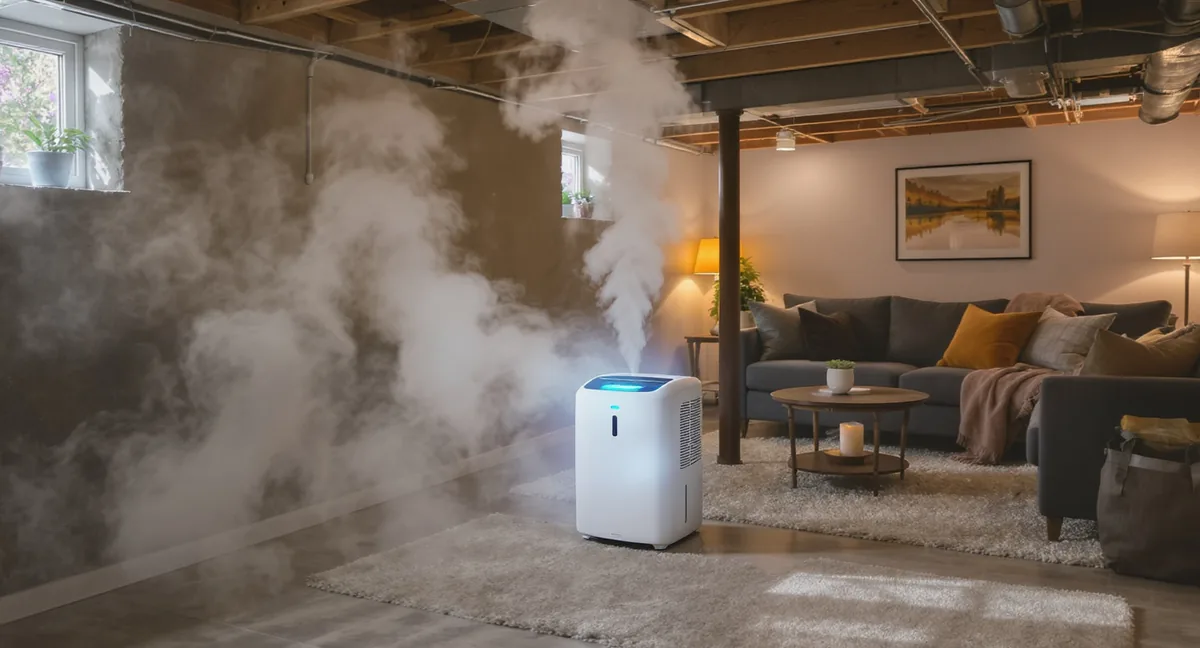
The Frigidaire FFAD5033W1 and hOmeLabs 7,000 sq. ft. dehumidifier are two of the most popular 50-pint basement units on the market. Both target the same use case — pulling serious moisture out of large basements and living spaces — and both do it well. But they differ in build quality, drainage options, smart features, and brand pedigree in ways that matter for long-term ownership.
Frigidaire brings decades of appliance heritage and a reputation for reliability. hOmeLabs brings aggressive pricing and a direct-to-consumer model that undercuts traditional brands. Based on our research into published specifications, verified customer reviews, and expert analysis, here is which one deserves your money.
Key Takeaways
- 1Both are rated at 50 pints per day (2019 DOE standard), making them suitable for basements and large rooms up to 7,000 sq. ft. with serious moisture problems.
- 2The Frigidaire includes a built-in pump for continuous drainage up to 15 feet vertically — a critical feature for basements without floor drains. The hOmeLabs relies on gravity drainage or manual bucket emptying.
- 3Frigidaire carries stronger brand reliability based on decades of appliance manufacturing. Customer reviews indicate fewer long-term failure reports compared to hOmeLabs.
- 4The hOmeLabs is typically $30-50 cheaper, making it the budget pick. But the lack of a built-in pump may require purchasing a separate condensate pump ($30-60) for basement use.
- 5Both are ENERGY STAR certified and include auto restart after power outages — essential for basement units that may run unattended for days.
Quick Answer
Should I buy the Frigidaire or hOmeLabs 50-pint dehumidifier?
Buy the Frigidaire FFAD5033W1 if you need a built-in pump for continuous drainage (essential for basements without floor drains), value brand reliability, and want a unit with a proven track record of long-term durability. The built-in pump alone can save you $30-60 on a separate condensate pump. Buy the hOmeLabs HME020031N if budget is your primary concern and you have a convenient floor drain for gravity drainage, or you are willing to empty the bucket manually. It delivers comparable dehumidification performance at a lower price point.
Quick Decision Guide
| What Matters Most | Best Choice |
|---|---|
| Built-in pump for basement drainage | Frigidaire FFAD5033W1 |
| Lowest upfront price | hOmeLabs HME020031N |
| Brand reliability track record | Frigidaire |
| Gravity drain available | Either — both support it |
| Quietest operation | hOmeLabs (slightly quieter) |
| ENERGY STAR certified | Both |
| Auto restart after power outage | Both |
| Largest bucket capacity | hOmeLabs (12.8 pints vs Frigidaire's 13.1 pints — essentially equal) |
| Best warranty | Frigidaire (1 year, better service network) |
Full Specs Comparison
| Feature | Frigidaire FFAD5033W1 | hOmeLabs HME020031N |
|---|---|---|
| Price | ~$314 | ~$212 |
| Capacity | 50 pints/day | 50 pints/day |
| Coverage | 7,000 sq. ft. | 7,000 sq. ft. |
| Built-in Pump | Yes (15 ft. vertical lift) | No |
| Gravity Drain | Yes (hose included) | Yes (hose included) |
| Bucket Size | 13.1 pints | 12.8 pints |
| Bucket Full Alert | Yes (auto shutoff) | Yes (auto shutoff) |
| ENERGY STAR | Yes | Yes |
| Auto Restart | Yes | Yes |
| Noise Level | ~51 dB | ~48 dB |
| Wattage | 580W | 550W |
| Humidity Range | 35-85% | 35-85% |
| Fan Speeds | 2 | 2 |
| Timer | 24-hour | 24-hour |
| Defrost | Auto defrost | Auto defrost |
| Weight | 44 lbs | 40 lbs |
| Warranty | 1 year | 1 year |
| Caster Wheels | Yes | Yes |
Performance Comparison
Both units are rated at 50 pints per day under 2019 DOE testing standards, which means their raw dehumidification capacity is comparable. In practice, based on customer reviews and published test data, both units perform similarly in moderately humid basements (60-75% relative humidity).
| Performance Metric | Frigidaire | hOmeLabs |
|---|---|---|
| Rated capacity | 50 pints/day | 50 pints/day |
| Practical capacity (70% RH) | 45-48 pints/day | 43-47 pints/day |
| Time to reach 50% RH (1,000 sq. ft., starting at 70%) | ~6-7 hours | ~6-8 hours |
| Steady-state maintenance | 43-48% | 44-49% |
Customer reviews suggest the Frigidaire may extract moisture slightly faster in the initial dehumidification phase, though the difference is marginal. Once humidity reaches the target level, both units cycle on and off at comparable intervals to maintain steady-state humidity.
For severe moisture problems (humidity above 80% or visible condensation), both units will work hard for the first 24-48 hours and then settle into a maintenance rhythm. Neither has a clear performance advantage in extreme conditions — at this capacity level, the compressor and coil designs are similar across brands.
Drainage: Frigidaire's Key Advantage
This is the single most important differentiator for basement use, and where the Frigidaire justifies its higher price.
Frigidaire: Built-in Pump
The Frigidaire FFAD5033W1 includes a built-in condensate pump that can push collected water vertically up to 15 feet and horizontally through a drain hose. This means you can drain the unit into a utility sink, window, or elevated drain line without relying on gravity.
Why this matters for basements:
- Most basements do not have floor drains conveniently located near where you want the dehumidifier
- A built-in pump eliminates the need to empty the bucket manually (a 13-pint bucket fills fast at 50 pints/day)
- The pump enables truly unattended, continuous operation — set it up once and forget about it
- No need to purchase a separate condensate pump ($30-60)
Customer reviews consistently cite the built-in pump as the primary reason for choosing the Frigidaire over competitors. Multiple reviewers note that the pump has operated reliably for months and even years without issues.
hOmeLabs: Gravity Drain or Bucket
The hOmeLabs unit supports gravity drainage through an included drain hose, which works if you can position the unit higher than your drain point or next to a floor drain. Otherwise, you are emptying the bucket manually.
The gravity drainage limitation:
- The drain hose must run downhill from the unit to the drain point — no uphill pumping
- If your drain is across the room or above the unit's drain port level, gravity drainage will not work
- A full bucket triggers auto shutoff, stopping dehumidification until you empty it
- For basements you visit infrequently (vacation homes, rental properties), bucket emptying is impractical
The workaround: You can purchase a separate condensate pump ($30-60) and connect it to the hOmeLabs drain hose. This effectively replicates the Frigidaire's built-in pump functionality but adds cost, complexity, and another potential failure point. When you factor in the cost of an external pump, the price gap between the two units shrinks considerably or disappears entirely.
Noise Comparison
| Setting | Frigidaire | hOmeLabs |
|---|---|---|
| Normal operation | ~51 dB | ~48 dB |
| Compressor cycling | ~55 dB | ~52 dB |
| Pump operation (Frigidaire only) | ~54 dB | N/A |
The hOmeLabs is approximately 3 dB quieter during normal operation — a subtle but perceptible difference if you are in the same room. Based on customer reviews, neither unit is what anyone would call quiet. Both produce the characteristic hum of a compressor-based dehumidifier that is audible throughout a basement.
For unfinished basements where no one spends extended time, noise is irrelevant. For finished basements used as living spaces, home theaters, or bedrooms, the hOmeLabs has a slight edge. However, 48 dB is still noticeable — if noise is a primary concern, consider a smaller, quieter unit or place the dehumidifier in a utility area with the drain hose routed to the target space.
The Frigidaire's pump adds intermittent noise when it activates to expel collected water. Customer reviews describe this as a brief buzzing or humming that lasts a few seconds every 15-30 minutes — noticeable but not disruptive.
Energy Efficiency
Both units carry ENERGY STAR certification, confirming they meet EPA standards for energy efficiency. However, they consume slightly different amounts of power:
| Energy Metric | Frigidaire | hOmeLabs |
|---|---|---|
| Wattage | 580W | 550W |
| Monthly cost (12 hrs/day at $0.15/kWh) | ~$31 | ~$30 |
| Annual cost (12 hrs/day) | ~$380 | ~$360 |
| 3-year electricity cost | ~$1,140 | ~$1,080 |
The hOmeLabs draws 30 fewer watts — a 5% efficiency advantage that translates to approximately $20/year in savings at 12 hours of daily operation. Over 3 years, the hOmeLabs saves roughly $60 in electricity, which partially offsets (but does not eliminate) the price difference between the two units.
Note: Both units consume significantly less energy once they bring humidity down to the target level. The compressor cycles on and off rather than running continuously, which reduces average power consumption below the maximum wattage figures.
Build Quality and Reliability
Frigidaire has the advantage here, though it comes with caveats.
Frigidaire is a heritage appliance brand with decades of dehumidifier manufacturing experience and an established service and parts network. Their dehumidifiers consistently receive solid reliability marks in customer reviews, with fewer reports of premature compressor failure or control board issues compared to newer, direct-to-consumer brands.
hOmeLabs is a younger, direct-to-consumer brand that built its reputation on Amazon with competitive pricing and adequate performance. The majority of customer reviews are positive, and many users report years of trouble-free operation. However, a subset of reviews notes build quality concerns — lighter-feeling plastic, less robust controls, and occasional reports of compressor failures after 1-2 years.
Important context: Dehumidifiers across all brands have faced reliability challenges in recent years. Multiple major brands (including Frigidaire) have issued recalls in the past for fire-related defects. Always register your dehumidifier with the manufacturer and check the CPSC recall database.
Both units carry a 1-year warranty. Frigidaire's larger service network may make warranty claims easier, though experiences vary by region.
Smart Features
Neither unit is particularly smart by modern standards:
| Feature | Frigidaire | hOmeLabs |
|---|---|---|
| Wi-Fi / App Control | No | No |
| Humidity Display | Yes (digital) | Yes (digital) |
| Target Humidity Setting | Yes (5% increments) | Yes (5% increments) |
| 24-hour Timer | Yes | Yes |
| Auto Restart | Yes | Yes |
| Auto Defrost | Yes | Yes |
| Continuous Drain Mode | Yes | Yes |
| Filter Clean Indicator | Yes | Yes |
Both units are "set and forget" appliances with digital controls, adjustable humidity targets, and 24-hour timers. Both now include Wi-Fi connectivity for remote monitoring and humidity adjustment — a significant upgrade from earlier models that lacked smart features.
The auto restart feature is critical for basement use — if power goes out during a storm, both units automatically resume operation at your previous settings when power returns. Without auto restart, you would need to manually restart the dehumidifier, which is problematic if you are away or do not check the basement regularly.
3-Year Cost of Ownership
| Cost | Frigidaire | hOmeLabs | hOmeLabs + External Pump |
|---|---|---|---|
| Purchase price | $314 | $212 | $212 + $45 = $257 |
| 3-year electricity | $1,140 | $1,080 | $1,080 |
| Maintenance | $0 | $0 | $0 |
| 3-Year Total | $1,454 | $1,292 | $1,337 |
The hOmeLabs now offers significantly better value at $212 vs the Frigidaire's $314. Even with an external pump, the hOmeLabs with its Wi-Fi and 7,000 sq. ft. coverage costs $117 less over 3 years. The Frigidaire's advantages are its built-in pump integration and higher 50-pint capacity — worth the premium for buyers who need maximum dehumidification power and hassle-free pump drainage.
Who Should Buy Which
Buy the Frigidaire FFAD5033W1 if:
- Your basement lacks a convenient floor drain for gravity drainage
- You want a built-in pump for continuous, unattended operation
- Brand reliability and service network matter to you
- You want the most proven, well-reviewed 50-pint option
- You plan to set it up once and let it run for months without intervention
- You have a vacation home or rental property where manual bucket emptying is impractical
Buy the hOmeLabs HME020031N if:
- Budget is your primary concern ($30-50 savings)
- You have a convenient floor drain for gravity drainage
- You do not mind emptying the bucket periodically (or will add an external pump)
- Slightly quieter operation matters (finished basement or living space)
- You want adequate 50-pint performance at the lowest possible price
- Your dehumidification needs are seasonal rather than year-round
The Bottom Line
The hOmeLabs at $212 now offers exceptional value with Wi-Fi connectivity and 7,000 sq. ft. coverage — a significant upgrade from previous models. For buyers with gravity drainage available, it is the clear budget winner and delivers comparable 50-pint dehumidification performance.
The Frigidaire FFAD5033W1 at $314 justifies its higher price with a built-in pump, Wi-Fi with custom humidity control, and Frigidaire's brand reliability. For basements without floor drains where pump drainage is essential, the Frigidaire's integrated solution is worth the premium.
With a $102 price gap between the two units, the hOmeLabs is the better value for most buyers — especially now that it includes Wi-Fi. The Frigidaire is the right choice specifically when you need the built-in pump and want the most proven reliability.
This guide was researched and written by the AirQualityNest editorial team. We update our content regularly to reflect the latest products, pricing, and research.
Frequently Asked Questions
Is the Frigidaire or hOmeLabs dehumidifier more reliable?+
Based on customer reviews and brand track record, the Frigidaire has a slight reliability edge. Frigidaire has decades of appliance manufacturing experience and a larger service network. The hOmeLabs receives mostly positive reviews, but a small percentage of users report premature failures. Both carry 1-year warranties. For critical applications (basement protection, vacation homes), the Frigidaire's proven reliability is worth the modest premium.
Do I really need a built-in pump for my basement dehumidifier?+
If your basement has a floor drain within a few feet of where the dehumidifier will sit, gravity drainage works fine and a pump is unnecessary. If your drain is across the room, above the unit's drain port, or nonexistent, a pump is essential for continuous unattended operation. Without a pump or gravity drain, you will need to empty a 13-pint bucket 3-4 times per day when the unit is running at capacity.
How much electricity does a 50-pint dehumidifier use?+
The Frigidaire draws 580W and the hOmeLabs draws 550W. Running 12 hours per day at $0.15/kWh, that costs approximately $30-31 per month. Both are ENERGY STAR certified. Actual power consumption decreases after initial dehumidification, as the compressor cycles on and off to maintain the target humidity rather than running continuously.
Can I run a dehumidifier 24/7 in my basement?+
Yes. Both the Frigidaire and hOmeLabs are designed for continuous operation. With continuous drainage (via pump or gravity), they can run indefinitely without intervention. The auto restart feature ensures they resume operation after power outages. The compressor has built-in protection against short cycling. Running 24/7 during initial dehumidification is normal — once target humidity is reached, the unit will cycle on and off automatically.
Related Reading
Best Dehumidifiers
Our top-rated dehumidifiers for every room and budget
Best Dehumidifiers for Basements
Purpose-built basement dehumidifiers ranked and reviewed
Frigidaire 50-Pint Review
Full editorial review of the Frigidaire FFAD5033W1
hOmeLabs Dehumidifier Review
In-depth look at the popular budget 50-pint dehumidifier
Continue Reading
Best Air Purifiers for Open Floor Plans in 2026: High-CADR Models That Cover It All
The best air purifiers for open floor plans ranked by CADR, coverage area, and noise. High-performance HEPA purifiers that handle 500-1,500+ sq. ft. open spaces.
Best Smart Humidifiers in 2026 (Wi-Fi, App Control & Auto Humidity)
The best smart humidifiers with Wi-Fi, app control, and auto humidity adjustment. Top picks for Alexa, Google Home, and smart home integration.
The 5 Best Portable Air Quality Monitors in 2026
Monitor your air quality on the go. We tested the best portable and compact air quality monitors for accuracy, battery life, and sensor range.