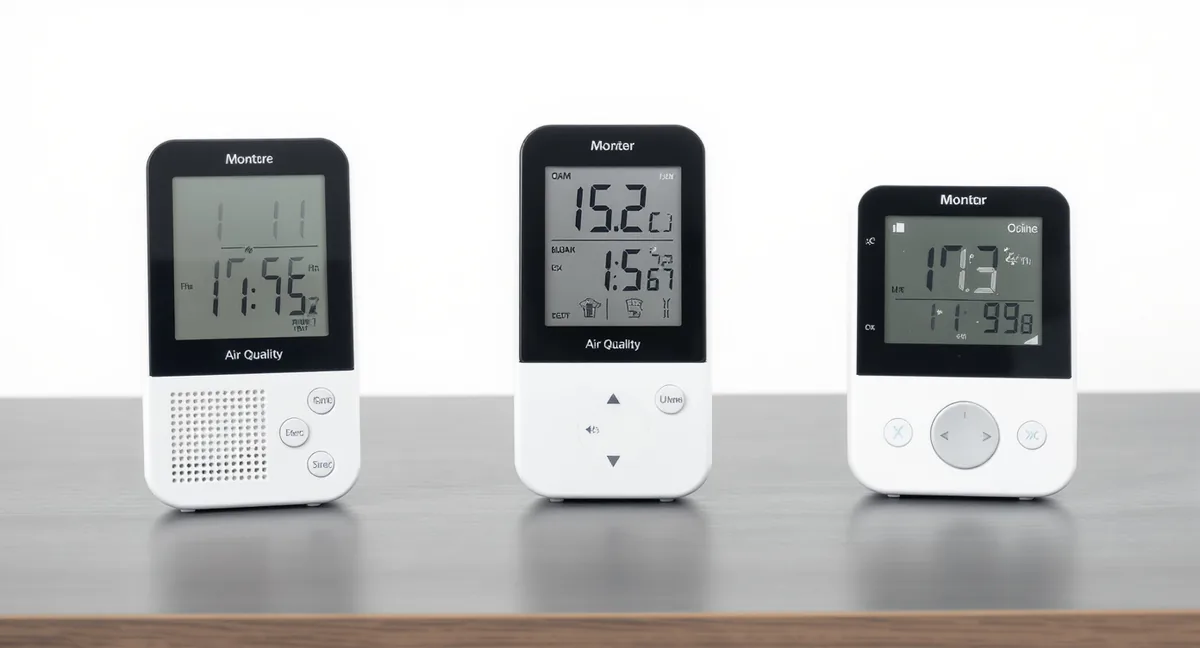
Update (April 2026): The Awair Element has been discontinued. This comparison has been updated to reflect the SAF Aranet4 Home, which now occupies the same $189 price point and productId slot as the Awair Element. The Aranet4 is a fundamentally different device — focused exclusively on CO2 accuracy rather than multi-sensor coverage — which changes the nature of this comparison significantly.
The Airthings View Plus and SAF Aranet4 Home represent two different philosophies in air quality monitoring. The Airthings tries to measure everything (seven parameters including radon). The Aranet4 measures fewer things (CO2, temperature, humidity, air pressure) but delivers the most accurate CO2 readings in the consumer market. Your choice depends on whether you need breadth or precision.
Key Takeaways
- 1Airthings View Plus monitors 7 parameters including radon — the only consumer monitor in this price range with a built-in radon sensor. This is its defining advantage.
- 2SAF Aranet4 Home costs $140 less ($189 vs $329.99) and delivers the most accurate CO2 monitoring available — trusted by schools and public health agencies.
- 3Both run on batteries — Airthings on 4 AA for ~1 year, Aranet4 on 2 AA for 2+ years. Both are truly portable with no power cables.
- 4The Airthings covers PM2.5, VOCs, and radon that the Aranet4 does not measure. If you need particulate or radon monitoring, the Airthings is the only choice.
- 5For focused CO2 monitoring — ventilation quality, bedroom air, office productivity — the Aranet4 is more accurate and lasts longer on batteries at a lower price.
Quick Answer
Should I buy the Airthings View Plus or Aranet4 Home?
Buy the Airthings View Plus ($329.99) if you want comprehensive multi-sensor coverage including radon, PM2.5, and VOCs. Buy the SAF Aranet4 Home ($189) if CO2 monitoring is your primary concern and you want the most accurate readings with the longest battery life. The Aranet4 does not measure PM2.5, VOCs, or radon.
Quick Decision Guide
| What Matters Most | Best Choice |
|---|---|
| Radon monitoring | Airthings View Plus (only option) |
| PM2.5 monitoring | Airthings View Plus (only option) |
| VOC monitoring | Airthings View Plus (only option) |
| CO2 accuracy | Aranet4 Home (±50 ppm vs ±75 ppm) |
| Battery life | Aranet4 Home (2+ years vs 1 year) |
| Lowest price | Aranet4 Home ($189 vs $329.99) |
| Most sensors | Airthings View Plus (7 parameters) |
| Portability | Aranet4 Home (smaller, lighter, longer battery) |
| Smart home automation | Airthings View Plus (Wi-Fi, IFTTT) |
| Best for basement monitoring | Airthings View Plus (radon + batteries) |
| Best for offices/classrooms | Aranet4 Home (CO2 precision) |
Full Specs Comparison
| Feature | Airthings View Plus | SAF Aranet4 Home |
|---|---|---|
| Price | $329.99 | $189 |
| Radon | Yes | No |
| PM2.5 | Yes | No |
| CO2 | Yes (NDIR sensor) | Yes (NDIR sensor, ±50 ppm) |
| VOCs | Yes | No |
| Temperature | Yes | Yes |
| Humidity | Yes | Yes |
| Air Pressure | Yes | Yes |
| Display | E-ink (customizable) | E-ink (traffic-light colors) |
| Power | 4x AA batteries (~1 year) | 2x AA batteries (2+ years) |
| Connectivity | Wi-Fi + Bluetooth | Bluetooth only |
| App | Airthings app | Aranet4 app |
| IFTTT | Yes | No |
| HomeKit | Yes (via Hub) | No |
| Alexa / Google | Yes | No |
| Dimensions | 3.2 x 3.2 x 1.4 in | 3.1 x 3.1 x 0.9 in |
| Warranty | 2 years | 2 years |
Sensor Coverage: Airthings Offers Far More
The most fundamental difference between these monitors is what they measure. The Airthings View Plus tracks seven air quality parameters. The Aranet4 Home tracks four — and only one of those (CO2) overlaps with the pollutants most people think of when they say "air quality monitoring."
Radon: Available Only on Airthings
Radon is a naturally occurring radioactive gas that seeps into homes through foundation cracks and is the second leading cause of lung cancer after smoking, according to the EPA. It is odorless, colorless, and impossible to detect without a sensor. The Airthings View Plus includes a dedicated radon sensor that provides continuous monitoring with readings updated hourly.
If you live in an EPA Zone 1 or Zone 2 area, have a basement, or have never tested for radon, the Airthings is the only option in this comparison. The Aranet4 does not detect radon.
PM2.5 and VOCs: Available Only on Airthings
The Aranet4 does not measure particulate matter or volatile organic compounds. If tracking cooking smoke, wildfire particulates, dust levels, or chemical off-gassing from furniture and cleaning products matters to you, the Airthings View Plus is the only choice. This is a significant gap — PM2.5 is the most health-relevant air quality metric alongside CO2.
CO2: Aranet4 Wins on Precision
Both monitors use NDIR sensors for CO2, but the Aranet4's dual-channel design delivers tighter accuracy — plus or minus 50 ppm compared to the Airthings' approximately 75 ppm. In practical terms, both are accurate enough for home ventilation management. But for classrooms, professional settings, or anyone who needs the highest confidence in their CO2 readings, the Aranet4 is the more precise instrument.
Display Quality
Both monitors use e-ink displays — a departure from the old comparison where the Awair Element had a bright LED display. The Aranet4's traffic-light color system (green, yellow, red segments) communicates CO2 status instantly without reading the number. The Airthings' e-ink display is customizable (choose which metrics to show) but requires a hand wave to wake.
Neither display is backlit. Both are readable in ambient light and invisible in complete darkness. For bedroom use, this is actually an advantage — no light emission during sleep.
Power and Placement Flexibility
Both monitors run on AA batteries, which is a major improvement over the old comparison where the Awair Element required wall power.
Aranet4 wins on battery life. Two AA batteries last over two years in the Aranet4, compared to approximately one year for the Airthings' four AA batteries. The Aranet4 is also smaller and lighter, making it easier to slip into a bag for travel or move between rooms.
Airthings wins on placement rationale. Because the Airthings measures radon, placing it in a basement makes sense. Its battery design means you can monitor radon where it matters most — below grade — without running extension cords.
Connectivity: Airthings Is Far More Connected
This is where the comparison diverges most from the old Awair comparison. The Aranet4 uses Bluetooth only. No Wi-Fi, no IFTTT, no HomeKit, no Alexa, no Google Home.
Airthings View Plus:
- Wi-Fi connectivity for remote monitoring from anywhere
- IFTTT integration for automations (turn on fans when CO2 is high)
- Alexa and Google Assistant voice queries
- HomeKit support (via optional Airthings Hub)
- Multi-device dashboard for whole-home monitoring
Aranet4 Home:
- Bluetooth connection to phone app only
- Must be within Bluetooth range to sync data
- No smart home integrations
- No remote monitoring
If you want to automate responses to air quality changes — turning on an exhaust fan when CO2 exceeds 1,000 ppm, getting a phone notification when PM2.5 spikes — the Airthings View Plus is the only option. The Aranet4 is a passive monitoring device: it shows you data, but you take action manually.
Cost Analysis
| Factor | Airthings View Plus | SAF Aranet4 Home |
|---|---|---|
| Purchase price | $329.99 | $189 |
| Annual battery cost | ~$8 (4x AA) | ~$3 (2x AA every 2 years) |
| Subscription needed? | No | No |
| Hub for HomeKit | ~$80 (optional) | N/A (no HomeKit) |
| 1-year total | $338 | $192 |
| 3-year total | $354 | $195 |
The Aranet4 is significantly cheaper both upfront and over time. The Airthings' additional cost buys you four extra sensors (radon, PM2.5, VOCs, barometric pressure) and full smart home connectivity.
Who Should Buy Which
Buy the Airthings View Plus ($329.99) if:
- Radon monitoring is important — you live in a radon-prone area or have never tested your home
- You want PM2.5 and VOC monitoring alongside CO2
- Smart home automation is part of your setup (IFTTT, Alexa, Google Home)
- You plan to monitor multiple rooms and want a cohesive multi-device dashboard
- You want the most comprehensive sensor coverage in a single device
Buy the SAF Aranet4 Home ($189) if:
- CO2 monitoring is your primary concern and you want the most accurate readings available
- Budget matters — $140 savings for focused CO2 monitoring
- You value extreme battery life (2+ years without replacement)
- Portability matters — carry it to meetings, travel, or check different rooms
- You do not need smart home integration or remote monitoring
- You already have a separate PM2.5 monitor like the Amazon Smart Air Quality Monitor
The Bottom Line
The Airthings View Plus and SAF Aranet4 Home serve different needs despite both being air quality monitors in the same price neighborhood.
If you want to know everything about your indoor air — radon, particles, chemicals, ventilation — the Airthings View Plus is the only single device that covers it all. The radon sensor alone justifies the price for homes in affected areas, and the Wi-Fi connectivity enables automations that make air quality management hands-free.
If CO2 and ventilation quality are your focus — you work from home, you want to optimize bedroom air, or you need to monitor meeting rooms — the Aranet4 Home is the better tool. It does one job (CO2 monitoring) better than anything else at any consumer price, and its two-year battery life and compact form factor make it genuinely portable.
For the broadest coverage at a reasonable total cost, consider pairing the Aranet4 Home ($189) with an Amazon Smart Air Quality Monitor ($50) — you get gold-standard CO2 accuracy plus PM2.5 and VOC coverage for $239 total, still less than the Airthings alone. The only gap is radon, which requires the Airthings or a dedicated test kit.
This guide was researched and written by the AirQualityNest editorial team. We update our content regularly to reflect the latest products, pricing, and research.
Frequently Asked Questions
Is the Airthings View Plus worth $140 more than the Aranet4 Home?+
It depends on what you need to measure. The Airthings adds radon, PM2.5, VOC monitoring, and smart home connectivity that the Aranet4 lacks entirely. If radon detection matters, the Airthings is the only option and the premium is justified. If you only need CO2 monitoring, the Aranet4 delivers better accuracy at a lower price.
Which air quality monitor has better CO2 accuracy?+
The SAF Aranet4 Home has more precise CO2 measurement — rated at plus or minus 50 ppm compared to the Airthings' approximately 75 ppm. Both use NDIR sensors, but the Aranet4's dual-channel design delivers tighter accuracy. For most home use, both are accurate enough, but the Aranet4 is preferred in professional and educational settings.
Can the Aranet4 Home detect radon or PM2.5?+
No. The Aranet4 Home measures only CO2, temperature, humidity, and atmospheric pressure. It does not include radon, PM2.5, or VOC sensors. For radon detection, you need the Airthings View Plus or a dedicated radon test kit. For PM2.5, consider the Amazon Smart Air Quality Monitor or Airthings View Plus.
Do I need a subscription for either monitor?+
No. Both the Airthings and Aranet4 apps are free to use with full functionality. Neither requires a subscription for monitoring, historical data viewing, or alerts. Airthings offers optional premium features through their dashboard, but the core experience is free.
Related Reading
Best Air Quality Monitors
Our top picks for home air quality monitoring in 2026
Airthings View Plus Review
Full editorial review of Airthings' flagship monitor
Aranet4 Home (Awair Replacement)
Our review of the Aranet4 — the Awair Element's recommended replacement
How to Test Your Home Air Quality
Complete guide to understanding and testing your indoor air
Best Radon Detectors
Continuous radon monitors and test kits for every budget
Continue Reading

Best Air Purifiers for Open Floor Plans in 2026: High-CADR Models That Cover It All
The best air purifiers for open floor plans ranked by CADR, coverage area, and noise. High-performance HEPA purifiers that handle 500-1,500+ sq. ft. open spaces.
Best Smart Humidifiers in 2026 (Wi-Fi, App Control & Auto Humidity)
The best smart humidifiers with Wi-Fi, app control, and auto humidity adjustment. Top picks for Alexa, Google Home, and smart home integration.

The 5 Best Portable Air Quality Monitors in 2026
Monitor your air quality on the go. We tested the best portable and compact air quality monitors for accuracy, battery life, and sensor range.