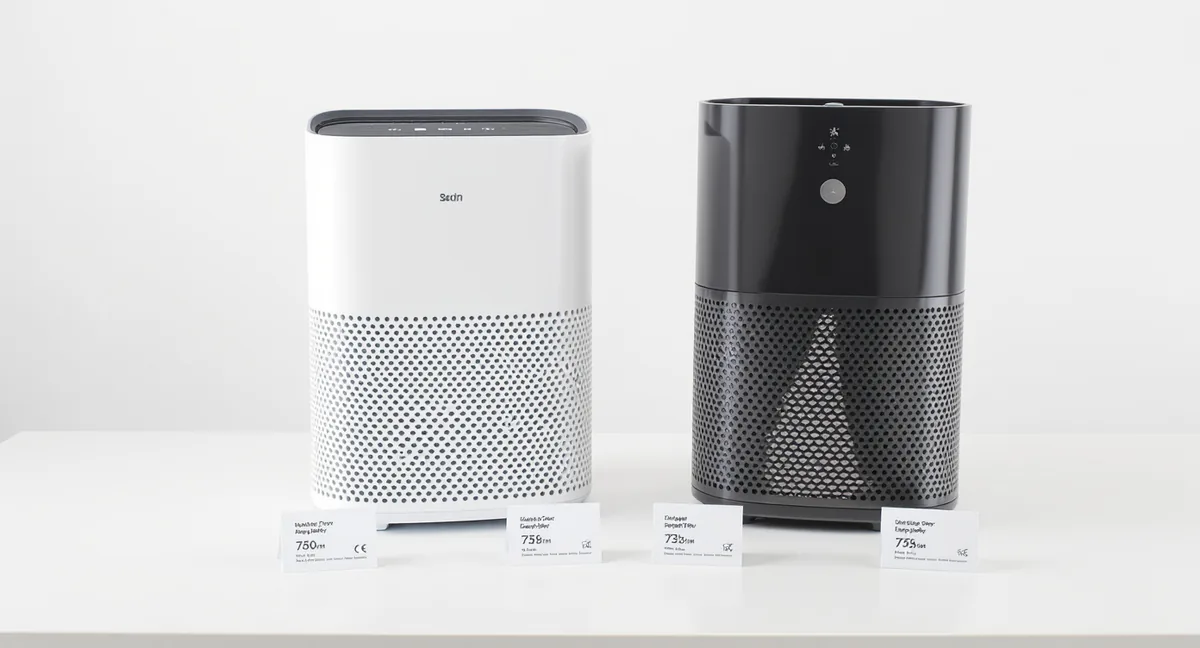
Levoit and Dyson represent opposite ends of the air purifier market. Levoit built its brand on delivering strong specs at aggressive prices — their best-selling models cost $99 to $182. Dyson built its brand on engineering, design, and multifunctionality — their purifiers start at $550 and climb from there. The price gap is impossible to ignore: a Dyson Purifier Cool TP07 costs roughly three times what a Levoit Core 400S does.
But price alone does not tell the whole story. Dyson purifiers double as bladeless fans, feature iconic industrial design, and run on one of the most polished smart home apps available. Levoit counters with AHAM-verified CADR numbers, dramatically lower filter costs, and performance-per-dollar that no Dyson model can match. These brands are not really competing head-to-head — they are serving fundamentally different buyers.
Based on our research and analysis of thousands of customer reviews, here is the complete breakdown.
Key Takeaways
- 1Levoit publishes AHAM-verified CADR ratings on all models. Dyson does not participate in AHAM CADR testing, making direct airflow comparisons harder — a consistent criticism from air quality experts.
- 2The price gap is dramatic: the Levoit Core 400S costs ~$182 while the Dyson Purifier Cool TP07 costs ~$561. That is a 3x premium for the Dyson.
- 3Annual filter costs compound the gap: Levoit filters run ~$30-40/year vs ~$70-80/year for Dyson replacements. Over three years, Levoit ownership costs roughly half what Dyson does.
- 4Dyson's unique advantage is its bladeless fan function — no Levoit model offers this. If you need a combined purifier and cooling fan, Dyson is the only option between these two brands.
- 5Both brands offer full smart features with app control. Levoit uses the VeSync app; Dyson uses the Dyson Link app. Both support Alexa, but only Levoit supports Google Assistant and only Dyson supports Apple Siri.
- 6For pure air-cleaning performance per dollar, Levoit wins decisively. Dyson's premium buys design, fan function, and brand — not better filtration.
Quick Answer
Is the Dyson air purifier worth 3x the price of a Levoit?
For most buyers, no. The Levoit Core 400S delivers comparable or better HEPA filtration performance at one-third the cost, with AHAM-verified CADR ratings, lower filter costs, and full smart features. However, the Dyson Purifier Cool TP07 justifies its premium if you genuinely need a combined purifier and bladeless cooling fan, if Dyson's iconic design matters in your space, or if you are already invested in the Dyson ecosystem. The Dyson is not a bad product — it is just a very expensive air purifier that happens to also be a very good fan.
Brand Philosophy: Value Engineering vs Design Engineering
Levoit
Levoit entered the air purifier market in 2017 and rapidly became the best-selling brand on Amazon. Their approach is straightforward: deliver the most features and filtration performance possible at the lowest price. Every Levoit model uses True HEPA H13 filtration (99.97% capture at 0.3 microns), and every model publishes AHAM-verified CADR ratings so buyers can make direct comparisons. Levoit is owned by Vesync, and their mid-to-upper range models include Wi-Fi, app control, laser PM2.5 sensors, and voice assistant compatibility.
Key Levoit models:
- Levoit Core 300 — Small-to-medium rooms (219 sq ft), ~$99. The budget king.
- Levoit Core 400S — Large rooms (403 sq ft), ~$182. The smart mid-range flagship.
Dyson
Dyson has been in the air treatment space since 2015, applying their signature engineering and design-first approach. Dyson purifiers are not just air cleaners — they are bladeless fans that also purify. Every Dyson purifier projects a directed stream of filtered air across the room, functioning as both a cooling fan and an air cleaner. Dyson uses sealed HEPA H13 filtration and activated carbon, but notably does not participate in AHAM CADR certification.
Key Dyson models:
- Dyson Purifier Cool TP07 — Mid-range flagship (~$561). Purifier + cooling fan with Dyson Link app.
- Dyson Purifier Big Quiet Formaldehyde — Premium tier (~$1,029). Larger coverage with catalytic formaldehyde destruction.
Head-to-Head: Levoit Core 400S vs Dyson Purifier Cool TP07
These are the most commonly compared models from each brand — the mid-range flagships that most buyers consider.
| Feature | Levoit Core 400S | Dyson Purifier Cool TP07 |
|---|---|---|
| Price | ~$182 | ~$561 |
| CADR (Dust) | 260 CFM (AHAM-verified) | ~250 CFM (Dyson-rated, not AHAM-verified) |
| Room Coverage | 403 sq ft | 800 sq ft (Dyson-rated) |
| Filtration | True HEPA H13 + Activated Carbon | Sealed HEPA H13 + Activated Carbon |
| Fan Function | No | Yes — bladeless cooling fan |
| Noise (Low) | 24 dB | ~30 dB |
| Noise (High) | 52 dB | ~55 dB |
| Smart App | VeSync (Wi-Fi) | Dyson Link (Wi-Fi) |
| PM2.5 Sensor | Yes — laser sensor | Yes — particulate + VOC sensors |
| Auto Mode | Yes — sensor-driven | Yes — sensor-driven |
| Voice Assistants | Alexa, Google Assistant | Alexa, Apple Siri |
| Annual Filter Cost | ~$30-40 | ~$70-80 |
| Weight | 10.4 lbs | 16.2 lbs |
| Warranty | 2-year | 2-year |
1. The CADR Transparency Problem
This is the elephant in the room for every Dyson comparison. CADR (Clean Air Delivery Rate) is the industry-standard metric for air purifier performance, certified by the Association of Home Appliance Manufacturers (AHAM). Levoit publishes AHAM-verified CADR ratings on every model — the Core 400S scores 260 CFM for dust, 256 for smoke, and 260 for pollen. These numbers are independently tested and directly comparable to any other AHAM-certified purifier.
Dyson does not participate in AHAM CADR testing. Instead, Dyson uses their own internal testing methodology and publishes proprietary metrics. The TP07 is rated for 800 sq ft by Dyson, but without standardized CADR numbers, it is difficult to verify how that claim compares to competitors under identical test conditions.
Based on independent reviews and third-party testing estimates, the Dyson TP07 delivers roughly 250 CFM of airflow — comparable to, but not exceeding, the Levoit Core 400S. At three times the price, comparable airflow is a tough sell on filtration performance alone.
Why this matters: If you are comparison shopping based on measurable air-cleaning ability, Levoit gives you the numbers to compare. Dyson asks you to trust their proprietary testing. For data-driven buyers, this is a significant point in Levoit's favor.
2. The Price Gap: $379 Is a Lot of Air Purifier
The Core 400S at $182 versus the TP07 at $561 is a $379 difference. To put that in perspective, $379 is enough to buy a Core 400S and a Core 300 and still have change left over. You could purify two separate rooms with Levoit for less than one room with Dyson.
Expanding the Range
The price gap is consistent across both brands' lineups:
| Tier | Levoit | Dyson |
|---|---|---|
| Budget/Entry | Core 300 — ~$99 | No budget option |
| Mid-Range | Core 400S — ~$182 | Purifier Cool TP07 — ~$561 |
| Premium | Core 600S — ~$240 | Big Quiet Formaldehyde — ~$1,029 |
Levoit's entire lineup fits within Dyson's starting price. The Core 300 at $99 provides True HEPA H13 filtration for small rooms — a segment Dyson simply does not address. If you need a purifier for a bedroom, home office, or nursery and you want to spend under $150, Levoit is effectively your only choice between these two brands.
3. Filter Costs: The Hidden Long-Term Gap
The upfront price difference is only the beginning. Replacement filters widen the cost gap every year.
| Cost Over 3 Years | Levoit Core 400S | Dyson Purifier Cool TP07 |
|---|---|---|
| Purchase price | $182 | $561 |
| Year 1 filters | $35 | $75 |
| Year 2 filters | $35 | $75 |
| Year 3 filters | $35 | $75 |
| 3-Year Total | ~$295 | ~$786 |
Over three years, the Dyson TP07 costs approximately $491 more than the Levoit Core 400S. That is nearly the cost of three additional Levoit purifiers. For budget-conscious buyers, the long-term economics are overwhelmingly in Levoit's favor.
Even comparing the budget Levoit Core 300 ($99 purchase, ~$30/year filters) against the Dyson TP07, the Dyson's 3-year cost is roughly four times higher.
4. Smart Features: Both Deliver, Different Ecosystems
Both brands offer full smart purifier experiences, but through different ecosystems.
Levoit (VeSync App)
- Real-time PM2.5 readings from a laser particle sensor
- Air quality history and trends
- Remote control, scheduling, and timer functions
- Auto mode driven by the PM2.5 sensor
- Compatible with Amazon Alexa and Google Assistant
- Multiple Levoit/Vesync devices in one app
Dyson (Dyson Link App)
- Real-time PM2.5 and VOC readings
- Historical air quality graphs
- Remote control, scheduling, and oscillation settings
- Auto mode driven by particulate and gas sensors
- Compatible with Amazon Alexa and Apple Siri
- Multiple Dyson devices in one app
According to customer reviews, the Dyson Link app is generally considered more polished and visually refined. The VeSync app is functional and reliable but less premium-feeling. Both provide the core smart features most users need — the difference is aesthetic rather than functional.
Voice assistant note: If your home runs on Google Assistant, Levoit is the better fit. If you are in the Apple ecosystem, Dyson supports Siri while Levoit does not. Both support Alexa.
5. The Fan Factor: Dyson's Genuine Differentiator
The single strongest argument for the Dyson premium is its bladeless fan function. The TP07 is not just an air purifier — it projects a focused stream of purified air across the room, functioning as a cooling fan. This is a real, practical feature that no Levoit model replicates.
In practice, this means:
- You can replace both a standing fan and an air purifier with one Dyson device
- The airflow is adjustable between wide diffused mode and focused personal cooling
- In cooler months, backward airflow mode lets you purify without the fan breeze
- For apartments and small rooms where every device counts, the consolidation is genuinely useful
If you currently use a separate fan, the Dyson's effective premium narrows. A $561 Dyson replacing a $182 purifier and a $75 fan brings the net premium to roughly $304 — still significant, but more justifiable for a single, elegant device.
However, if you have ceiling fans, central HVAC, or simply do not use a standing fan, the fan function adds no value and the entire $379 premium buys design and brand alone.
6. Noise Levels: Levoit Is Quieter
| Setting | Levoit Core 400S | Dyson Purifier Cool TP07 |
|---|---|---|
| Low | 24 dB | ~30 dB |
| High | 52 dB | ~55 dB |
The Levoit Core 400S is noticeably quieter on both low and high settings. At 24 dB on low, it is nearly inaudible — excellent for bedroom use. The Dyson's 30 dB low setting is still quiet, but the 6 dB difference is perceptible in a silent room at night.
The Dyson's higher noise levels are partly a consequence of its fan function. Projecting directed airflow inherently creates more noise than passively releasing purified air. This is a trade-off of the dual-function design.
For overnight bedroom use, both work well on low settings, but the Levoit has the edge for light sleepers.
7. Design and Aesthetics: Dyson's Other Premium
This is subjective, but customer sentiment is clear: the Dyson TP07 is one of the most visually striking home appliances on the market. Its slim tower profile with the signature bladeless amplifier loop looks like modern sculpture. It draws compliments, photographs well, and has genuine design cachet.
The Levoit Core 400S is a compact cylinder with a clean, modern look. It is perfectly presentable — even attractive for an air purifier — but it does not make a design statement. It is a tool that blends into a room rather than commanding attention.
For buyers who view their air purifier as a functional appliance, this difference is irrelevant. For buyers who care about the aesthetics of their living space, the Dyson occupies a different category entirely.
Budget and Premium Options From Each Brand
If You Want to Spend Less: Levoit Core 300 (~$99)
The Core 300 is the best-selling air purifier in the United States for a reason. At $99, it delivers True HEPA H13 filtration for rooms up to 219 sq ft with AHAM-verified CADR of 141 CFM. It lacks smart features and app control, but for a bedroom or home office where you want clean air at the lowest possible cost, nothing else comes close. Annual filter costs run about $30.
If You Want the Best Dyson: Big Quiet Formaldehyde (~$1,029)
The Big Quiet is Dyson's premium tier — larger room coverage, quieter operation for its size, and a catalytic formaldehyde-destruction filter that continuously breaks down formaldehyde without needing replacement. It is the only model here with dedicated formaldehyde sensing and destruction. At $1,029, it costs significantly more than the TP07 but offers genuinely more capability. According to customer reviews, the Big Quiet is the Dyson model most owners recommend if you are committed to the brand.
Who Should Buy Which
Buy Levoit if:
- Budget and value are your top priorities
- You want AHAM-verified performance data you can compare directly
- Smart features at the lowest possible price matter to you
- You use Google Assistant for voice control
- You need a purifier for a smaller room (Core 300) or a larger room (Core 400S)
- You want the lowest total cost of ownership — purchase price and filters combined
- Noise sensitivity is important (Levoit is quieter)
Buy Dyson if:
- You want a combined air purifier and bladeless cooling fan — and will actually use both functions
- Design and aesthetics are a genuine priority in your living space
- You are already in the Dyson ecosystem with other Dyson products
- You use Apple Siri for voice control
- The premium price does not strain your budget
- You value the Dyson Link app's polished interface and air quality reporting
The Bottom Line
Levoit is the better air purifier for most buyers. The Core 400S delivers comparable or better HEPA filtration performance at one-third the price of the Dyson TP07, with AHAM-verified CADR, lower filter costs, quieter operation, and full smart features. Over three years, it costs roughly $491 less to own. For buyers whose primary goal is cleaning indoor air effectively and affordably, the Levoit is the clear winner.
Dyson is the better product for a specific buyer. If you want a beautiful, multifunctional device that purifies air and serves as a bladeless cooling fan, if design matters as much as function, and if the premium price is comfortable — the Dyson TP07 delivers a genuinely different experience. It is not overpriced for what it is. It is just that what it is goes far beyond air purification.
Based on our research, the question "is the Dyson worth it?" has a clear answer: it depends on whether you are buying an air purifier or buying a Dyson. For clean air alone, Levoit wins by every measurable metric. For the complete package of design, fan function, and ecosystem, Dyson delivers something Levoit simply does not offer.
This guide was researched and written by the AirQualityNest editorial team. We update our content regularly to reflect the latest products, pricing, and research.
Frequently Asked Questions
Is Levoit as good as Dyson for air purification?+
Yes — and by some measures, better. The Levoit Core 400S delivers AHAM-verified CADR of 260 CFM, comparable to the Dyson TP07's estimated ~250 CFM. Both use True HEPA H13 filtration capturing 99.97% of particles at 0.3 microns. The Levoit is quieter on both low and high settings. For pure air-cleaning performance, the Levoit matches or exceeds the Dyson at roughly one-third the cost.
Why does Dyson not publish CADR ratings?+
Dyson has chosen not to participate in the AHAM CADR certification program, stating that their internal testing methodology better represents real-world performance. Critics argue that this makes it harder for consumers to directly compare Dyson purifiers to competitors under standardized conditions. Levoit and most other major brands do publish AHAM-verified CADR numbers.
Are Dyson air purifier filters expensive?+
Yes, relative to competitors. Dyson replacement filters cost approximately $70-80 per year, compared to $30-40 per year for Levoit. Over three years, Dyson filter costs total $210-240 versus $90-120 for Levoit. Combined with the higher purchase price, Dyson's total cost of ownership is roughly 2.5x higher than Levoit's.
Can a Levoit air purifier work as a fan like a Dyson?+
No. Levoit air purifiers release purified air but do not project a directed cooling breeze the way Dyson purifiers do. The bladeless fan function is unique to Dyson and is the primary functional feature that differentiates Dyson from virtually every other air purifier brand. If you need both a fan and a purifier, Dyson's two-in-one approach eliminates the need for a separate device.
Which is better for a bedroom, Levoit or Dyson?+
For bedroom use, the Levoit Core 400S has the edge. It operates at 24 dB on low — nearly inaudible — versus the Dyson TP07's approximately 30 dB. The Levoit also costs significantly less. Unless you specifically want the Dyson's fan function for cooling while you sleep, the Levoit provides quieter, more affordable bedroom air purification.
Related Reading
Dyson vs Shark Air Purifier
Another Dyson premium comparison — is the brand worth 2x the price?
Levoit Core 300 vs 400S vs Vital 200S
Find the right Levoit model for your room size and budget
Coway vs Levoit
Two value brands compared across performance and features
Best Smart Air Purifiers
Top picks for app-connected purifiers with real-time monitoring
Continue Reading
Best Air Purifiers for Open Floor Plans in 2026: High-CADR Models That Cover It All
The best air purifiers for open floor plans ranked by CADR, coverage area, and noise. High-performance HEPA purifiers that handle 500-1,500+ sq. ft. open spaces.
Best Smart Humidifiers in 2026 (Wi-Fi, App Control & Auto Humidity)
The best smart humidifiers with Wi-Fi, app control, and auto humidity adjustment. Top picks for Alexa, Google Home, and smart home integration.
The 5 Best Portable Air Quality Monitors in 2026
Monitor your air quality on the go. We tested the best portable and compact air quality monitors for accuracy, battery life, and sensor range.