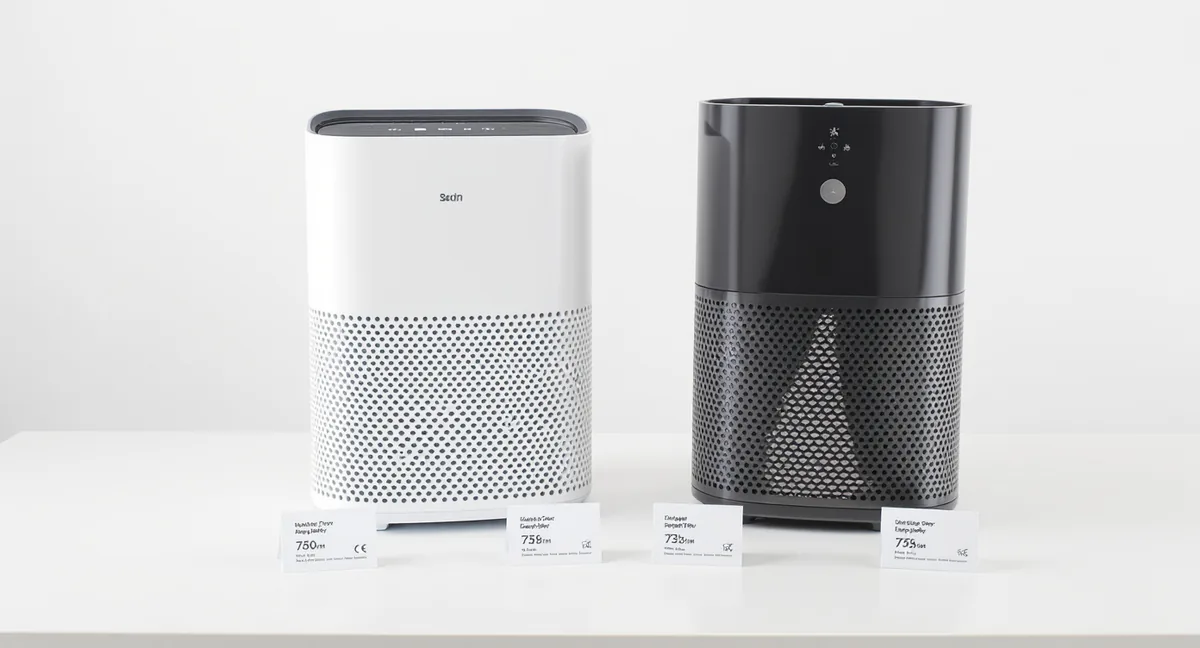
Here is the uncomfortable question every Dyson shopper eventually faces: is the brand premium actually worth it, or are you paying for the name? The Shark Air Purifier 6 at $350 and the Dyson Purifier Cool TP07 at $561 force this question into sharp focus. Both are HEPA air purifiers with app control and smart features from household-name brands. One costs $211 more than the other. What does that $211 buy you?
The answer is more nuanced than "Dyson is better" or "Shark is the better value." These two purifiers are designed around fundamentally different ideas of what an air purifier should do beyond cleaning air. The Dyson doubles as a bladeless cooling fan with Dyson's signature industrial design. The Shark includes a self-cleaning base that reduces maintenance in a way no other consumer purifier offers. Both solve real problems — just different ones.
Key Takeaways
- 1The Dyson TP07's biggest unique feature is its bladeless cooling fan function — it is a genuine two-in-one purifier and fan, which can replace a separate standing fan in your room.
- 2The Shark Air Purifier 6's self-cleaning base is a category-unique feature: it automatically cleans the pre-filter, extending filter life and reducing hands-on maintenance significantly.
- 3Both use HEPA filtration, but neither the Dyson TP07 nor the Shark 6 has catalytic formaldehyde detection or destruction — that feature is exclusive to the Dyson Big Quiet Formaldehyde, a different and pricier model.
- 4Both purifiers have app control and smart features, but Dyson's ecosystem is more mature and polished. Shark's SharkClean app provides functional smart control at a lower price.
- 5At $561 vs $350, the Dyson commands a 60% premium. Based on our research, the Dyson justifies its price for buyers who value the fan function and design aesthetic. For pure air-cleaning value, the Shark delivers comparable performance for significantly less.
Quick Answer
Is the Dyson TP07 worth $211 more than the Shark Air Purifier 6?
It depends on what you value beyond air purification. The Dyson TP07 justifies its premium if you want a combined purifier and bladeless cooling fan, if Dyson's iconic design matters to you, or if you are already in the Dyson Link ecosystem. The Shark Air Purifier 6 is the better pure-value purchase if your priority is effective HEPA filtration with the unique advantage of a self-cleaning base that reduces maintenance. For air cleaning alone, the Shark delivers comparable results at $211 less.
Quick Decision Guide
| What Matters Most | Best Choice |
|---|---|
| Combined purifier + cooling fan | Dyson Purifier Cool TP07 |
| Self-cleaning maintenance | Shark Air Purifier 6 |
| Best value for HEPA filtration | Shark Air Purifier 6 ($350) |
| Design and aesthetics | Dyson Purifier Cool TP07 |
| More polished app experience | Dyson Purifier Cool TP07 |
| Lowest long-term maintenance effort | Shark Air Purifier 6 |
| Slim tower form factor | Dyson Purifier Cool TP07 |
| Lower total cost of ownership | Shark Air Purifier 6 |
| Formaldehyde detection | Neither (Dyson Big Quiet has this, not the TP07) |
Full Specs Comparison
| Feature | Dyson Purifier Cool TP07 | Shark Air Purifier 6 |
|---|---|---|
| Price | ~$560.99 | ~$349.99 |
| CADR | ~250 CFM | ~250-280 CFM |
| Room Coverage | 800 sq ft (Dyson-rated) | ~1,200 sq ft (Shark-rated) |
| Filtration | HEPA H13 + Activated Carbon | HEPA + Activated Carbon |
| Fan Function | Yes — bladeless cooling fan | No |
| Self-Cleaning Base | No | Yes — auto-cleans pre-filter |
| Noise (Low) | ~30 dB | ~26 dB |
| Noise (High) | ~55 dB | ~52 dB |
| Smart App | Dyson Link app | SharkClean app |
| Voice Assistants | Alexa, Apple Siri | Alexa, Google Assistant |
| Air Quality Sensors | PM2.5, VOCs (basic) | PM2.5, odor sensor |
| Auto Mode | Yes — sensor-driven | Yes — sensor-driven |
| Formaldehyde Detection | No | No |
| Annual Filter Cost | ~$70-80 | ~$50-70 |
| Weight | 16.2 lbs | ~17 lbs |
| Warranty | 2-year Dyson warranty | 2-year Shark warranty |
1. The Price Gap: What Does $211 Actually Buy?
The core question of this comparison
At $561 versus $350, the Dyson TP07 costs 60% more than the Shark Air Purifier 6. That is a significant premium, and it demands justification. Here is what the extra $211 gets you:
What you get with the Dyson TP07 that the Shark lacks:
- A bladeless cooling fan that can replace a separate standing fan
- Dyson's iconic industrial design — the tower form factor with the amplifier loop
- The Dyson Link app ecosystem (generally considered more polished than Shark's)
- Apple Siri integration (Shark does not support Siri)
- Dyson's brand cachet and resale value
What you get with the Shark Air Purifier 6 that the Dyson lacks:
- A self-cleaning base that automatically cleans the pre-filter
- Google Assistant support (Dyson does not support Google Assistant)
- Lower purchase price and lower annual filter costs
- Reduced maintenance — the self-cleaning base means less hands-on filter management
Neither list is objectively better than the other. The Dyson's extras are about experience and multifunctionality. The Shark's extras are about practicality and cost. Your priorities determine which set matters more.
2. Filtration and Air Cleaning Performance
Winner: Comparable — slight edge to Shark on CADR
Both purifiers use HEPA filtration with activated carbon for odors and gases. The Dyson uses sealed HEPA H13 (99.97% capture at 0.3 microns), while the Shark uses HEPA filtration that captures particles of similar size. Both are effective at removing pollen, dust mites, pet dander, mold spores, smoke particles, and most bacteria from indoor air.
The CADR numbers are close. The Dyson TP07 delivers approximately 250 CFM, while the Shark Air Purifier 6 is estimated at 250-280 CFM. Shark's room coverage rating (approximately 1,200 sq ft) is more generous than Dyson's (800 sq ft), though manufacturer coverage ratings should always be evaluated against the number of Air Changes Per Hour you need.
At 4 ACH (the recommended rate for allergy relief):
- The Dyson TP07 effectively handles rooms up to approximately 400-450 sq ft
- The Shark Air Purifier 6 effectively handles rooms of similar or slightly larger size
An important clarification on formaldehyde: The Dyson Purifier Cool TP07 does not have formaldehyde detection or catalytic formaldehyde destruction. That feature is exclusive to the Dyson Big Quiet Formaldehyde — a separate, higher-end model. If formaldehyde removal is important to you, neither the TP07 nor the Shark Air Purifier 6 addresses it with specialized technology. Both rely on their activated carbon filters for basic VOC and chemical adsorption, which provides some formaldehyde capture but without the dedicated sensing and catalytic destruction found in the Big Quiet.
3. The Fan Factor: Dyson's Unique Advantage
Winner: Dyson Purifier Cool TP07 (if you need a fan)
The Dyson TP07 is not just an air purifier — it is a bladeless cooling fan that projects a focused stream of purified air across the room. This dual function is the single strongest argument for the Dyson premium.
In practice, this means:
- You can replace both a standing fan and a separate air purifier with one device
- The airflow is adjustable — wide diffused mode for room circulation, focused mode for personal cooling
- The purified air is actively projected rather than passively released, which can improve air distribution in oddly shaped rooms
- In cooler months, you can set the TP07 to purify without the fan function (backward airflow mode)
If you currently use a separate fan and a separate purifier, the Dyson TP07 eliminates one device from your room. For apartments and bedrooms where every piece of furniture counts, this consolidation has real value.
The Shark Air Purifier 6 does not have a fan function. It is a dedicated air purifier that releases cleaned air but does not project a cooling breeze. For buyers who do not need a fan — especially in climate-controlled homes where ceiling fans or HVAC provide air circulation — this is a non-issue. But for buyers who do use a standing fan, the Dyson's two-in-one capability changes the value equation.
4. The Self-Cleaning Base: Shark's Unique Advantage
Winner: Shark Air Purifier 6 (for maintenance reduction)
The Shark Air Purifier 6's self-cleaning base is genuinely innovative in the consumer air purifier market. No other major purifier brand offers this feature.
Here is how it works: the self-cleaning base automatically removes dust, hair, and large particles from the pre-filter at regular intervals. This keeps the primary HEPA filter cleaner for longer, maintains consistent airflow, and means you spend less time manually cleaning or vacuuming the pre-filter — a chore that most air purifier owners either do reluctantly or not often enough.
According to customer reviews, the self-cleaning base is one of the most appreciated features of the Shark Air Purifier 6. Owners consistently report that filter life is extended and maintenance is noticeably reduced compared to their previous purifiers. For pet owners in particular — where hair and dander accumulate on pre-filters rapidly — the self-cleaning function is especially valuable.
The Dyson TP07 has no self-cleaning mechanism. Its filters need to be checked and replaced on the manufacturer's schedule, and while the Dyson Link app tracks filter life, the physical maintenance is entirely manual.
5. Smart Features and App Experience
Winner: Dyson Purifier Cool TP07 (app quality) / Shark Air Purifier 6 (Google Assistant support)
Both purifiers offer app-based control and smart features, but the experiences are not equivalent.
Dyson Link App
The Dyson Link app is one of the most polished appliance companion apps available:
- Real-time air quality data (PM2.5, VOCs)
- Historical air quality graphs and trends
- Remote control from anywhere via Wi-Fi
- Scheduling, timers, and auto mode
- Fan speed and oscillation control
- Integration with Amazon Alexa and Apple Siri
- Multiple Dyson devices managed in one app
Customer reviews consistently praise the Dyson app for its clean interface, reliable connectivity, and the depth of air quality data it provides. If you own other Dyson products, having everything in one ecosystem is a convenience multiplier.
SharkClean App
The SharkClean app provides functional smart control:
- Real-time air quality status
- Remote fan speed and mode control
- Filter life tracking and replacement reminders
- Scheduling and timers
- Auto mode based on sensor readings
- Integration with Amazon Alexa and Google Assistant
The SharkClean app is functional and gets the job done, but customer reviews note it is less refined than Dyson's offering. The interface is more utilitarian, the air quality data is less granular, and connectivity can occasionally be inconsistent. That said, it provides all the core smart features most owners need at a $211 lower price point.
Voice assistant note: Dyson supports Alexa and Siri but not Google Assistant. Shark supports Alexa and Google Assistant but not Siri. If your home is built around Google Home, the Shark is the better choice for voice control. If you are in the Apple ecosystem, Dyson has the edge.
6. Noise Levels
Winner: Shark Air Purifier 6
| Setting | Dyson Purifier Cool TP07 | Shark Air Purifier 6 |
|---|---|---|
| Low | ~30 dB | ~26 dB |
| Medium | ~42 dB | ~38 dB |
| High | ~55 dB | ~52 dB |
The Shark Air Purifier 6 is quieter across all speed settings. At 26 dB on low, it produces a barely audible hum. The Dyson TP07 at 30 dB is still reasonably quiet, but the difference is perceptible — particularly in a quiet bedroom at night.
The Dyson's higher noise levels are partly attributable to its fan function. Projecting a directed airstream creates more audible airflow than simply releasing purified air passively. This is a trade-off inherent to the TP07's dual-function design: you get the cooling fan capability, but it comes with slightly more noise.
On high speed, the 3 dB gap (55 dB vs 52 dB) is modest but noticeable. Both are loud enough on high that you would not want them running at maximum during a conversation or while watching TV without raising the volume.
For overnight bedroom use, both purifiers work well on their low settings. The Shark's 26 dB low is quieter, but neither is loud enough to disrupt sleep for most people.
7. Design and Aesthetics
Winner: Dyson Purifier Cool TP07
This is subjective, but the market and customer sentiment are clear: the Dyson TP07 is one of the most visually striking home appliances ever made. Its slim tower profile with the signature bladeless amplifier loop looks like a piece of modern sculpture. It photographs well, draws positive comments, and has become an iconic design in the small appliance category. If the visual presence of your air purifier matters — if it sits in a living room where guests will see it — the Dyson commands attention in a way the Shark does not.
The Shark Air Purifier 6 has a clean, modern design that is perfectly presentable but unmistakably an appliance. Its form factor is functional — the self-cleaning base adds some visual bulk — and it does not attempt the kind of design statement the Dyson makes. It is the kind of product that blends into a room rather than becoming a conversation piece.
For buyers who view an air purifier as a functional tool that should not call attention to itself, the Shark's understated look is perfectly fine. For buyers who want a purifier that doubles as a design object, the Dyson is in a different category entirely.
8. Filter Costs and Total Ownership
Winner: Shark Air Purifier 6
Annual Filter Costs
| Dyson TP07 | Shark Air Purifier 6 | |
|---|---|---|
| Annual filter cost | ~$70-80 | ~$50-70 |
| Self-cleaning pre-filter savings | N/A | Extends primary filter life |
| Filter replacement frequency | ~12 months | ~12 months (extended by self-cleaning) |
The Shark's lower filter costs and its self-cleaning base — which extends HEPA filter lifespan by keeping the pre-filter clean — give it a structural cost advantage over time.
3-Year Total Cost Comparison
| Cost Factor | Dyson TP07 | Shark Air Purifier 6 |
|---|---|---|
| Purchase price | $560.99 | $349.99 |
| Filters (3 years) | ~$210-240 | ~$150-210 |
| Electricity (3 years, est.) | ~$40-50 | ~$35-45 |
| 3-Year Total | ~$811-851 | ~$535-605 |
| Annual cost of ownership | ~$270-284/year | ~$178-202/year |
Over three years, the Shark Air Purifier 6 costs approximately $210-250 less than the Dyson TP07. That is a meaningful savings — roughly the cost of the Shark purifier itself. For budget-conscious buyers who want effective HEPA filtration without the premium price, the Shark's economics are compelling.
However, if you would otherwise buy a separate fan ($50-100), the Dyson's effective premium narrows. A $561 Dyson replacing a $350 purifier + a $75 fan is only a $136 net premium for a more elegant, integrated solution.
Who Should Buy Which
Buy the Dyson Purifier Cool TP07 ($561) if:
- You want a combined air purifier and cooling fan in one device — eliminating the need for a separate standing fan
- Design and aesthetics are important — you want a visually striking appliance in your living space
- You are already in the Dyson ecosystem with other Dyson products managed through the Dyson Link app
- You value Apple Siri integration for voice control
- The bladeless fan function provides genuine utility in your climate and room setup
- You are willing to pay the premium for Dyson's engineering, build quality, and design heritage
Buy the Shark Air Purifier 6 ($350) if:
- Your priority is effective HEPA air purification at the best possible price
- The self-cleaning base appeals to you — less maintenance is a genuine quality-of-life improvement, especially for pet owners
- You use Google Assistant and want voice control through Google Home
- You prefer to spend less upfront and less over time on filter replacements
- You do not need a fan function — your home has ceiling fans, HVAC, or other air circulation
- You want a reliable, full-featured smart purifier without paying a design premium
The Bottom Line
The Dyson TP07 is the better product — it combines genuinely useful fan functionality with effective air purification, wraps it in iconic design, and pairs it with one of the best appliance apps on the market. If the fan function solves a real need in your home and you appreciate premium design, the $561 price is reasonable for what you get.
The Shark Air Purifier 6 is the better value — it delivers comparable air-cleaning performance with the unique advantage of a self-cleaning base, quieter operation, Google Assistant support, and a price that is $211 lower. Its 3-year total cost of ownership is roughly $210-250 less than the Dyson's.
Based on our research and analysis of customer reviews, the question "is the Dyson worth 2x the price?" has a clear answer: it depends on whether you value what makes the Dyson different. The fan function, the design, the Dyson ecosystem — these are the premiums you are paying for. They are real, tangible benefits. But they are not air-cleaning benefits. For pure air purification performance per dollar, the Shark Air Purifier 6 matches the Dyson at a fraction of the cost — and its self-cleaning base adds a maintenance advantage the Dyson cannot match.
If you are buying an air purifier because you need cleaner air, the Shark is the smarter purchase. If you are buying an air purifier because you want a beautiful, multifunctional device that also cleans your air, the Dyson is worth the premium.
Sources & References
- Dyson Product Specifications — Manufacturer-published specifications for the Dyson Purifier Cool TP07
- Shark Product Specifications — Manufacturer-published specifications for Shark air purifier models
- AHAM (Association of Home Appliance Manufacturers) — CADR certification program and testing standards for portable air cleaners
This guide was researched and written by the AirQualityNest editorial team. We update our content regularly to reflect the latest products, pricing, and research.
Frequently Asked Questions
Does the Dyson TP07 detect formaldehyde?+
No. The Dyson Purifier Cool TP07 does not have formaldehyde detection or catalytic formaldehyde destruction. That feature is exclusive to the Dyson Big Quiet Formaldehyde, which is a separate, larger model priced at approximately $1,029. The TP07 uses HEPA H13 and activated carbon filtration, which provides some passive formaldehyde adsorption but without dedicated sensing or destruction technology.
How does the Shark Air Purifier 6 self-cleaning base work?+
The Shark Air Purifier 6's self-cleaning base automatically removes accumulated dust, hair, and large debris from the pre-filter at regular intervals. This keeps the primary HEPA filter cleaner and extends its effective lifespan, reducing both maintenance effort and filter replacement frequency. According to customer reviews, this feature is particularly valuable for pet owners where hair and dander accumulate rapidly on pre-filters.
Is the Dyson TP07 loud because of its fan function?+
The Dyson TP07 is somewhat louder than dedicated purifiers, particularly on its low setting (30 dB vs the Shark's 26 dB). The fan function creates directed airflow, which inherently produces more noise than passive air release. On high speed, the TP07 reaches approximately 55 dB. For overnight use on the lowest setting, it is still quiet enough for most sleepers, but it is not as silent as some competing purifiers.
Can I use the Dyson TP07 with Google Assistant?+
No. The Dyson Purifier Cool TP07 integrates with Amazon Alexa and Apple Siri for voice control, but it does not support Google Assistant. If your smart home is built around Google Home, the Shark Air Purifier 6 — which supports both Alexa and Google Assistant — is the better choice for voice-controlled operation.
Which purifier is better for pet owners: Dyson TP07 or Shark Air Purifier 6?+
The Shark Air Purifier 6 has a meaningful advantage for pet owners thanks to its self-cleaning base. Pet hair and dander rapidly accumulate on pre-filters, and the Shark's automatic pre-filter cleaning keeps the HEPA filter working efficiently with less manual maintenance. Both purifiers use HEPA filtration that effectively captures pet dander and allergens, but the Shark's reduced maintenance burden makes it the more practical choice for homes with pets.
Related Reading
IQAir vs Dyson
Premium air purifier showdown: medical-grade filtration vs smart design
Dyson vs Blueair
Two premium brands compared across performance, features, and value
Best Smart Air Purifiers
Top picks for app-connected purifiers with real-time monitoring
Air Purifier Maintenance Guide
How to maintain your purifier for peak performance and filter longevity
Continue Reading
Best Air Purifiers for Open Floor Plans in 2026: High-CADR Models That Cover It All
The best air purifiers for open floor plans ranked by CADR, coverage area, and noise. High-performance HEPA purifiers that handle 500-1,500+ sq. ft. open spaces.
Best Smart Humidifiers in 2026 (Wi-Fi, App Control & Auto Humidity)
The best smart humidifiers with Wi-Fi, app control, and auto humidity adjustment. Top picks for Alexa, Google Home, and smart home integration.
The 5 Best Portable Air Quality Monitors in 2026
Monitor your air quality on the go. We tested the best portable and compact air quality monitors for accuracy, battery life, and sensor range.