IQAir and Austin Air are not mainstream brands. You will not find them at Target or Best Buy. These are the purifiers that allergists recommend, that people with multiple chemical sensitivity (MCS) rely on, and that hospitals and clinics deploy in treatment rooms. Both carry price tags that reflect serious engineering — and both deliver filtration performance that consumer-grade purifiers simply cannot match.
But they solve different problems. The IQAir HealthPro Plus is built around the most advanced particle filtration available in a residential unit. The Austin Air HealthMate HM400 carries the largest activated carbon bed in any home purifier. Choosing between them depends entirely on whether your primary concern is particles or gases.
This guide breaks down every meaningful difference to help you make the right call.
Key Takeaways
- 1IQAir's HyperHEPA technology filters particles down to 0.003 microns — 100x smaller than standard HEPA's 0.3 micron threshold. This is unmatched for ultrafine particles, viruses, and combustion byproducts.
- 2Austin Air's 15 lbs of activated carbon and zeolite delivers the strongest gas-phase filtration of any home purifier. It is the gold standard for VOCs, formaldehyde, chemicals, and odors.
- 3Austin Air's 5-year filter life dramatically reduces long-term costs — roughly $60/year vs IQAir's $100-130/year in filter replacements.
- 4IQAir is significantly quieter (22 dB low vs Austin Air's 35 dB low), making it the better bedroom purifier.
- 5For allergies, asthma, and particle concerns, IQAir wins. For chemical sensitivities, VOCs, and off-gassing, Austin Air wins.
Quick Answer
Is IQAir or Austin Air better?
Neither is universally better — they excel at different things. The IQAir HealthPro Plus is the superior particle filter, capturing ultrafine particles down to 0.003 microns with its HyperHEPA technology. It is the best choice for severe allergies, asthma, and airborne viruses. The Austin Air HealthMate HM400 is the superior gas and chemical filter, with 15 lbs of activated carbon that no competitor matches. It is the best choice for VOCs, chemical sensitivities, formaldehyde, and smoke odors. If you must choose one and your primary concern is particles/allergens, buy the IQAir. If your primary concern is chemicals/gases/odors, buy the Austin Air.
Head-to-Head Specs
| Feature | IQAir HealthPro Plus | Austin Air HealthMate HM400 |
|---|---|---|
| Price | $1,199.99 | $845.00 |
| CADR | 300+ CFM (Swiss-tested) | ~400 CFM (estimated) |
| Room Coverage | 1,125 sq ft | 1,500 sq ft |
| Particle Filtration | HyperHEPA — 0.003 microns | True HEPA — 0.3 microns |
| Gas/VOC Filtration | V5-Cell (2.5 lbs media) | 15 lbs activated carbon + zeolite |
| Noise (Low/High) | 22 - 59 dB | 35 - 65 dB |
| Weight | 35 lbs | 47 lbs |
| Filter Lifespan | PreMax: 12-18 mo / HyperHEPA: 24+ mo | 5 years (all filters) |
| Annual Filter Cost | ~$100-130 | ~$60 |
| Smart Features | None | None |
| Warranty | 10-year motor warranty | 5-year mechanical warranty |
| Made In | Switzerland | USA (Buffalo, NY) |
1. Filtration Technology
Winner: IQAir for particles / Austin Air for gases
This is the defining difference between these two purifiers, and understanding it is critical to making the right purchase.
IQAir HyperHEPA: The Particle Specialist
The IQAir HealthPro Plus uses a three-stage filtration system engineered in Switzerland:
- PreMax Pre-Filter — Captures large particles (pollen, pet dander, dust) and extends the life of the main filter.
- V5-Cell Gas & Odor Filter — Contains activated carbon and alumina pellets for gas-phase filtration. At approximately 2.5 lbs of media, it handles moderate VOCs and odors but is not the V5-Cell's primary purpose.
- HyperHEPA Filter — The centerpiece. This filter is certified to capture particles down to 0.003 microns at greater than 99.5% efficiency. Standard HEPA filters are rated to 0.3 microns. IQAir's HyperHEPA goes 100 times smaller.
Why does 0.003 microns matter? At that scale, you are capturing ultrafine particles — combustion byproducts from traffic and cooking, certain virus particles, nanoparticles from printers and electronics, and the smallest components of wildfire smoke. Standard HEPA filters are excellent at 0.3 microns and above, but their efficiency drops for particles in the 0.01-0.1 micron range. IQAir's HyperHEPA was designed specifically to address this gap.
The HealthPro Plus also uses a sealed system with individual filter testing — every unit ships with a hand-signed test certificate showing actual measured performance.
Austin Air HealthMate: The Gas and Chemical Specialist
The Austin Air HealthMate HM400 uses a four-stage filtration system manufactured in Buffalo, New York:
- Large Particle Pre-Filter — Removes dust and large allergens.
- Medium Particle Pre-Filter — Captures smaller particulates before the main filters.
- 15 lbs Activated Carbon + Zeolite Blend — This is Austin Air's standout feature. Fifteen pounds of activated carbon mixed with zeolite creates an extraordinarily deep bed for gas-phase adsorption. Most consumer purifiers include a few ounces of carbon in a thin pad. Austin Air uses orders of magnitude more. This bed adsorbs VOCs, formaldehyde, benzene, toluene, ammonia, and hundreds of other gaseous pollutants.
- True HEPA Filter — Certified 99.97% efficiency at 0.3 microns. This is standard (not enhanced) HEPA, but it is genuine medical-grade filtration that meets the same standard used in hospital rooms.
The zeolite component is worth noting — it is particularly effective at adsorbing formaldehyde and ammonia, which standard activated carbon handles less efficiently.
The bottom line: If your air quality problem is particulate (allergens, dust, smoke particles, viruses, ultrafine pollution), the IQAir's HyperHEPA is in a class by itself. If your problem is gaseous (new home off-gassing, chemical sensitivities, VOCs from paint or furniture, cooking odors, tobacco or wildfire smoke odor), Austin Air's 15-lb carbon bed is unmatched.
2. CADR and Airflow
Winner: Austin Air HealthMate
| Metric | IQAir HealthPro Plus | Austin Air HealthMate HM400 |
|---|---|---|
| CADR | 300+ CFM (Swiss-tested) | ~400 CFM (estimated) |
| Room Coverage | 1,125 sq ft | 1,500 sq ft |
| Recommended for 4+ ACH | ~700 sq ft | ~900 sq ft |
The Austin Air HealthMate moves more air. Its estimated CADR of approximately 400 CFM gives it roughly 30% more airflow than the IQAir's 300+ CFM rating. For large rooms and open floor plans, this translates to faster air turnover and larger effective coverage.
A note on CADR ratings: Neither IQAir nor Austin Air participates in the AHAM Verifide CADR certification program. IQAir publishes its own Swiss-tested airflow numbers. Austin Air's CADR is estimated based on airflow specifications and independent assessments. Neither brand submits to the standardized third-party testing that brands like Coway, Blueair, and Levoit use. This makes direct CADR comparison less precise than with AHAM-certified models.
For practical purposes at the recommended 4+ air changes per hour, the IQAir is well-suited for large bedrooms and living rooms up to about 700 sq ft. The Austin Air can handle larger spaces approaching 900 sq ft.
3. Carbon Capacity and Gas-Phase Filtration
Winner: Austin Air HealthMate (by a wide margin)
This is not close. The Austin Air HealthMate's 15 lbs of activated carbon and zeolite is the largest gas-phase filter bed available in any residential air purifier. For context:
| Purifier | Carbon/Gas-Phase Media |
|---|---|
| Austin Air HealthMate HM400 | 15 lbs |
| IQAir HealthPro Plus (V5-Cell) | ~2.5 lbs |
| Typical consumer purifier | 0.2-0.5 lbs |
Austin Air delivers roughly 6x the carbon media of the IQAir and 30-75x what most consumer purifiers offer. This matters because activated carbon adsorption is a capacity-based process — the carbon gets saturated over time, and more carbon means more capacity and longer effective life. Austin Air's massive carbon bed is why the company can rate its filters for 5 years of continuous use.
The IQAir V5-Cell is not a bad gas filter. It contains a meaningful amount of activated carbon and alumina pellets, and it will handle moderate odors and light VOC levels. But it was designed as a complementary stage in a particle-focused system, not as a primary chemical remediation tool.
If you are dealing with any of the following, Austin Air's carbon capacity is the decisive advantage:
- New construction or renovation off-gassing
- Multiple chemical sensitivity (MCS)
- Proximity to industrial or agricultural operations
- Heavy cooking odors
- Tobacco or cannabis smoke
- Wildfire smoke (odor component, not just particles)
- Formaldehyde from pressed-wood furniture or flooring
4. Noise Levels
Winner: IQAir HealthPro Plus
| Setting | IQAir HealthPro Plus | Austin Air HealthMate HM400 |
|---|---|---|
| Low | 22 dB | 35 dB |
| High | 59 dB | 65 dB |
The IQAir is significantly quieter at every speed setting. At 22 dB on low, it is barely audible — close to the threshold of human hearing in a quiet room. This makes the HealthPro Plus an excellent bedroom purifier that can run overnight without disrupting sleep.
The Austin Air HealthMate starts at 35 dB on its lowest setting. That is a noticeable hum — not loud, but clearly present. Most users describe it as gentle white noise. On its highest setting, the Austin Air reaches 65 dB, which is roughly the volume of a normal conversation and too loud for comfortable sleeping.
The noise difference comes down to engineering priorities. The IQAir uses a precision fan motor with vibration dampening and aerodynamic airflow channels designed in Switzerland to minimize turbulence noise. The Austin Air prioritizes raw airflow volume and carbon capacity over acoustic refinement.
For bedroom use: The IQAir is the clear choice. Its 22 dB low setting is essentially silent.
For daytime use in common areas: Both are acceptable on low and medium settings. The Austin Air's white noise may even be desirable for some users.
5. Build Quality and Construction
Winner: Tie — different philosophies, both excellent
IQAir HealthPro Plus
Swiss-engineered and manufactured with the precision you would expect from the country that makes surgical instruments and fine watches. The housing is a durable ABS polymer with a clean, modern tower design. Internal components are machined to tight tolerances. The German EBM-Papst fan motor comes with a 10-year warranty — a statement of confidence in the engineering.
The HealthPro Plus includes caster wheels for mobility, which is helpful given its 35 lb weight. Controls are on the top panel with an intuitive interface. There is a filter life monitor that tracks actual usage hours.
At 35 lbs, it is heavy but manageable. The tower form factor is relatively compact for its performance class.
Austin Air HealthMate HM400
Made in Buffalo, New York from 22-gauge steel — the same grade used in commercial HVAC equipment. This is an industrial-strength housing that will last decades. Where most purifiers use lightweight plastics, Austin Air builds its units like commercial equipment.
The perforated steel intake on all sides allows 360-degree air intake. The baked powder-coat finish is available in multiple colors and resists scratches and scuffs. Austin Air units from the 1990s are still running with their original housings.
At 47 lbs, the HealthMate is genuinely heavy. It does not have wheels (though aftermarket caster platforms are available). Moving it between rooms requires effort. Once you place it, expect it to stay there.
The IQAir feels like a precision instrument. The Austin Air feels like a piece of industrial equipment. Both are built to last 10+ years.
6. Filter Lifespan and Replacement Cost
Winner: Austin Air HealthMate
This is one of Austin Air's strongest advantages and deserves careful consideration.
IQAir Filter Costs
| Filter | Lifespan | Replacement Cost |
|---|---|---|
| PreMax Pre-Filter | 12-18 months | ~$50-70 |
| V5-Cell Gas & Odor | 18-24 months | ~$80-100 |
| HyperHEPA | 24+ months | ~$100-130 |
| Effective annual cost | ~$100-130/year |
IQAir filters are premium-priced, which is expected given the HyperHEPA technology. A full filter set costs approximately $200-250, and you will need to replace at least one component every 12-18 months.
Austin Air Filter Costs
| Filter | Lifespan | Replacement Cost |
|---|---|---|
| Complete filter set | 5 years | ~$300 |
| Effective annual cost | ~$60/year |
Austin Air's 5-year filter life is exceptional. The massive carbon bed takes years to saturate under normal residential use, and the True HEPA filter similarly benefits from the deep pre-filter stages that protect it from premature loading. A single $300 filter replacement every 5 years works out to roughly $60 per year — about half of IQAir's annual filter cost.
5-Year Filter Cost Comparison
| Period | IQAir HealthPro Plus | Austin Air HealthMate |
|---|---|---|
| Years 1-5 filter cost | ~$500-650 | ~$300 |
| Savings with Austin Air | $200-350 |
Over five years, Austin Air saves $200-350 in filter costs alone. This partially offsets the IQAir's higher purchase price and makes the Austin Air the more economical long-term investment.
7. Price and Long-Term Value
Winner: Austin Air HealthMate (total cost of ownership)
5-Year Total Cost of Ownership
| Cost Factor | IQAir HealthPro Plus | Austin Air HealthMate HM400 |
|---|---|---|
| Purchase price | $1,199.99 | $845.00 |
| Filters (5 years) | ~$550 | ~$300 |
| Electricity (5 years, est.) | ~$100 | ~$110 |
| 5-Year Total | ~$1,549 | ~$1,255 |
| Annual cost of ownership | ~$310 | ~$251 |
The Austin Air HealthMate costs approximately $294 less over five years — a meaningful difference. Its lower purchase price combined with dramatically lower filter costs make it the more economical choice by a significant margin.
However, value is not just about the lowest total cost. The IQAir delivers HyperHEPA filtration that no other residential purifier can match. If you need ultrafine particle removal — for severe allergies, immunocompromised family members, or virus filtration — the IQAir's premium is the cost of technology that simply does not exist elsewhere.
The Austin Air's value proposition is strongest when gas-phase filtration is the priority. No competing purifier at any price delivers 15 lbs of carbon. The HealthMate is not just the best value for chemical removal — it is the only serious option.
8. Who Should Buy Which
Buy the IQAir HealthPro Plus if:
- You have severe allergies, asthma, or respiratory conditions triggered by particulates
- You need the highest possible particle filtration (0.003 microns)
- Virus and ultrafine particle removal is a priority
- You live near highways or in areas with combustion-related pollution
- Quiet bedroom operation is important (22 dB on low)
- You want Swiss precision engineering with a 10-year motor warranty
- An immunocompromised family member needs the cleanest possible air
Buy the Austin Air HealthMate HM400 if:
- You have chemical sensitivities (MCS) or react to VOCs
- Your home has new construction, renovations, or new furniture off-gassing formaldehyde
- You live near agricultural or industrial sources of chemical pollution
- You want the strongest smoke odor removal available
- Lower long-term costs and 5-year filter life appeal to you
- You want a tank-like steel build that will last decades
- You need to cover a larger room (up to 1,500 sq ft rated)
- Budget is a consideration — lower purchase price and lower filter costs
Consider both if:
- You have both severe particle sensitivities and chemical sensitivities. Some users with serious health conditions run one IQAir and one Austin Air in different rooms — the IQAir in the bedroom for overnight particle removal, and the Austin Air in the main living area for daytime chemical filtration. This is a significant investment ($2,000+) but provides comprehensive coverage that no single purifier can match.
The Bottom Line
IQAir wins on particle filtration. The HyperHEPA technology is in a class by itself — no other residential purifier captures particles down to 0.003 microns. For allergies, asthma, virus concerns, and ultrafine pollution, the HealthPro Plus is the best purifier you can buy. It is also significantly quieter, making it the better bedroom purifier.
Austin Air wins on gas and chemical removal. Fifteen pounds of activated carbon is not a marketing number — it is a genuine engineering commitment to gas-phase filtration that no competitor matches. For VOCs, formaldehyde, chemical sensitivities, and persistent odors, the HealthMate HM400 is the gold standard. Its 5-year filter life and lower total cost of ownership make it the more economical long-term investment.
Neither purifier has smart features — no apps, no Wi-Fi, no auto mode. Both are manual, no-frills machines designed to do one thing exceptionally well. If you want app control and air quality sensors, these are not the purifiers for you. If you want the best possible filtration performance regardless of bells and whistles, you are looking at the right two machines.
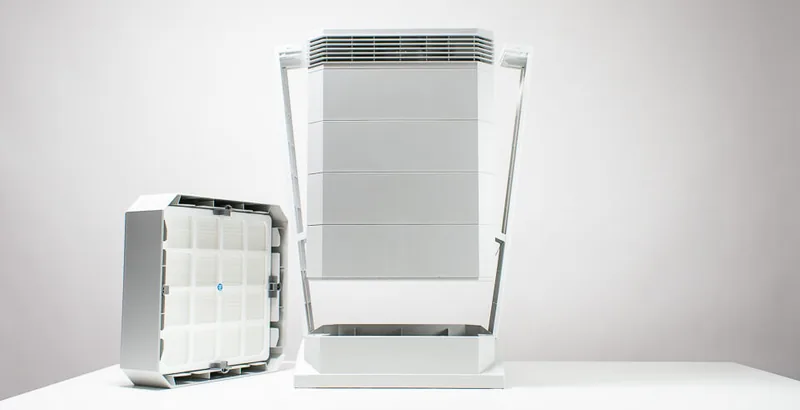
The IQAir HealthPro Plus is the particle filtration champion. Best for severe allergies, asthma, ultrafine pollution, and virus concerns. Swiss-engineered with a 10-year motor warranty and the quietest operation in its class.
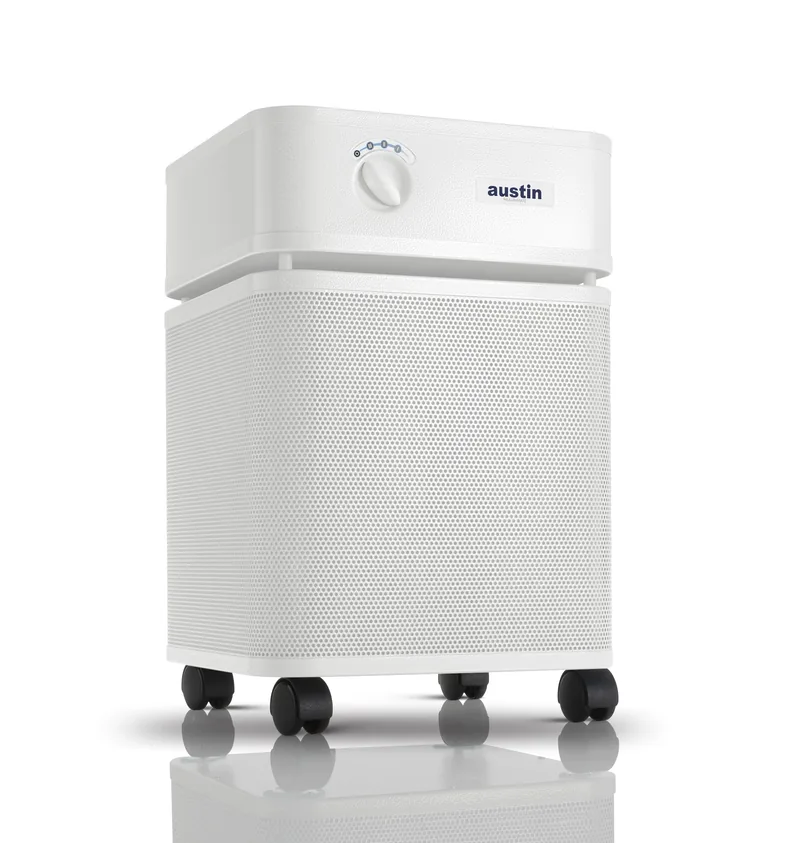
The Austin Air HealthMate HM400 is the gas and chemical filtration champion. Best for VOCs, chemical sensitivities, off-gassing, and smoke odors. Made in the USA with an all-steel build and an industry-leading 5-year filter life.
Sources & References
- AHAM (Association of Home Appliance Manufacturers) — CADR certification program and testing standards for portable air cleaners — neither IQAir nor Austin Air participates in AHAM Verifide
- California Air Resources Board (CARB) — Ozone emission certification for air cleaning devices sold in California
- IQAir Product Specifications — Manufacturer-published specifications and HyperHEPA certification data
- Austin Air Product Specifications — Manufacturer-published specifications for the HealthMate HM400
This guide was researched and written by the AirQualityNest editorial team. We update our content regularly to reflect the latest products, pricing, and research.
Frequently Asked Questions
Is IQAir better than Austin Air for allergies?+
Yes. The IQAir HealthPro Plus is the better choice for allergies. Its HyperHEPA filter captures particles down to 0.003 microns — 100x smaller than what standard HEPA filters target. This means it captures not only pollen, dust mites, and pet dander, but also ultrafine allergen fragments that pass through standard HEPA filters. If airborne allergens are your primary concern, the IQAir delivers the most thorough particle removal available in a home purifier.
Is Austin Air better than IQAir for chemicals and VOCs?+
Yes, significantly. The Austin Air HealthMate contains 15 lbs of activated carbon and zeolite — roughly 6x more gas-phase filtration media than the IQAir's V5-Cell. This massive carbon bed adsorbs VOCs, formaldehyde, benzene, and hundreds of other gaseous pollutants far more effectively and for far longer than the IQAir's smaller carbon stage. For chemical sensitivities, new home off-gassing, or any gas-phase air quality concern, the Austin Air is the clear choice.
Which purifier has lower long-term costs?+
Austin Air. The HealthMate's filters last 5 years and cost approximately $300 to replace, working out to about $60 per year. The IQAir HealthPro Plus requires filter replacements every 12-24 months depending on the stage, costing approximately $100-130 per year. Over 5 years, the Austin Air saves $200-350 in filter costs. Combined with its lower purchase price ($845 vs $1,199.99), the Austin Air is significantly more economical.
Which is quieter, IQAir or Austin Air?+
IQAir is substantially quieter. The HealthPro Plus operates at 22 dB on its lowest setting — barely audible in a quiet room. The Austin Air HealthMate starts at 35 dB on low, which is a noticeable hum. On maximum, the IQAir reaches 59 dB versus the Austin Air's 65 dB. For bedroom use or noise-sensitive environments, the IQAir has a clear advantage.
Do IQAir or Austin Air produce ozone?+
Neither purifier produces meaningful ozone. Both use purely mechanical filtration (HEPA media and activated carbon) without ionization, UV-C, plasma, or electrostatic charging. This makes them safe choices for people with severe respiratory conditions, including those who are sensitive to even trace ozone levels. Both are CARB-compliant for sale in California.
Related Reading
IQAir HealthPro Plus Review
Full editorial review based on specs and aggregated customer feedback
Austin Air HealthMate Review
In-depth look at Austin Air's flagship chemical-filtration purifier
Best Premium Air Purifiers
Our top picks for buyers with higher budgets
Dyson vs Blueair Comparison
Another premium head-to-head with different strengths
HEPA Filters Explained
How HEPA filtration works and what H13, H14, and HyperHEPA mean
Carbon Filters Explained
How activated carbon removes gases, VOCs, and odors from air
Continue Reading

Best Air Purifiers for Open Floor Plans in 2026: High-CADR Models That Cover It All
The best air purifiers for open floor plans ranked by CADR, coverage area, and noise. High-performance HEPA purifiers that handle 500-1,500+ sq. ft. open spaces.
Best Smart Humidifiers in 2026 (Wi-Fi, App Control & Auto Humidity)
The best smart humidifiers with Wi-Fi, app control, and auto humidity adjustment. Top picks for Alexa, Google Home, and smart home integration.
The 5 Best Portable Air Quality Monitors in 2026
Monitor your air quality on the go. We tested the best portable and compact air quality monitors for accuracy, battery life, and sensor range.