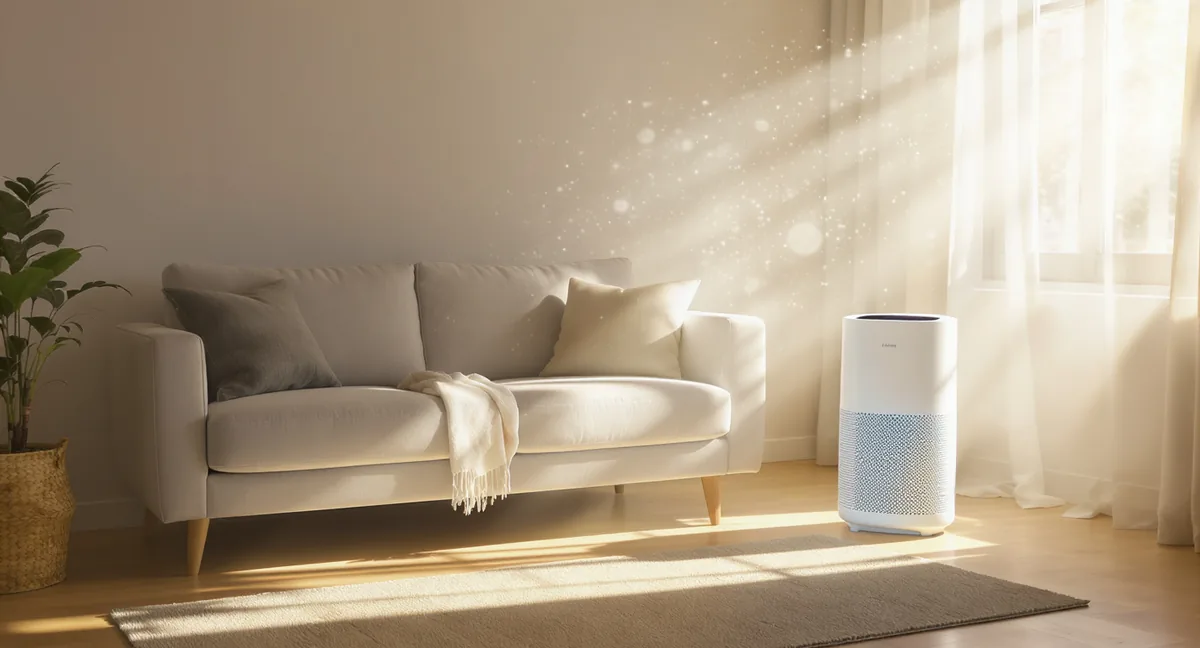
Coway and Blueair are two of the most respected names in air purification, but they approach the problem from entirely different directions. Coway, the South Korean brand behind the legendary Airmega AP-1512HH "Mighty," focuses on sensor-driven automation, energy efficiency, and competitive pricing. Blueair, the Swedish brand with nearly three decades of air purification expertise, emphasizes raw airflow performance through its proprietary HEPASilent technology and Scandinavian design sensibility.
Both brands make genuinely excellent purifiers. The question is not which brand is better — it is which brand's philosophy aligns with how you actually use an air purifier.
Based on our research and analysis of customer reviews across both lineups, here is the definitive comparison.
Key Takeaways
- 1Blueair's HEPASilent technology combines mechanical and electrostatic filtration, delivering higher CADR at lower noise levels than conventional HEPA — but it produces trace ozone (well below CARB safety limits).
- 2Coway's Eco mode is a standout feature: it turns the fan off entirely when air quality is good and restarts automatically when sensors detect particles. No Blueair model offers this energy-saving automation.
- 3Blueair covers more room area per model. The Blue Pure 211+ covers 540 sq ft versus the Coway AP-1512HH's 361 sq ft — a significant difference for open floor plans.
- 4Coway's air quality sensors and indicator lights are more responsive than Blueair's basic models, though Blueair's premium i-series models close this gap with app-connected sensors.
- 5The Blueair Blue Pure 211+ has customizable fabric pre-filters in multiple colors — a unique design touch that lets you match the purifier to your room decor.
- 6Annual filter costs are similar between the two brands (~$40-80/year depending on model), but Coway's lower purchase prices tilt the total cost of ownership in its favor.
Quick Answer
Should I buy a Coway or a Blueair air purifier?
Buy Coway if you want intelligent automation (Eco mode, responsive sensors), quiet bedroom operation, and the best value under $250. Buy Blueair if you need maximum airflow for large rooms, prefer Scandinavian design aesthetics, or specifically want HEPASilent technology's combination of high CADR and relatively low noise. For rooms under 400 sq ft, the Coway AP-1512HH is the smarter purchase. For larger open spaces above 400 sq ft, the Blueair Blue Pure 211+ has a clear advantage.
Brand Overview
Coway
Founded in South Korea in 1989, Coway has grown into one of the world's largest water and air purifier manufacturers. Their Airmega line dominates the North American market, with the AP-1512HH "Mighty" consistently ranking as one of the most recommended purifiers across review sites. Coway's design philosophy centers on sensor-driven intelligence: real-time air quality monitoring, automatic fan adjustment, and their signature Eco mode that powers down the fan entirely when the air is clean.
Key Coway models:
- Coway Airmega AP-1512HH — Mid-range classic (361 sq ft), ~$230. The legendary "Mighty."
- Coway Airmega 400 — Premium large-room purifier (1,560 sq ft), ~$450. Dual-filter design for big spaces.
Blueair
Founded in Stockholm, Sweden in 1996, Blueair has nearly 30 years of air purification heritage. They developed the proprietary HEPASilent technology — a hybrid approach that electrically charges airborne particles before they reach the filter media, allowing Blueair to use less dense filter material while maintaining high capture rates. This results in higher airflow with less fan effort and less noise per CFM. Blueair was acquired by Unilever in 2016.
Key Blueair models:
- Blueair Blue Pure 211+ — Mid-range workhorse (540 sq ft), ~$260. High CADR, simple controls.
- Blueair Blue Pure 211i Max — Large-room smart purifier (674 sq ft), ~$245. HEPASilent smart technology with app control.
Filtration Technology: The Core Difference
This is where these two brands diverge most fundamentally.
| Feature | Coway | Blueair |
|---|---|---|
| Primary technology | True HEPA mechanical filtration | HEPASilent (mechanical + electrostatic) |
| Particle capture | 99.97% at 0.3 microns | 99.97% at 0.1 microns (manufacturer claim) |
| How it works | Dense filter media traps particles mechanically | Electrical charge makes particles stick to less-dense media |
| Ozone production | Optional ionizer (can be turned off) | Inherent to HEPASilent process |
| Ozone safety | Zero with ionizer off | CARB certified (below 0.050 ppm) |
| Carbon filtration | Separate activated carbon filter | Integrated or separate carbon options |
| Pre-filter | Washable mesh pre-filter | Washable fabric pre-filter (Blue Pure series) |
Coway's approach: Dense HEPA media captures particles through mechanical interception, impaction, and diffusion. It is the proven, traditional approach. The trade-off is that denser media means more air resistance, requiring more fan effort (and more noise) to push air through at high flow rates.
Blueair's approach: HEPASilent charges particles with a small electrical field before they reach the filter. Charged particles stick to filter fibers more readily, so Blueair can use less dense filter material while achieving similar capture rates. The result is higher airflow with less resistance — meaning more CADR per decibel of noise. The trade-off is that the electrostatic charging process inherently produces trace amounts of ozone, though all Blueair models are CARB certified well below safety limits.
For most buyers: Both technologies deliver excellent particle capture. The practical difference is that Blueair can push more air through at a given noise level, which matters most in large rooms. If you are sensitive to ozone concerns — for instance, if you have birds or severe asthma — Coway with its ionizer turned off produces zero ozone emissions.
Head-to-Head: Coway AP-1512HH vs Blueair Blue Pure 211+
These are the models most buyers end up comparing — the best-selling mid-range options from each brand.
| Feature | Coway Airmega AP-1512HH | Blueair Blue Pure 211+ |
|---|---|---|
| Price | ~$230 | ~$260 |
| CADR (Dust) | 246 CFM | 350 CFM |
| CADR (Smoke) | 233 CFM | 300 CFM |
| Room Coverage | 361 sq ft | 540 sq ft |
| Noise (Low) | 24.4 dB | 31 dB |
| Noise (High) | 53.8 dB | 56 dB |
| Air Quality Sensor | Yes — color indicator (green/purple/red) | No (basic models) |
| Auto Mode | Yes — sensor-driven | No |
| Eco Mode | Yes — fan off when air is clean | No |
| Smart App | No | No (only on i-series models) |
| Pre-filter | Washable mesh | Washable fabric (customizable colors) |
| Annual Filter Cost | ~$40 | ~$40-50 |
| Weight | 12.3 lbs | 13.2 lbs |
| Dimensions | 16.8 x 18.3 x 9.6 in | 13 x 13 x 20.5 in |
| ENERGY STAR | Yes | Yes |
1. CADR and Room Coverage: Blueair Wins Big
This is Blueair's strongest advantage. The Blue Pure 211+ delivers 350 CFM for dust versus the Coway's 246 CFM — a 42% CADR advantage. That translates directly to room coverage: the Blueair handles 540 sq ft versus 361 sq ft for the Coway.
In Air Changes Per Hour (the metric that actually determines air-cleaning effectiveness):
- At 300 sq ft: Coway delivers ~6.1 ACH, Blueair delivers ~8.7 ACH
- At 400 sq ft: Coway drops to ~4.6 ACH, Blueair maintains ~6.5 ACH
- At 500 sq ft: Coway is below 4 ACH (inadequate for allergies), Blueair still delivers ~5.2 ACH
For open floor plans, large living rooms, or combined kitchen-living spaces: The Blueair's higher CADR is a meaningful advantage. It cleans larger volumes of air faster.
For standard bedrooms and home offices (under 350 sq ft): Both purifiers deliver excellent ACH, and the CADR difference is less impactful.
2. Sensor Intelligence: Coway Wins Decisively
The Coway AP-1512HH has an air quality sensor that continuously monitors particle levels and displays the results through a color-coded LED ring (blue for good, purple for moderate, red for poor). This sensor drives two features that no basic Blueair model offers:
Auto Mode: The fan speed adjusts automatically based on real-time air quality readings. When someone cooks, lights a candle, or opens a window, the Coway detects the increase in particles and ramps up the fan. When the air clears, it steps back down. Based on customer reviews, the auto mode is responsive and reliable — it reacts within 30-60 seconds to changes in air quality.
Eco Mode: This is Coway's signature feature. When the air quality sensor detects consistently clean air for 30 minutes, Eco mode turns the fan off entirely — and with it, the noise and energy consumption drop to zero. The sensor continues monitoring, and the fan restarts automatically if particles rise above the threshold. According to customer reviews, this feature is especially valued for overnight use: the purifier runs when needed and sleeps when it does not.
The Blueair Blue Pure 211+ has no air quality sensor, no auto mode, and no eco mode. You set a fan speed manually and it runs continuously at that speed. For buyers who want set-it-and-forget-it operation, this simplicity is perfectly fine. But for buyers who value smart automation, the Coway is in a different league.
Note: Blueair's premium i-series models (like the 311i+ and HealthProtect 7470i) do include sensors and app connectivity. But those models cost $250-550, putting them in a higher price tier.
3. Noise Levels: Coway Wins on Low, Both Loud on High
| Setting | Coway AP-1512HH | Blueair Blue Pure 211+ |
|---|---|---|
| Low | 24.4 dB | 31 dB |
| Medium | ~40 dB | ~44 dB |
| High | 53.8 dB | 56 dB |
The Coway is significantly quieter on low speed — 24.4 dB versus 31 dB. That 6.6 dB gap is clearly audible in a quiet bedroom. For overnight use, the Coway's whisper-quiet low speed (and its Eco mode, which eliminates noise entirely when air is clean) gives it a substantial advantage.
On high speed, both are loud enough to notice. The Blueair's 56 dB is roughly equivalent to a normal conversation, while the Coway's 53.8 dB is marginally quieter. Neither is suitable for quiet environments on their maximum setting.
However: The Blueair delivers more CADR per decibel than the Coway, thanks to HEPASilent technology. At 31 dB on low, the Blueair is moving more air than the Coway at 24.4 dB. If you compare them at the same CADR output, the noise difference narrows. This is HEPASilent's core engineering advantage — more airflow with less fan effort.
4. Design: Different Aesthetics, Both Thoughtful
The Coway AP-1512HH has a compact, rounded rectangle design with a modern air quality indicator on the front panel. It is sleek, unobtrusive, and lightweight at 12.3 lbs. It looks like a well-designed home appliance — professional without being flashy.
The Blueair Blue Pure 211+ has a distinctive cylindrical tower design with 360-degree air intake and a colored fabric pre-filter that wraps around the base. The fabric pre-filter comes in multiple colors (diva blue, dark shadow, buff yellow, crystal pink, and lunar rock), allowing you to customize the purifier's appearance to match your room decor. This is a unique touch that no Coway model offers.
Both brands produce attractive, modern-looking purifiers. The Blueair's fabric customization gives it a slight edge for design-conscious buyers, while the Coway's compact footprint is better for tight spaces.
5. Filter Costs and Total Ownership
| Cost Over 3 Years | Coway AP-1512HH | Blueair Blue Pure 211+ |
|---|---|---|
| Purchase price | $230 | $260 |
| Year 1 filters | $40 | $45 |
| Year 2 filters | $40 | $45 |
| Year 3 filters | $40 | $45 |
| 3-Year Total | ~$350 | ~$395 |
The total cost difference is modest — roughly $45 over three years. Coway's advantage comes from its lower purchase price rather than dramatically cheaper filters.
Moving Up: Large-Room Tier Comparison
| Cost Over 3 Years | Coway Airmega 400 | Blueair Blue Pure 211i Max |
|---|---|---|
| Purchase price | $450 | $245 |
| Annual filter cost | ~$80 | ~$75 |
| 3-Year Total | ~$690 | ~$470 |
At the large-room tier, the value equation has flipped. The Blueair Blue Pure 211i Max at $245 covers 674 sq ft with HEPASilent smart technology, app control, and a 23 dB low setting. The Coway Airmega 400 at $450 covers up to 1,560 sq ft with dual filters — more coverage, but at nearly double the price. The Blueair is now the more affordable option by a wide margin.
6. Eco Mode and Energy Efficiency
Both models are ENERGY STAR certified, but Coway's Eco mode takes energy efficiency a step further. When the air is clean, Eco mode shuts the fan off completely, reducing power consumption to sensor-monitoring levels only — a fraction of a watt. Over months of operation, this adds up.
According to customer reviews, Eco mode runs the fan approximately 30-50% of the time in typical homes with reasonable baseline air quality. That translates to meaningful energy savings and reduced noise exposure compared to a purifier running continuously at low speed.
The Blueair Blue Pure 211+ runs at whatever speed you set, 24 hours a day. On low speed it draws approximately 30W — modest, but more than the Coway's average consumption over a full day with Eco mode engaged.
7. Premium Options From Each Brand
Coway Airmega 400 (~$450)
The Airmega 400 is Coway's large-room flagship. It covers up to 1,560 sq ft with dual HEPA filters, includes a comprehensive air quality sensor, auto and Eco modes, and a filter life indicator. It is one of the highest-CADR consumer purifiers available, making it suitable for open floor plans, large living areas, and even small commercial spaces. Customer reviews consistently praise its ability to handle large spaces while remaining relatively quiet.
Blueair Blue Pure 211i Max (~$245)
The Blue Pure 211i Max is Blueair's current large-room offering, covering up to 674 sq ft with HEPASilent smart technology, app connectivity, and auto mode. At $245, it is priced very close to the Coway AP-1512HH — making the brand comparison tighter than ever on price. Its 410 CADR and 23 dB low setting deliver strong performance at a whisper-quiet volume. The 211i Max replaced the discontinued Classic 605, trading some raw CADR for dramatically better value and smarter features.
Who Should Buy Which
Buy Coway if:
- You want smart automation without paying premium prices — auto mode and Eco mode are included on the $230 AP-1512HH
- Quiet bedroom operation is a priority (24.4 dB on low is hard to beat)
- Energy efficiency matters — Eco mode reduces running costs over time
- Your room is under 400 sq ft — the AP-1512HH provides excellent coverage at this size
- You prefer zero-ozone filtration (with the ionizer turned off)
- You want responsive air quality feedback (the color indicator reacts quickly to changes)
Buy Blueair if:
- You need maximum airflow for a large room or open floor plan (540+ sq ft with the 211+)
- You value design customization — the colored fabric pre-filters are a unique touch
- You prefer HEPASilent technology's higher CADR-to-noise ratio
- You want a purifier for heavy pollution events (wildfire smoke, high-pollen days) where raw airflow matters most
- Scandinavian design aesthetics appeal to you
- Simplicity is a feature — you want to set a speed and leave it alone without sensor-driven automation
The Bottom Line
Coway is the smarter purchase for most buyers. The AP-1512HH delivers sensor-driven automation, whisper-quiet operation, Eco mode energy savings, and a proven filtration track record for $230. For bedrooms, home offices, and standard-sized living rooms, it does everything most people need from an air purifier — and it does it quietly and efficiently.
Blueair is the better choice for large spaces. When you need to move serious volumes of air — in open floor plans, large living rooms, or during heavy pollution events — the Blue Pure 211+'s 42% CADR advantage over the Coway translates to faster, more thorough air cleaning. HEPASilent technology delivers that higher airflow with less noise per CFM than traditional HEPA, making it the performance leader in its price range.
Based on our research, these are both genuinely excellent brands with distinct strengths. The right choice depends on whether you need smart automation and quiet efficiency (Coway) or maximum airflow and Scandinavian design (Blueair). Either way, you are getting a high-quality air purifier backed by a reputable manufacturer.
This guide was researched and written by the AirQualityNest editorial team. We update our content regularly to reflect the latest products, pricing, and research.
Frequently Asked Questions
Is Coway or Blueair better for allergies?+
Both are excellent for allergies. The Coway AP-1512HH's auto mode and air quality sensor make it responsive to allergen spikes, automatically increasing fan speed when pollen or dust levels rise. The Blueair Blue Pure 211+ has a higher CADR, meaning it cleans more air volume faster — an advantage in larger rooms where allergens can accumulate. For bedrooms under 350 sq ft, Coway is the better pick. For larger living spaces, Blueair's higher airflow gives it an edge.
Does Blueair produce ozone?+
Blueair's HEPASilent technology produces trace amounts of ozone as part of the electrostatic charging process. All Blueair models are CARB certified with ozone levels well below the 0.050 ppm safety threshold. For the vast majority of users, this is not a health concern. However, if you have birds, severe asthma, or strong preferences against any ozone production, Coway with its ionizer turned off produces zero ozone.
What is Coway Eco mode and is it worth it?+
Eco mode is a Coway-exclusive feature. When the air quality sensor detects consistently clean air for 30 minutes, Eco mode turns the fan off entirely while the sensor continues monitoring. If particle levels rise, the fan restarts automatically. According to customer reviews, this reduces running time by 30-50% in homes with reasonable baseline air quality, saving energy and reducing noise exposure. It is especially valued for overnight use.
Which has better filters, Coway or Blueair?+
Both use excellent filtration. Coway uses standard True HEPA (99.97% at 0.3 microns) while Blueair uses HEPASilent, which combines electrostatic and mechanical filtration. Annual filter costs are similar ($40-50/year for mid-range models). Coway filters are slightly cheaper. Blueair's Blue Pure fabric pre-filters are customizable and washable. Both deliver thorough particle capture for dust, pollen, pet dander, and smoke.
Can I use a Blueair Blue Pure 211+ in a bedroom?+
Yes, but it is not ideal for noise-sensitive sleepers. The Blue Pure 211+ runs at 31 dB on low — quiet, but noticeably louder than the Coway AP-1512HH's 24.4 dB. In a quiet bedroom, that 6.6 dB difference is perceptible. The 211+ also lacks auto mode and Eco mode, so it runs continuously at whatever speed you set. For bedrooms, the Coway's quieter operation and smart automation make it the better fit.
Related Reading
Blueair 211+ vs Coway AP-1512HH
Detailed model-to-model comparison of these two popular purifiers
Levoit vs Blueair
How Blueair compares to the other top value brand
Coway vs Winix
Two sensor-equipped brands compared on features and value
Best Air Purifiers for Allergies
Top picks for allergy sufferers including Coway and Blueair models
Continue Reading
Best Air Purifiers for Open Floor Plans in 2026: High-CADR Models That Cover It All
The best air purifiers for open floor plans ranked by CADR, coverage area, and noise. High-performance HEPA purifiers that handle 500-1,500+ sq. ft. open spaces.
Best Smart Humidifiers in 2026 (Wi-Fi, App Control & Auto Humidity)
The best smart humidifiers with Wi-Fi, app control, and auto humidity adjustment. Top picks for Alexa, Google Home, and smart home integration.
The 5 Best Portable Air Quality Monitors in 2026
Monitor your air quality on the go. We tested the best portable and compact air quality monitors for accuracy, battery life, and sensor range.