Every few years, a company claims to have invented something better than HEPA. Molekule's PECO (Photo Electrochemical Oxidation) technology is the most prominent challenger in recent memory, promising to destroy pollutants at a molecular level rather than simply trapping them. It is an appealing pitch. It is also an expensive one — and the evidence behind it deserves scrutiny.
This guide compares Molekule's PECO technology against traditional HEPA filtration, using the Molekule Air Mini+ ($360) and the Coway Airmega AP-1512HH ($229) as our representative models. We examine how each technology works, what the independent evidence says, and which one actually delivers better air quality for your money.
Key Takeaways
- 1HEPA filtration is backed by decades of peer-reviewed research and captures 99.97% of particles at 0.3 microns. It is the gold standard endorsed by the EPA, allergists, and pulmonologists.
- 2Molekule's PECO technology claims to destroy pollutants rather than trap them, but the company does not publish traditional CADR ratings — making independent performance verification difficult.
- 3The FTC previously raised concerns about Molekule's advertising claims, and independent analyses have questioned whether PECO delivers meaningful advantages over standard HEPA in real-world conditions.
- 4The Coway AP-1512HH costs $171 less upfront and approximately $90-120 less per year in filter replacements compared to the Molekule Air Mini+.
- 5Customer reviews tell a clear story: the Coway consistently earns 4.5+ stars across thousands of reviews, while the Molekule has significantly more mixed ratings with recurring complaints about underwhelming performance.
Quick Answer
Should I buy a Molekule or a HEPA air purifier?
For the vast majority of buyers, a traditional HEPA air purifier like the Coway Airmega AP-1512HH is the better purchase. It costs less upfront ($229 vs $360), has dramatically lower filter replacement costs (~$40/year vs $130-160/year), publishes AHAM-verified CADR ratings, and has decades of clinical evidence supporting its effectiveness. Molekule's PECO technology makes interesting claims about destroying pollutants at the molecular level, but independent verification is limited, the company has faced FTC scrutiny over its marketing, and customer reviews are notably more mixed. PECO may have niche potential for VOC destruction, but the evidence is not strong enough to justify paying nearly twice the price.
How Each Technology Works
Understanding the fundamental difference between PECO and HEPA is essential before comparing products. These are not two versions of the same approach — they represent entirely different philosophies of air purification.
HEPA: Mechanical Filtration (Proven Since the 1940s)
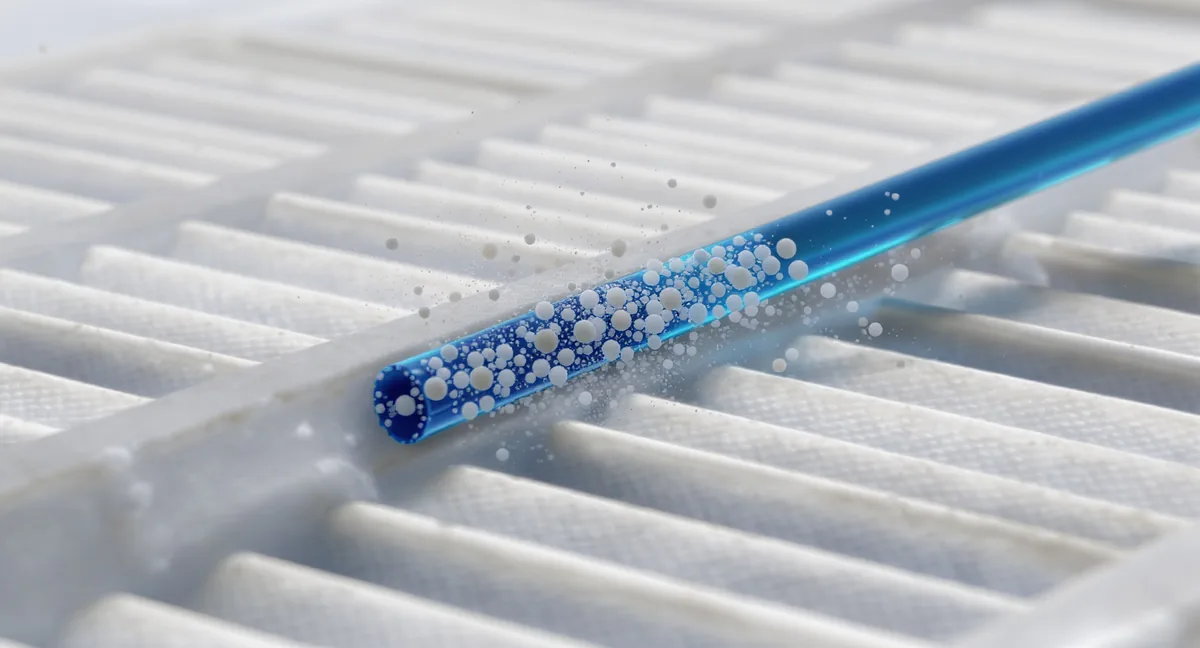
HEPA (High-Efficiency Particulate Air) filtration was developed during the Manhattan Project to capture radioactive particles. The technology uses a dense mat of randomly arranged fibers — typically fiberglass or synthetic material — that traps particles through three physical mechanisms: impaction, interception, and diffusion.
A True HEPA filter must capture 99.97% of particles at 0.3 microns — the Most Penetrating Particle Size (MPPS). Particles both smaller and larger are actually caught at even higher rates. This standard is internationally recognized (DOE STD-3020-2015) and has been validated by thousands of independent studies over 80 years.
The Coway AP-1512HH uses a four-stage system: a washable pre-filter, a deodorization carbon filter, a True HEPA filter, and an air quality indicator. Air is drawn through these stages by a fan, and what comes out the other side contains 99.97% fewer particles. The particles stay trapped in the filter until you replace it. Simple, proven, and verifiable.
PECO: Photo Electrochemical Oxidation (Molekule's Proprietary Approach)
Molekule's PECO technology uses a light-activated catalytic process. UV-A light shines on a proprietary nano-coated filter, generating free radicals (hydroxyl radicals) on the filter surface. These free radicals are intended to oxidize and break down organic pollutants — bacteria, mold, viruses, VOCs, and allergens — at the molecular level, converting them into trace amounts of carbon dioxide and water.
The promise is significant: rather than just trapping pollutants, PECO claims to destroy them. In theory, this means the filter never becomes a reservoir of captured biological contaminants, and volatile organic compounds that pass through standard HEPA are broken down.
The concept has scientific roots. Photocatalytic oxidation is a real and studied process used in industrial applications and water treatment. The question is not whether the underlying chemistry is real — it is whether Molekule's consumer implementation delivers meaningful, measurable air quality improvements that justify the cost premium.
What Does the Independent Evidence Say?
This is where the comparison becomes critical. Based on our research, the evidence landscape for each technology is starkly different.
HEPA: Overwhelming Independent Validation
HEPA filtration has been studied in thousands of peer-reviewed papers. Its effectiveness against particles — including allergens, dust, smoke, mold spores, and many bacteria — is not debated in the scientific community. The EPA, CDC, ASHRAE, and allergist organizations worldwide recommend HEPA purifiers for improving indoor air quality.
The Coway AP-1512HH specifically has AHAM-verified CADR ratings of 233 (dust), 246 (pollen), and 240 (smoke). AHAM (Association of Home Appliance Manufacturers) testing is the industry standard — a third-party organization tests the purifier in a controlled chamber and publishes verified performance numbers. You know exactly what you are getting.
Molekule: Limited Independent Verification and FTC Scrutiny
Molekule funded internal studies conducted at the University of Minnesota and the University of South Florida, which reported positive results for PECO's ability to destroy certain pollutants. However, these studies were industry-funded and tested under controlled laboratory conditions that may not reflect real-world residential use.
More importantly, the Federal Trade Commission (FTC) raised concerns about Molekule's advertising claims. The company's early marketing made bold statements about destroying pollutants that competitors could not, and the FTC questioned whether these claims were adequately substantiated. This led Molekule to modify some of its marketing language.
Molekule does not publish traditional CADR ratings. The company has argued that CADR testing does not capture PECO's full capabilities since it measures particle removal, not destruction. While this argument has some theoretical merit, the practical effect is that consumers cannot compare Molekule's performance against other purifiers using the industry's standard metric. According to independent reviewers who have attempted to measure the Molekule's particle removal capabilities, its performance in traditional particle filtration appears to lag significantly behind similarly priced HEPA purifiers.
Head-to-Head Specs
| Feature | Molekule Air Mini+ | Coway Airmega AP-1512HH |
|---|---|---|
| Price | ~$360 | ~$229 |
| Technology | PECO (Photo Electrochemical Oxidation) | True HEPA + Activated Carbon |
| CADR Rating | Not published | 233/246/240 (dust/pollen/smoke) — AHAM verified |
| Room Coverage | ~250 sq ft (manufacturer claim) | 361 sq ft (AHAM verified) |
| Particle Filtration Standard | No standard HEPA certification | True HEPA — 99.97% at 0.3 microns |
| VOC Treatment | Claims molecular destruction via oxidation | Activated carbon adsorption |
| Noise (Low/High) | ~30 / ~56 dB | 24.4 / 53.8 dB |
| Filter Replacement | PECO filter ( | HEPA + carbon combo (~$40) |
| Annual Filter Cost | ~$130-160 | ~$40 |
| Smart Features | App control, particle sensor | Air quality indicator light |
| Weight | 7.3 lbs | 12.3 lbs |
| Warranty | 1-year limited | 3-year limited |
The Cost Gap Is Enormous
Price is where the HEPA advantage becomes impossible to ignore. The Molekule Air Mini+ costs nearly twice the purchase price of the Coway, and the difference compounds dramatically over time due to filter replacement costs.
| Cost Over 3 Years | Molekule Air Mini+ | Coway AP-1512HH |
|---|---|---|
| Purchase price | $360 | $229 |
| Year 1 filters | $130-160 | $40 |
| Year 2 filters | $130-160 | $40 |
| Year 3 filters | $130-160 | $40 |
| 3-Year Total | $790-880 | $349 |
Over three years, you will spend $441-531 more on the Molekule — roughly 2.3-2.5 times the total cost of the Coway. That premium might be justifiable if PECO delivered dramatically better air quality. Based on the available evidence, that case has not been convincingly made.
The Molekule's PECO filter needs replacement approximately every 6 months at ~$65, and the pre-filter every 3 months at ~$30. The Coway's HEPA and carbon filter combination costs approximately $40 per year — one of the lowest ongoing costs of any air purifier on the market.
Customer Satisfaction: A Tale of Two Products
Customer reviews provide a useful reality check beyond marketing claims and spec sheets. According to customer reviews across major retailers, the contrast between these two products is striking.
Coway AP-1512HH: Consistently Excellent
The Coway Airmega AP-1512HH maintains a 4.5+ star average across tens of thousands of Amazon reviews, making it one of the highest-rated air purifiers ever sold. Common themes in positive reviews include noticeable allergy relief, quiet operation, reliability over years of use, and low maintenance costs. Wirecutter, Consumer Reports, and multiple editorial outlets have named it a top pick repeatedly.
Negative reviews for the Coway are relatively rare and typically focus on minor issues: the air quality indicator light accuracy, the ionizer feature (which can be disabled), or occasional manufacturing defects — standard concerns for any consumer appliance sold at volume.
Molekule Air Mini+: Notably Mixed
The Molekule Air Mini+ has a significantly more polarized review profile. While some customers report satisfaction — particularly those who purchased it for odor and VOC concerns — a substantial number of reviews express disappointment with actual air-cleaning performance. According to customer reviews, recurring complaints include:
- Underwhelming particle removal — customers who purchased air quality monitors report that the Molekule does not reduce PM2.5 levels as effectively as similarly priced HEPA purifiers
- Expensive filter replacements — many buyers report sticker shock when they discover the ongoing filter costs
- Reliability concerns — some reviews mention hardware issues and difficulty with customer service
- Performance does not match marketing — a common theme is that the product underdelivers relative to the premium price and bold claims
These are customer observations, not controlled experiments. But when hundreds of verified purchasers independently report similar experiences, the pattern deserves weight in a buying decision.
The VOC Question: Does PECO Have a Legitimate Niche?
The strongest theoretical case for PECO is VOC (volatile organic compound) destruction. Traditional HEPA filters do not capture gaseous pollutants — that is the job of activated carbon filters, which adsorb VOCs but eventually saturate and need replacement. PECO claims to oxidize and destroy VOCs rather than just capturing them.
This is where PECO's science is most credible. Photocatalytic oxidation can break down organic molecules, and in controlled laboratory settings, Molekule's funded studies showed reductions in certain VOCs. The question is whether this translates into meaningful real-world VOC reduction in a typical home.
Several factors complicate the picture:
- Incomplete oxidation — Photocatalytic processes can produce intermediate byproducts if the oxidation is not complete. Some research on photocatalytic oxidation systems has found that incomplete oxidation can generate formaldehyde or other secondary pollutants, though Molekule states their system achieves complete oxidation.
- Contact time — Real-world air purifiers push air through filters quickly. The contact time between air and the catalytic surface may be shorter than what laboratory studies used.
- VOC concentration — Typical residential VOC levels are relatively low. The practical benefit of VOC destruction may be marginal compared to simply running a quality activated carbon filter and addressing VOC sources directly (ventilation, source removal).
For buyers with specific, identified VOC concerns — new construction off-gassing, proximity to industrial sources, chemical sensitivities — the concept of catalytic VOC destruction is worth investigating. But a high-quality HEPA purifier with a robust activated carbon filter, combined with proper ventilation, addresses VOC concerns effectively for most households at a fraction of the cost.
Room Coverage and Performance
Without CADR ratings for the Molekule, direct performance comparison requires relying on manufacturer room coverage claims and independent observations.
The Coway AP-1512HH covers 361 square feet based on its AHAM-verified CADR of 233 — delivering approximately 4.8 air changes per hour in a 250 square foot room. This is concrete, third-party verified data.
The Molekule Air Mini+ claims coverage of approximately 250 square feet. However, without CADR verification, independent reviewers and customers have reported that its effective coverage for meaningful particle reduction appears to be smaller than this claim suggests. The Air Mini+ is physically a compact device — at 7.3 pounds, it is substantially smaller than the Coway — and its fan capacity is limited accordingly.
For bedrooms and small offices, the Molekule may provide adequate coverage. For living rooms, open floor plans, or any space above 200 square feet, the Coway's verified CADR delivers significantly more confidence in its air-cleaning reach.
The Verdict: HEPA Is the Proven Choice
Based on our research into the available evidence, customer feedback, expert analysis, and cost comparison, traditional HEPA filtration remains the clearly superior choice for the vast majority of air purifier buyers.
The Coway Airmega AP-1512HH represents everything the air purifier industry has refined over decades: proven filtration technology with verifiable performance, low ongoing costs, quiet operation, and consistently high customer satisfaction. At $229, it delivers outstanding value.
The Molekule Air Mini+ represents an interesting technological concept that has not yet demonstrated — through independent, third-party verification — that it delivers better real-world results than a good HEPA purifier costing half as much. The FTC's scrutiny of its marketing claims, the absence of CADR ratings, the dramatically higher cost of ownership, and the mixed customer reviews all suggest that the premium is difficult to justify for most buyers.
If your primary concerns are allergies, dust, pet dander, smoke, or general indoor air quality — buy a HEPA purifier. The Coway AP-1512HH, or alternatives like the Levoit Core 400S or Winix 5510, deliver proven performance at reasonable prices.
If your specific concern is VOC destruction — PECO is conceptually interesting, but consider whether a quality HEPA purifier with a robust carbon filter and better ventilation might address your needs at far lower cost. You might also explore our guide to the best air purifiers for VOCs for options that tackle chemical pollutants without the Molekule's cost premium.
Sources & References
- Federal Trade Commission (FTC) — FTC has previously scrutinized Molekule's advertising claims regarding air purifier performance
- AHAM (Association of Home Appliance Manufacturers) — CADR certification program — Coway AP-1512HH has verified ratings; Molekule does not participate
- EPA — Guide to Air Cleaners in the Home — EPA guidance on portable air cleaners, recommending HEPA filtration for particle removal
- DOE STD-3020-2015 — U.S. Department of Energy HEPA filter standard — 99.97% efficiency at 0.3 microns
This guide was researched and written by the AirQualityNest editorial team. We update our content regularly to reflect the latest products, pricing, and research.
Frequently Asked Questions
Is Molekule PECO better than HEPA?+
Based on the available independent evidence, HEPA filtration remains the proven, superior choice for most air purification needs. HEPA captures 99.97% of particles at 0.3 microns with decades of peer-reviewed validation. Molekule's PECO technology claims to destroy pollutants at a molecular level, but the company does not publish CADR ratings, has faced FTC scrutiny over its marketing claims, and customer reviews are notably more mixed than leading HEPA purifiers. PECO may have theoretical advantages for VOC destruction, but the real-world evidence is limited.
Why doesn't Molekule publish CADR ratings?+
Molekule has stated that standard CADR testing does not capture PECO's full capabilities since the test measures particle removal from the air, not molecular destruction of pollutants. While this argument has some theoretical basis, the practical effect is that consumers cannot compare Molekule's performance against other purifiers using the industry's standard, third-party verified metric. Most major air purifier brands — including Coway, Levoit, Blueair, and Honeywell — participate in AHAM's CADR verification program.
What did the FTC say about Molekule?+
The FTC raised concerns about Molekule's advertising claims, particularly regarding assertions that PECO technology was superior to HEPA and could eliminate pollutants that HEPA could not. The scrutiny led Molekule to modify some of its marketing language. This does not necessarily mean PECO does not work — but it does mean that some of the company's original performance claims were not adequately substantiated according to federal standards.
Are Molekule filters expensive?+
Yes. The Molekule Air Mini+ requires a PECO filter replacement approximately every 6 months (~$65) and a pre-filter replacement approximately every 3 months (~$30). This results in annual filter costs of approximately $130-160. By comparison, the Coway AP-1512HH's annual filter cost is approximately $40 — roughly one-quarter of the Molekule's ongoing expense.
Is PECO technology legitimate?+
Photocatalytic oxidation — the scientific principle behind PECO — is a real and studied process used in industrial and water treatment applications. The question is not whether the underlying chemistry works, but whether Molekule's consumer implementation delivers meaningful, measurable improvements over proven HEPA technology in real-world home environments. Industry-funded studies showed positive results under controlled conditions, but independent, third-party validation of PECO's residential performance remains limited.
Related Reading
What Is a HEPA Filter?
Deep dive into how HEPA filtration works and why the 0.3 micron standard matters
HEPA vs Ionic Air Purifier
Another alternative technology compared to HEPA — and why HEPA wins again
Best Air Purifiers for VOCs
Top-rated purifiers for chemical pollutant removal without the PECO premium
Molekule Air Mini+ Review
Our full editorial review of Molekule's compact PECO purifier
Continue Reading

Best Air Purifiers for Open Floor Plans in 2026: High-CADR Models That Cover It All
The best air purifiers for open floor plans ranked by CADR, coverage area, and noise. High-performance HEPA purifiers that handle 500-1,500+ sq. ft. open spaces.
Best Smart Humidifiers in 2026 (Wi-Fi, App Control & Auto Humidity)
The best smart humidifiers with Wi-Fi, app control, and auto humidity adjustment. Top picks for Alexa, Google Home, and smart home integration.
The 5 Best Portable Air Quality Monitors in 2026
Monitor your air quality on the go. We tested the best portable and compact air quality monitors for accuracy, battery life, and sensor range.