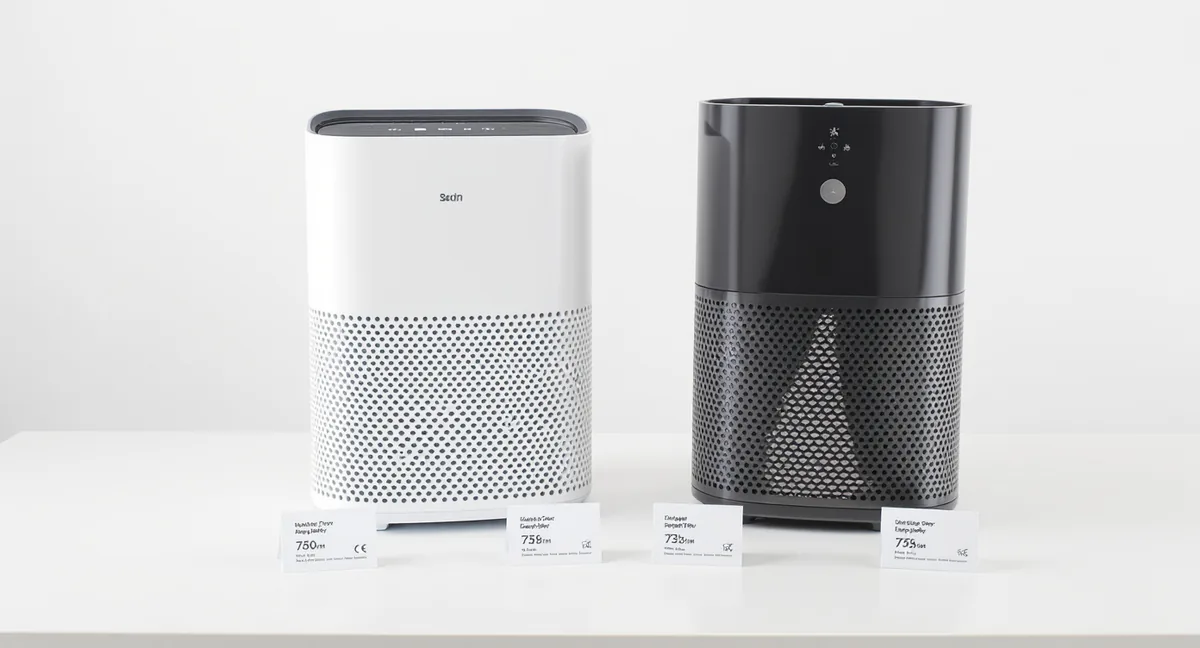
The Honeywell HPA300 and Winix 5510 are two of the most popular air purifiers under $250 — but they could not be more different in philosophy. The Honeywell is a brute-force air-moving machine with some of the highest CADR ratings in its price class. The Winix is a quieter, smarter, more energy-efficient purifier that adds PlasmaWave ionization technology, WiFi app control, a built-in air quality monitor, and auto mode.
At $250 vs. $180, the $70 price gap is just the beginning of the story. Based on our research into published specifications, customer reviews, and long-term operating costs, the right choice depends entirely on what you prioritize: maximum airflow or smarter, quieter operation.
Key Takeaways
- 1The Honeywell HPA300 dominates on CADR with ratings of 300/320/300 (smoke/dust/pollen) vs. the Winix's 253/253/253 — still a significant airflow advantage.
- 2The Winix 5510 is dramatically quieter at ~23.5 dB on low vs. the Honeywell's ~42 dB. For bedrooms and quiet spaces, the Winix wins decisively.
- 3Winix includes PlasmaWave technology, WiFi app control, a built-in air quality monitor, and auto mode — features the Honeywell lacks entirely.
- 4Filter costs favor the Winix at ~$80/year vs. the Honeywell's ~$90-100/year, and the Winix has a washable carbon filter that reduces ongoing expenses.
- 5The Honeywell covers up to 465 sq. ft. vs. the Winix's 392 sq. ft. — making it the better choice for large open rooms where raw airflow matters most.
Quick Answer
Should I buy the Honeywell HPA300 or Winix 5510?
Buy the Winix 5510 if your room is under 392 sq. ft. and you want quiet operation, smart auto mode, WiFi app control, and lower running costs. It is the better bedroom purifier and the better value for most homes. Buy the Honeywell HPA300 if you need to cover a large room (400+ sq. ft.), want the fastest possible particle clearance during events like cooking smoke or wildfire season, or prioritize raw airflow power over refinement. The Honeywell moves more air but pays for it with significantly more noise and higher operating costs.
Head-to-Head Specs
| Feature | Honeywell HPA300 | Winix 5510 |
|---|---|---|
| Price | $249.99 | $179.99 |
| CADR (Smoke/Dust/Pollen) | 300/320/300 | 253/253/253 |
| Coverage | 465 sq. ft. | 392 sq. ft. |
| Filter Type | True HEPA + Carbon Pre-filter | True HEPA + PlasmaWave + Carbon |
| Noise (Low) | ~42 dB | ~23.5 dB |
| Noise (High) | ~63 dB | ~65.7 dB |
| ENERGY STAR | No | Yes |
| Smart Features | Timer only | Auto mode + air quality monitor + WiFi app |
| PlasmaWave | No | Yes (can be disabled) |
| Pre-filter | Replaceable (every 3 months) | Washable |
| Annual Filter Cost | ~$90-100 | ~$80 |
| Weight | 17 lbs | 15.4 lbs |
| Dimensions | 20.1 x 22.8 x 10.8 in | 15 x 23.6 x 8.2 in |
1. CADR and Air Cleaning Performance
Winner: Honeywell HPA300 — by a wide margin
The Honeywell HPA300 has AHAM-verified CADR ratings of 300 Smoke, 320 Dust, and 300 Pollen. The Winix 5510 comes in at 253/253/253. The Honeywell still moves more clean air per minute than the Winix, though the gap has narrowed.
| Metric | Honeywell HPA300 | Winix 5510 |
|---|---|---|
| CADR (Smoke) | 300 CFM | 253 CFM |
| CADR (Dust) | 320 CFM | 253 CFM |
| CADR (Pollen) | 300 CFM | 253 CFM |
| ACH in 300 sq. ft. | 7.5 | 6.3 |
| ACH in 400 sq. ft. | 5.6 | 4.7 |
In practical terms, the Honeywell will clear a room of airborne particles significantly faster. If you are dealing with wildfire smoke, heavy cooking fumes, or a renovation project, the HPA300's raw throughput is a genuine advantage. According to customer reviews, the Honeywell is frequently praised for its rapid air clearance in high-pollution events.
Key caveat: Both purifiers use True HEPA filters that capture 99.97% of particles at 0.3 microns. The filtration quality is identical — the Honeywell simply processes more air volume through the same grade of filter media.
2. Room Coverage
Winner: Honeywell HPA300
The Honeywell is rated for rooms up to 465 sq. ft. compared to the Winix's 392 sq. ft. The gap narrows when you account for effective air changes per hour (ACH). Most experts recommend 4+ ACH for meaningful air quality improvement.
| Room Size | Honeywell ACH | Winix ACH | Better Choice |
|---|---|---|---|
| 200 sq. ft. | 11.2 | 9.5 | Either works |
| 300 sq. ft. | 7.5 | 6.3 | Either works |
| 392 sq. ft. | 5.7 | 4.8 | Either works |
| 465 sq. ft. | 4.8 | 4.1 | Honeywell recommended |
The updated picture: The Winix 5510 with its improved 253 CFM CADR delivers solid 4+ ACH in rooms up to its rated 392 sq. ft. — a meaningful improvement over its predecessor. The Honeywell maintains higher ACH in rooms up to 465 sq. ft., giving it an advantage in the largest spaces.
3. Noise: The Dealbreaker
Winner: Winix 5510 — decisively
If the performance gap favors the Honeywell, the noise gap on low speed favors the Winix even more strongly. At approximately 23.5 dB on its lowest setting, the Winix is essentially inaudible. The Honeywell's lowest setting produces around 42 dB — clearly audible and potentially disruptive for light sleepers.
| Setting | Honeywell HPA300 | Winix 5510 |
|---|---|---|
| Low | ~42 dB | ~23.5 dB |
| Medium | ~52 dB | ~40 dB |
| High | ~63 dB | ~65.7 dB |
Because decibels are logarithmic, the Honeywell's low setting is perceived as dramatically louder than the Winix's low setting. According to customer reviews, noise is the most common complaint about the HPA300 and the most frequently praised aspect of the Winix on its quietest setting.
For bedrooms: The Winix. This is not a close call. Running the Honeywell overnight in a bedroom would disturb most sleepers, even on its lowest fan speed.
For living rooms and common areas: The Honeywell's noise is manageable when masked by TV, conversation, and general ambient sound. Most customers report it fading into the background during daytime use.
4. Smart Features
Winner: Winix 5510
The Winix 5510 includes a built-in air quality monitor, WiFi app control, and an auto mode that adjusts fan speed based on real-time particle readings. The front-panel LED changes color to indicate current air quality — blue for clean, amber for moderate, and red for poor. This means the Winix intelligently ramps up when it detects pollution and dials back when the air is clean, saving energy and reducing noise during quiet periods.
The Winix also includes PlasmaWave technology, a form of bipolar ionization that generates hydroxyl radicals to help neutralize odors, bacteria, and some volatile organic compounds. PlasmaWave can be toggled on or off with a dedicated button — when disabled, the Winix operates as a standard HEPA + carbon purifier.
The Honeywell HPA300 has no air quality sensor, no auto mode, and no smart features beyond a basic timer (2/4/8 hours). You manually select a fan speed, and it runs at that speed until you change it. There is no feedback on current air quality and no automatic adjustment.
The Winix 5510 includes WiFi app control for remote monitoring and scheduling. The Honeywell has no smart connectivity whatsoever.
5. Energy Efficiency
Winner: Winix 5510
The Winix carries ENERGY STAR certification. The Honeywell does not. Combined with the Winix's auto mode — which reduces fan speed when the air is clean — the energy consumption difference is significant over months of continuous operation.
| Energy Factor | Honeywell HPA300 | Winix 5510 |
|---|---|---|
| ENERGY STAR | No | Yes |
| Auto Mode | No | Yes (sensor-based) |
| Estimated Annual Energy Cost | ~$25-35 | ~$10-15 |
| Wattage (Low/High) | ~48W / ~112W | ~6W / ~70W |
Based on our research, the Honeywell draws substantially more power at every speed setting. Running 24/7 on medium, the Honeywell costs approximately $20-25 more per year in electricity than the Winix. Over three years, that adds up to $60-75 in extra energy costs.
6. Filter Replacement Costs
Winner: Winix 5510
Filter costs are an ongoing expense that many shoppers overlook at purchase time. The Honeywell uses three individual HEPA filters plus a carbon pre-filter that needs replacing every three months. The Winix uses a single HEPA filter and includes a washable activated carbon filter that reduces consumable costs.
| Filter Cost | Honeywell HPA300 | Winix 5510 |
|---|---|---|
| HEPA filter(s) per year | ~$60-70 | ~$54 |
| Carbon/Pre-filter per year | ~$30 (replaceable, every 3 mo.) | ~$26 (washable carbon extends life) |
| Total Annual Filter Cost | ~$90-100 | ~$80 |
| 3-Year Filter Total | ~$270-300 | ~$240 |
The Winix's washable pre-filter and washable carbon filter are a meaningful convenience advantage. Instead of purchasing replacement pre-filters quarterly, you simply rinse the Winix's pre-filter under running water. According to customer reviews, many Winix owners report the washable carbon filter lasting well beyond the recommended replacement interval, further reducing costs.
7. Long-Term Value: 3-Year Total Cost of Ownership
| Cost Factor | Honeywell HPA300 | Winix 5510 |
|---|---|---|
| Purchase Price | $249.99 | $179.99 |
| Filters (3 years) | ~$270-300 | ~$240 |
| Electricity (3 years) | ~$85 | ~$35 |
| 3-Year Total | ~$605-635 | ~$435 |
The Winix costs approximately $150-180 less to own over three years. It is cheaper to buy, cheaper to run, and cheaper to maintain. The Honeywell's total cost of ownership is only justified if you genuinely need its superior CADR for a large room.
8. PlasmaWave: Worth It or a Concern?
The Winix's PlasmaWave technology is a differentiating feature that divides opinions. It generates hydroxyl radicals — safe, naturally occurring molecules — to help break down odors, allergens, and some chemicals on a molecular level. Winix states the technology produces no harmful ozone, and the unit is CARB (California Air Resources Board) certified for low ozone emissions.
Based on our research:
- PlasmaWave adds a layer of odor and VOC reduction that HEPA filtration alone cannot provide
- Customer reviews frequently cite improved odor control as a benefit of PlasmaWave
- The feature can be disabled with one button press if you prefer pure mechanical filtration
- Households with pet birds or severe asthma should disable PlasmaWave as a precaution, since even trace emissions can affect sensitive respiratory systems
The Honeywell HPA300 is a pure mechanical HEPA purifier with no ionization features — which some buyers prefer for the simplicity and zero-ozone guarantee.
The Verdict
Buy the Honeywell HPA300 if:
- Your room is 350-465 sq. ft. (large living rooms, basements, open floor plans)
- You need the fastest possible particle clearance for smoke, cooking, or wildfire events
- Noise is not a concern (living rooms, garages, utility areas)
- You prioritize raw airflow power above all else
- You want the simplest possible operation — no sensors, no modes, just a fan speed dial
Buy the Winix 5510 if:
- Your room is under 392 sq. ft. (bedrooms, offices, living rooms)
- Quiet operation matters — especially for sleeping (23.5 dB on low)
- You want auto mode and WiFi app control that adjusts to real-time air quality
- Energy efficiency and lower operating costs are priorities
- You want PlasmaWave for additional odor and VOC reduction
- Budget is a factor ($70 less upfront and $150-180 less over 3 years)
The Bottom Line
These purifiers serve fundamentally different needs. The Honeywell HPA300 is the muscle car of budget air purifiers — loud, thirsty, and incredibly powerful. The Winix 5510 is the efficient sedan — quieter on low, smarter with WiFi app control and a built-in air quality monitor, cheaper to run, and perfectly capable for most rooms. For the majority of buyers with rooms under 392 sq. ft., the Winix is the better value by a significant margin. For large rooms where you need maximum CADR, the Honeywell is the right tool for the job.
Sources & References
- AHAM (Association of Home Appliance Manufacturers) — CADR certification program — both the Honeywell HPA300 and Winix 5500-2 carry AHAM Verified ratings
- ENERGY STAR Certified Room Air Cleaners — The Winix 5500-2 is ENERGY STAR certified; the Honeywell HPA300 is not listed
- California Air Resources Board (CARB) — The Winix 5500-2 with PlasmaWave is CARB certified for ozone emissions compliance
- Honeywell Product Specifications — Manufacturer-published specifications for the Honeywell HPA300
- Winix Product Specifications — Manufacturer-published specifications for the Winix 5510
This guide was researched and written by the AirQualityNest editorial team. We update our content regularly to reflect the latest products, pricing, and research.
Frequently Asked Questions
Is the Honeywell HPA300 worth the extra $70 over the Winix 5510?+
Only if you need the Honeywell's higher CADR (300 vs. 253 smoke) for a large room of 400+ sq. ft. For rooms under 392 sq. ft., the Winix 5510 delivers strong filtration at dramatically lower noise on low speed, lower energy costs, and lower filter costs. Over three years, the Honeywell costs $150-180 more to own, so the price gap actually widens over time.
Which is quieter, the Honeywell HPA300 or the Winix 5510?+
On low speed, the Winix 5510 is dramatically quieter at approximately 23.5 dB versus the Honeywell's 42 dB. The Winix is essentially inaudible in a quiet bedroom, while the Honeywell is clearly noticeable. On high speed, the Winix reaches 65.7 dB, comparable to the Honeywell's 63 dB. For overnight bedroom use on low, the Winix is the clear choice.
Does the Winix 5510 PlasmaWave produce ozone?+
The Winix 5510 is CARB certified, meaning its ozone emissions fall well below the California safety threshold. However, PlasmaWave can be turned off with a button if you prefer zero-ozone operation. With PlasmaWave disabled, the Winix functions as a standard True HEPA + carbon purifier.
Which air purifier has cheaper replacement filters?+
The Winix 5510 has lower annual filter costs at approximately $80/year compared to the Honeywell's $90-100/year. The Winix also has a washable pre-filter and washable carbon filter, which reduces the frequency and cost of replacements. The Honeywell requires quarterly carbon pre-filter replacements.
Can the Winix 5510 handle a large living room?+
The Winix 5510 is rated for 392 sq. ft. and delivers solid performance (4+ air changes per hour) in rooms up to that size. For rooms larger than 400 sq. ft., the Honeywell HPA300 with its higher CADR is the stronger choice.
Related Reading
Air Purifier Sizing Guide
Calculate the right CADR and coverage for your room size
Coway vs Honeywell Comparison
See how the Coway Mighty stacks up against the Honeywell HPA300
Best Air Purifiers Under $200
Top-rated budget air purifiers ranked and compared
Coway vs Winix Comparison
Another popular mid-range matchup worth considering
Honeywell HPA300 Review
Our full review of the Honeywell's large-room performance
Continue Reading
Best Air Purifiers for Open Floor Plans in 2026: High-CADR Models That Cover It All
The best air purifiers for open floor plans ranked by CADR, coverage area, and noise. High-performance HEPA purifiers that handle 500-1,500+ sq. ft. open spaces.
Best Smart Humidifiers in 2026 (Wi-Fi, App Control & Auto Humidity)
The best smart humidifiers with Wi-Fi, app control, and auto humidity adjustment. Top picks for Alexa, Google Home, and smart home integration.
The 5 Best Portable Air Quality Monitors in 2026
Monitor your air quality on the go. We tested the best portable and compact air quality monitors for accuracy, battery life, and sensor range.