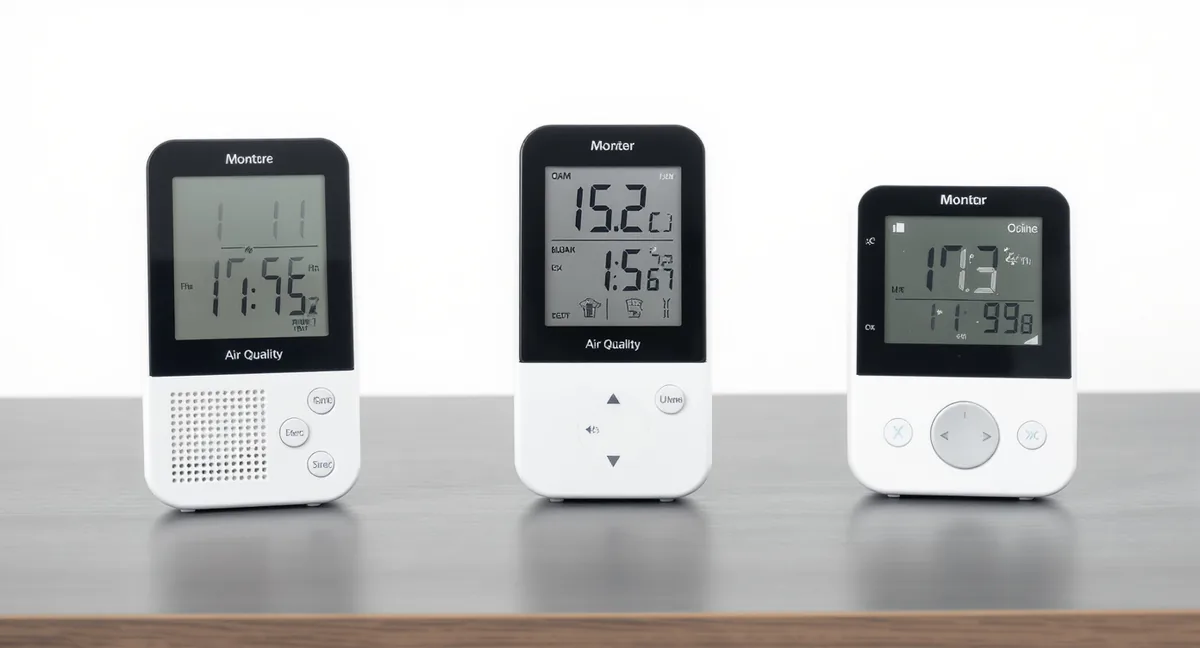
The Aranet4 Home and Airthings View Plus represent two fundamentally different philosophies in air quality monitoring. The Aranet4 is a specialist — a portable, battery-powered CO2 monitor built around the gold-standard NDIR sensor, designed to do one thing exceptionally well. The Airthings View Plus is a generalist — a comprehensive multi-sensor monitor that tracks seven air quality parameters including radon, PM2.5, CO2, VOCs, temperature, humidity, and barometric pressure.
Choosing between them depends on whether you need the best possible CO2 monitoring or the broadest possible air quality coverage. Based on our research into published specifications, customer reviews, and expert analysis, here is the definitive comparison.
Key Takeaways
- 1The Aranet4 Home uses a premium NDIR CO2 sensor considered the gold standard for accuracy. It is purpose-built for CO2 monitoring and excels at this single task.
- 2The Airthings View Plus monitors 7 parameters including radon and PM2.5, making it far more comprehensive but less focused on any single metric.
- 3The Aranet4 is highly portable — compact, lightweight, battery-powered with an e-ink display lasting up to 4 years. It is ideal for classrooms, offices, and travel.
- 4Only the Airthings View Plus includes radon and PM2.5 sensors. If either of these pollutants is a concern, the Aranet4 cannot help.
- 5For dedicated CO2 monitoring in schools, offices, and ventilation verification, the Aranet4 is preferred by experts. For whole-home air quality monitoring, the Airthings View Plus offers far more value.
Quick Answer
Should I buy the Aranet4 Home or Airthings View Plus?
Buy the Aranet4 Home ($189) if your primary concern is CO2 monitoring — especially for classrooms, offices, meeting rooms, or verifying ventilation adequacy. Its NDIR sensor is considered the gold standard for CO2 accuracy, and its portable, battery-powered design with an e-ink display lasting up to 4 years makes it ideal for on-the-go monitoring. Buy the Airthings View Plus ($329.99) if you want comprehensive air quality monitoring across multiple parameters. It tracks radon, PM2.5, CO2, VOCs, temperature, humidity, and barometric pressure — the broadest sensor coverage available in a consumer monitor. It is the better choice for whole-home monitoring where CO2 is just one of several concerns.
Quick Decision Guide
| What Matters Most | Best Choice |
|---|---|
| Best CO2 accuracy | Aranet4 Home (specialist NDIR) |
| Radon monitoring | Airthings View Plus (only option) |
| PM2.5 monitoring | Airthings View Plus (only option) |
| Portability (travel/classroom) | Aranet4 Home (compact, 4-year battery) |
| Most comprehensive monitoring | Airthings View Plus (7 parameters) |
| Lowest price | Aranet4 Home ($189 vs $329.99) |
| E-ink display quality | Aranet4 Home (large, clear CO2 reading) |
| School/office use | Aranet4 Home (designed for this) |
| Whole-home monitoring | Airthings View Plus (multi-room ecosystem) |
| Smart home integration | Airthings View Plus (IFTTT, Alexa, Google) |
Full Specs Comparison
| Feature | Aranet4 Home | Airthings View Plus |
|---|---|---|
| Price | $189 | $329.99 |
| CO2 Sensor | NDIR (gold standard) | NDIR |
| CO2 Range | 0-9,999 ppm | 400-5,000 ppm |
| Radon | No | Yes |
| PM2.5 | No | Yes |
| VOCs | No | Yes |
| Temperature | Yes | Yes |
| Humidity | Yes | Yes |
| Air Pressure | Yes | Yes |
| Display | E-ink (large CO2 readout) | E-ink (customizable) |
| Battery Life | Up to 4 years (2x AA) | ~1 year (4x AA) |
| Bluetooth | Yes | Yes |
| Wi-Fi | No (Bluetooth only) | Yes |
| App | Aranet Home app | Airthings app |
| Smart Home | Limited (no IFTTT) | IFTTT, Alexa, Google |
| CO2 Alert | Visual + audible alarm | App notification |
| Portability | Excellent (pocket-sized) | Good (shelf-sized) |
| Weight | 4.4 oz | 8.8 oz |
| Warranty | 2 years | 2 years |
CO2 Monitoring: The Core Comparison
Both monitors use NDIR (Non-Dispersive Infrared) sensors for CO2 measurement — the most accurate technology available in consumer devices. But the Aranet4's entire design is optimized around CO2 monitoring, while the Airthings treats CO2 as one parameter among seven.
Aranet4: The CO2 Specialist
The Aranet4 Home was designed from the ground up as a CO2 monitor. Its NDIR sensor covers a range of 0-9,999 ppm — nearly double the Airthings' 400-5,000 ppm range. While CO2 levels above 5,000 ppm are rare in most settings, the extended range matters for industrial environments, greenhouses, and worst-case scenarios in poorly ventilated spaces.
The Aranet4's e-ink display prominently shows the current CO2 reading in large, easy-to-read numbers with a traffic-light color indicator (green, yellow, red) that makes status immediately obvious from across a classroom or meeting room. The display also shows a trend arrow indicating whether CO2 levels are rising, falling, or stable — a feature teachers and office managers find invaluable for proactive ventilation decisions.
Customer reviews consistently praise the Aranet4's CO2 accuracy. Users who have compared it against reference-grade CO2 instruments report readings that track closely, and the device has become a favorite among indoor air quality professionals and researchers for its reliability.
The Aranet4 also includes an audible CO2 alarm that triggers when levels exceed a user-defined threshold — typically set at 1,000 or 1,400 ppm. This active alerting is valuable in classrooms and offices where someone may not be watching a display or checking an app.
Airthings View Plus: CO2 as Part of the Whole
The Airthings View Plus also uses an NDIR CO2 sensor, and customer feedback indicates it provides accurate and responsive readings. However, the Airthings measures CO2 within a narrower 400-5,000 ppm range. For typical home and office environments (where CO2 rarely exceeds 2,500 ppm), this range is perfectly adequate.
The Airthings e-ink display can be customized to show CO2, but it shares screen space with other parameters. The CO2 reading is not as prominently displayed as on the Aranet4, and there is no audible alarm — alerts come through the app as push notifications.
CO2 Accuracy Verdict
Both monitors deliver accurate CO2 readings for consumer-grade devices. The Aranet4 has a slight edge in sensor range, display prominence, and the audible alarm feature. For use cases where CO2 monitoring is the primary goal — classrooms, meeting rooms, ventilation verification — the Aranet4 is the more purpose-built tool.
Sensor Coverage: Airthings Has No Competition
This is where the comparison tilts dramatically in the Airthings View Plus's favor. Beyond CO2, temperature, humidity, and air pressure (which both monitor), the Airthings adds three critical sensors the Aranet4 lacks entirely:
Radon (Airthings Only)
Radon is a radioactive gas and the second leading cause of lung cancer. The Airthings View Plus provides continuous radon monitoring — the only consumer device in this price range to do so. If you live in a radon-prone area, this sensor alone can justify the $140 premium over the Aranet4.
PM2.5 (Airthings Only)
Fine particulate matter (PM2.5) from cooking, wildfires, traffic exhaust, and other sources is one of the most harmful indoor pollutants. The Airthings View Plus tracks PM2.5 levels in real time, alerting you when particle pollution rises. The Aranet4 has no particle sensor of any kind.
VOCs (Airthings Only)
Volatile Organic Compounds from cleaning products, paint, new furniture, and building materials affect indoor air quality. The Airthings View Plus includes a VOC sensor that flags elevated chemical levels. The Aranet4 does not measure VOCs.
The bottom line on sensor coverage: If you need comprehensive air quality monitoring, the Airthings View Plus is the only choice. If you specifically need CO2 monitoring and nothing else, the Aranet4 is more focused and more affordable.
Portability and Battery Life
Aranet4 wins decisively. The Aranet4 Home weighs just 4.4 ounces and fits in a pocket or bag. Its two AA batteries last up to 4 years — extraordinary longevity that means you can set it on a desk and forget about maintenance for years. This makes it ideal for:
- Classrooms: Teachers can move it between rooms or schools carry it in a bag
- Offices: Place it in any meeting room without worrying about power
- Travel: Monitor hotel rooms, airplane cabins, or conference venues
- Multi-room spot checks: Carry it from room to room to identify problem areas
The Airthings View Plus is also battery-powered (4x AA, lasting approximately 1 year) and cordless. But at 8.8 ounces and a larger form factor, it is designed to sit in one location rather than travel with you. Its batteries need annual replacement versus the Aranet4's multi-year lifespan.
App and Connectivity
Aranet4 Home: Bluetooth-Only
The Aranet4 connects via Bluetooth only — no Wi-Fi. Data syncs to the Aranet Home app when your phone is in range, providing historical charts and trend analysis. This design choice prioritizes battery life (no Wi-Fi radio to drain power) and simplicity.
Limitations of Bluetooth-only:
- No remote monitoring — you must be near the device to sync data
- No smart home integration (no IFTTT, no Alexa, no Google Assistant)
- No cloud-based dashboard for viewing data from anywhere
- Data logging requires periodic phone proximity for sync
For classroom and office use where someone is always nearby, Bluetooth is adequate. For home monitoring where you want to check readings from another room or while away, the lack of Wi-Fi is a meaningful limitation.
Airthings View Plus: Full Connectivity
The Airthings View Plus connects via Wi-Fi, enabling:
- Remote monitoring from anywhere through the Airthings app or web dashboard
- Historical data stored in the cloud with daily, weekly, and monthly trends
- IFTTT integration for home automation (e.g., trigger a fan when CO2 exceeds 1,000 ppm)
- Alexa and Google Assistant voice queries
- Multi-device management for whole-home monitoring across several rooms
For home users who want continuous, always-connected monitoring, the Airthings ecosystem is significantly more capable.
Use Case Recommendations
Best for Schools and Classrooms: Aranet4 Home
The Aranet4 has become the de facto standard CO2 monitor in educational settings. Its large, clear CO2 display is readable from across a classroom. The audible alarm alerts teachers when ventilation is insufficient. The 4-year battery life means minimal maintenance. And the compact size makes it easy to share between classrooms or carry between buildings.
Schools and universities across Europe and North America adopted the Aranet4 during the COVID-19 pandemic for ventilation monitoring, and many continue using it. Customer reviews from educators consistently cite its simplicity and reliability as key advantages.
Best for Office Meeting Rooms: Aranet4 Home
Meeting rooms are notorious for CO2 buildup — six people in a small conference room can push CO2 above 1,500 ppm within 30 minutes. The Aranet4's prominent display and audible alarm make it a practical tool for prompting someone to open a window or turn on ventilation. No app needed — just glance at the display.
Best for Whole-Home Monitoring: Airthings View Plus
If you want to understand the air quality in your home comprehensively, the Airthings View Plus is the better investment. It monitors radon in your basement, PM2.5 during cooking or wildfire season, CO2 in your bedroom overnight, and VOCs when you clean or bring in new furniture. The Wi-Fi connectivity and cloud dashboard mean you can check readings from anywhere.
For multi-room monitoring, multiple Airthings devices feed into a single dashboard, giving you a whole-home view that the Aranet4's Bluetooth-only design cannot match.
Best for Travel: Aranet4 Home
At 4.4 ounces with a 4-year battery, the Aranet4 is the only practical travel CO2 monitor. Use it to check ventilation in hotel rooms, Airbnb rentals, airplane cabins, or conference venues. The Airthings is simply too large and feature-heavy for portable use.
Cost Comparison
| Factor | Aranet4 Home | Airthings View Plus |
|---|---|---|
| Purchase price | $189 | $329.99 |
| Annual battery cost | ~$1 (every 4 years) | ~$5 (annual) |
| Subscription | None required | None required |
| 5-year total cost | ~$192 | ~$355 |
The Aranet4 is $140 cheaper upfront and has negligible ongoing costs thanks to its extraordinary battery life. Over 5 years, the cost gap widens to approximately $163 in the Aranet4's favor.
However, the Airthings monitors five additional parameters (radon, PM2.5, VOCs, plus more capable connectivity). On a per-sensor basis, the Airthings is the better value — you are paying $140 more for significantly more functionality.
The Bottom Line
The Aranet4 Home is the best dedicated CO2 monitor you can buy. Its NDIR sensor, extended measurement range, prominent display, audible alarm, and extraordinary 4-year battery life make it the purpose-built tool for CO2 monitoring in classrooms, offices, and travel. If CO2 is your primary concern and you want a device that does one thing exceptionally well, the Aranet4 is the clear choice at $189.
The Airthings View Plus is the best comprehensive air quality monitor you can buy. It covers seven parameters including radon and PM2.5, connects via Wi-Fi for remote monitoring, and integrates with smart home platforms. If you want a single device that gives you a complete picture of your indoor air quality, the Airthings View Plus justifies its $329.99 price tag — especially if radon monitoring matters for your home.
Can you use both? Absolutely. Some air quality enthusiasts use an Aranet4 as a portable spot-checker and classroom/office tool while keeping an Airthings View Plus as the permanent home monitor. The two devices complement each other well, and at a combined $519, the pair covers every monitoring scenario.
Based on our research and customer feedback, both are excellent, reliable devices. The right choice depends entirely on whether you need a CO2 specialist or a comprehensive air quality generalist.
This guide was researched and written by the AirQualityNest editorial team. We update our content regularly to reflect the latest products, pricing, and research.
Frequently Asked Questions
Is the Aranet4 more accurate than the Airthings for CO2?+
Both use NDIR (Non-Dispersive Infrared) CO2 sensors, which is the gold standard technology for consumer-grade CO2 measurement. Based on customer reviews comparing both to reference instruments, both deliver accurate and reliable CO2 readings. The Aranet4 has a wider measurement range (0-9,999 ppm vs 400-5,000 ppm), which matters in extreme situations but not in typical homes or offices.
Can the Aranet4 detect radon or PM2.5?+
No. The Aranet4 Home measures CO2, temperature, humidity, and atmospheric pressure only. It does not include sensors for radon, PM2.5, or VOCs. If you need these measurements, the Airthings View Plus is the better choice, or you can pair the Aranet4 with a separate monitor for those parameters.
Why do schools prefer the Aranet4?+
The Aranet4 became the standard classroom CO2 monitor due to its large, clear display readable from across a room, audible alarm when CO2 exceeds set thresholds, 4-year battery life requiring virtually no maintenance, compact portable design that can be moved between classrooms, and its reputation for reliable NDIR CO2 accuracy. It was widely adopted during the COVID-19 pandemic for ventilation monitoring.
Does the Aranet4 work with smart home systems?+
The Aranet4 Home uses Bluetooth only — it does not have Wi-Fi. This means it does not support IFTTT, Alexa, Google Assistant, or other smart home integrations. Data syncs to the Aranet Home app when your phone is in Bluetooth range. If smart home integration is important, the Airthings View Plus offers Wi-Fi connectivity with IFTTT, Alexa, and Google Assistant support.
Related Reading
Best CO2 Monitors
Our top-rated CO2 monitors for home, office, and classroom use
Best Air Quality Monitors
Comprehensive air quality monitors ranked and compared
Aranet4 Home Review
Full editorial review of the gold-standard CO2 monitor
Airthings View Plus Review
In-depth look at Airthings' comprehensive multi-sensor monitor
Continue Reading

Best Air Purifiers for Open Floor Plans in 2026: High-CADR Models That Cover It All
The best air purifiers for open floor plans ranked by CADR, coverage area, and noise. High-performance HEPA purifiers that handle 500-1,500+ sq. ft. open spaces.
Best Smart Humidifiers in 2026 (Wi-Fi, App Control & Auto Humidity)
The best smart humidifiers with Wi-Fi, app control, and auto humidity adjustment. Top picks for Alexa, Google Home, and smart home integration.
The 5 Best Portable Air Quality Monitors in 2026
Monitor your air quality on the go. We tested the best portable and compact air quality monitors for accuracy, battery life, and sensor range.