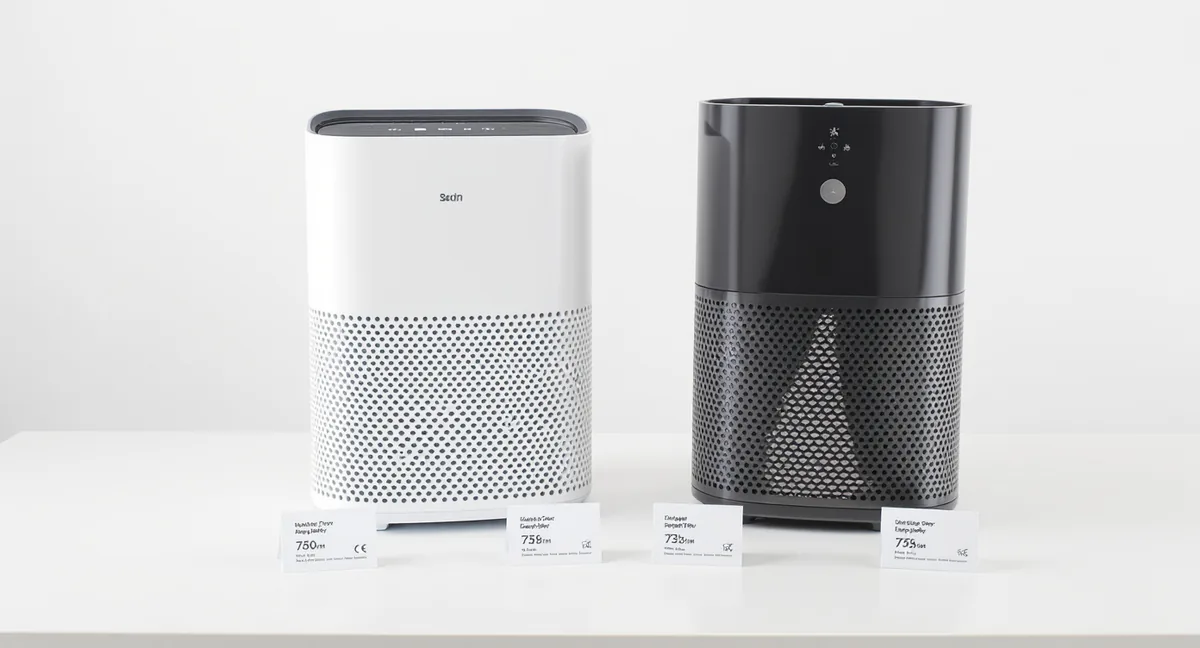
The promise of a sub-$50 air purifier is appealing — clean air for the price of a restaurant dinner. And yes, you can find air purifiers at this price point on Amazon. Models from AROEVE, MOOKA, and other budget brands sell for $30-$45 with thousands of reviews. But here is the honest reality: most purifiers under $50 cut corners that directly impact the quality of air you breathe.
Based on our research into customer reviews, published specifications, and editorial assessments, the sub-$50 category has real limitations. The best value in air purification starts around $99-$100, where you get genuine True HEPA H13 filtration, meaningful room coverage, and the reliability to run 24/7 for years.
This guide covers what you actually get for under $50, where those models fall short, and the best value alternatives if you can stretch your budget even slightly.
Key Takeaways
- 1True sub-$50 air purifiers exist but typically use HEPA-type or HEPA-style filters that capture only 85-95% of particles — not the 99.97% that True HEPA H13 delivers
- 2Most sub-$50 models have CADR ratings under 80, meaning they struggle to clean rooms larger than 100 sq. ft. effectively
- 3If you can stretch to $99-$100, the Levoit Core 300 delivers True HEPA H13 filtration with dramatically better performance and coverage
- 4Two-year total cost matters more than sticker price: a $40 purifier with expensive replacement filters can cost more than a $100 purifier with $20 filters
- 5For severe allergies, asthma, or smoke, skipping the sub-$50 tier and starting at $100+ is strongly recommended by customer reviewers and editorial sources
Quick Answer
What is the best air purifier under $50?
There is no sub-$50 air purifier we can confidently recommend for meaningful air purification. Most models at this price use HEPA-type filters (not True HEPA) with particle capture rates of 85-95% and very low CADR ratings. If you can stretch to $99.00, the Levoit Core 300 is the best value entry point — it delivers True HEPA H13 filtration (99.97% particle capture), 141 CADR, and covers rooms up to 219 sq. ft. For smart features and larger room coverage, the Levoit Vital 200S at $169.99 adds app control, a PM2.5 sensor, and 380 sq. ft. of coverage.
The Honest Truth About Sub-$50 Air Purifiers
We are not going to pretend this price point does not exist. You can walk into Walmart or scroll Amazon and find dozens of air purifiers for $25-$45. Some have tens of thousands of reviews. So what is the problem?
What sub-$50 purifiers typically deliver:
- HEPA-type or HEPA-style filters (85-95% particle capture, not the 99.97% True HEPA standard)
- CADR ratings of 50-80 (if published at all — many sub-$50 brands do not disclose CADR)
- Effective coverage of 50-120 sq. ft. — roughly a walk-in closet or half a small bedroom
- Basic 2-3 speed manual controls
- No air quality sensors, no auto mode, no smart features
What they typically lack:
- True HEPA H13 filtration (the standard that captures 99.97% of particles at 0.3 microns)
- AHAM-verified CADR ratings
- Meaningful activated carbon for odor control
- Coverage for a full-size bedroom (150+ sq. ft.)
- Long-term reliability based on customer review patterns
The core issue is filtration grade. According to customer reviews, many budget buyers purchase a sub-$50 purifier, notice no difference in their allergy symptoms or air quality, and then upgrade to a $100+ model where they immediately feel the improvement. The "savings" of buying cheap first often means spending more in total.
The HEPA-Type vs. True HEPA Problem
This is the most important distinction in the entire air purifier market, and it matters most at the budget tier:
| Filter Type | Capture Rate | Standard | Common Price Point |
|---|---|---|---|
| HEPA-type / HEPA-style | 85-95% at 2.0 microns | No formal standard | Under $50 |
| True HEPA H11 | 95% at 0.3 microns | EN 1822 | $80-130 |
| True HEPA H13 | 99.97% at 0.3 microns | EN 1822 | $90-600+ |
That gap between 85% and 99.97% sounds small but is enormous in practice. A HEPA-type filter lets through 50-150 times more particles than an H13 filter at the most penetrating particle size. For allergy sufferers, asthma patients, or anyone in areas with wildfire smoke, the difference is clinically significant.
The Better Strategy: Best Value Alternatives Starting at $99
Based on our research, the sweet spot for budget air purification starts at $99-$100. At this price, you cross the threshold into True HEPA H13 filtration, meaningful CADR, and the kind of build quality that lasts years rather than months.
If you can stretch your budget beyond $50, these purifiers deliver dramatically more value per dollar than anything in the sub-$50 tier.
1. Best Overall Value: Levoit Core 300
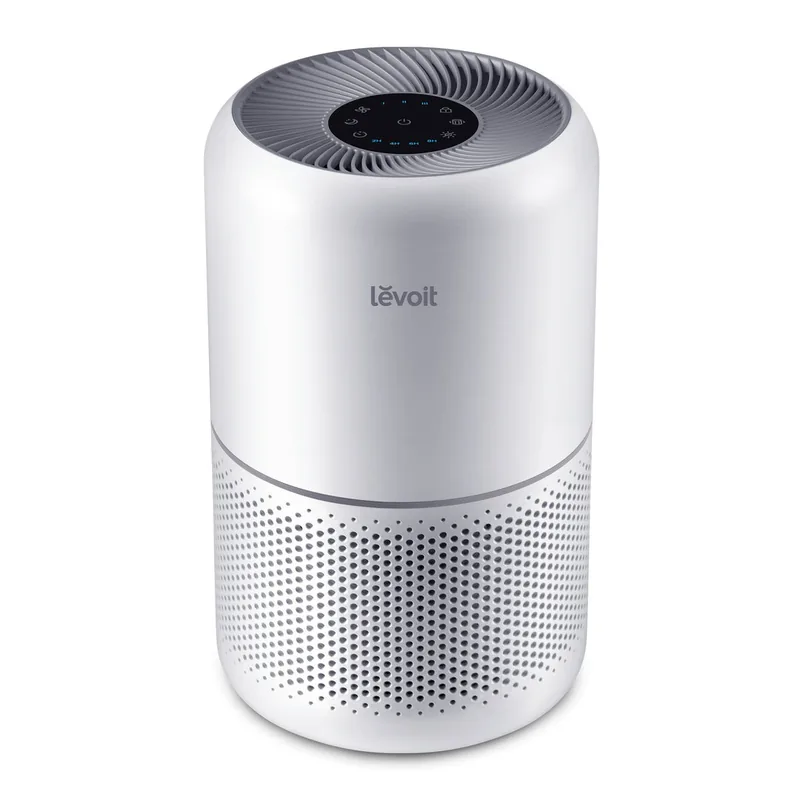
The Levoit Core 300 at $99.00 is the most popular budget air purifier in America for good reason. It delivers 141 CADR with True HEPA H13 filtration — performance that competes with purifiers in the $150-200 range. With over 45,000 Amazon reviews and a 4.7-star average, the customer consensus is overwhelming.
The 360-degree cylindrical air intake pulls from every direction, making it more forgiving of real-world placement — corners, nightstands, and tight spaces where front-intake designs struggle. At 24 dB on low, multiple reviewers describe it as genuinely inaudible during sleep.
Why it is the value king:
- 141 CADR covers rooms up to 219 sq. ft. — a full-size bedroom or office
- 24 dB on low is quieter than most libraries
- Multiple filter options: standard HEPA, pet allergy, toxin absorber
- $19.99 replacement filters every 6-8 months
- Proven multi-year reliability across tens of thousands of customer reviews
If your original $50 budget can stretch to $99 (especially during sales when it drops to $79-89), the Core 300 is the single best air purifier value on the market. Based on our research across editorial sources and customer feedback, no other purifier at any price delivers more clean air per dollar.
What We Like
- +Under $100 price point
- +Whisper-quiet at lowest setting
- +Compact cylinder design
- +Multiple filter options available
Could Be Better
- −Small room coverage only
- −No auto mode or air quality sensor
- −No smart features
2. Best for Germ and Odor Control: GermGuardian AC5250PT
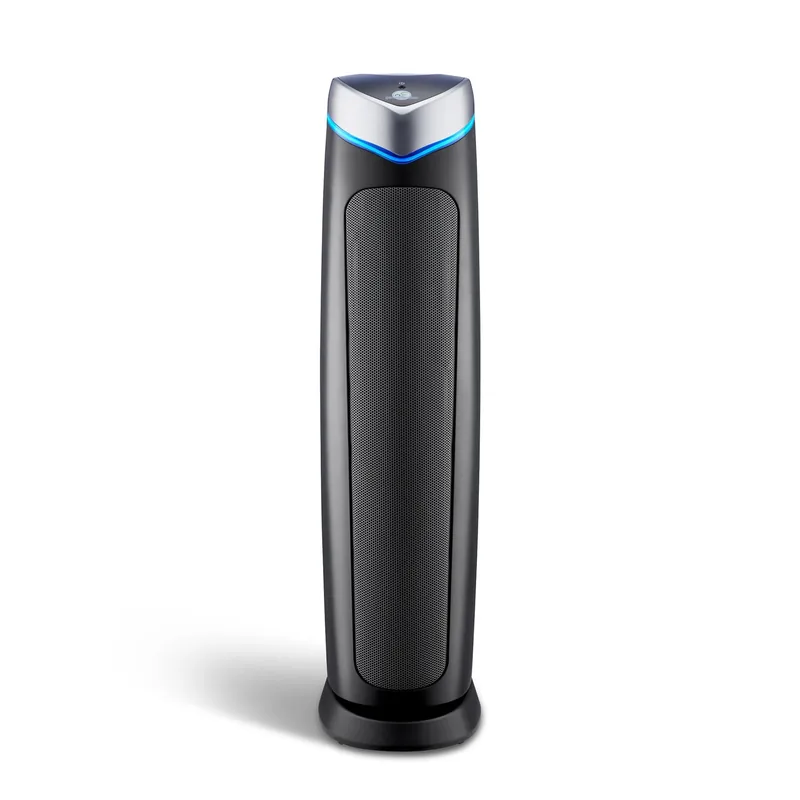
The GermGuardian AC5250PT at $99.99 adds UV-C light technology alongside its True HEPA filtration and charcoal filter. Customer reviewers who specifically purchased it for odor and germ concerns — pet households, homes with smokers nearby, and families with young children — report satisfaction with its performance across thousands of verified reviews.
The 28-inch tower design fits vertically into corners and tight spaces. At 167 CADR, it covers rooms up to 250 sq. ft. and includes a 5-speed fan with an ultra-quiet setting for bedrooms.
Why consider it: If your primary concerns go beyond particles to include odors, VOCs, and surface germ reduction, the UV-C plus charcoal combination provides additional layers that standard HEPA-only models lack. The Guardian Technologies brand also has an extensive warranty support network.
What We Like
- +UV-C light kills airborne bacteria and viruses
- +Pet Pure antimicrobial treatment on filter
- +Affordable 3-in-1 system
- +Tower design saves floor space
Could Be Better
- −Small room coverage at 167 sq. ft.
- −UV-C bulb needs replacement every 10 months
- −Louder than competitors on high
- −Lower CADR ratings
Side-by-Side: Budget Alternatives Compared
The Real Cost: Why Cheap Can Be Expensive
The sticker price of a sub-$50 purifier looks appealing until you factor in the total cost of ownership. Here is a realistic 2-year cost comparison:
| Purifier | Purchase | Year 1 Filters | Year 2 Filters | Electricity | 2-Year Total | True HEPA? |
|---|---|---|---|---|---|---|
| Generic sub-$50 model | $40 | $30-50 | $30-50 | $18 | $118-158 | No |
| Levoit Core 300 | $99 | $40 | $40 | $24 | $203 | Yes (H13) |
The gap between a generic $40 purifier and the Levoit Core 300 is only $45-85 over two years — but the performance difference is enormous. You are paying a modest premium for filtration that actually captures 99.97% of particles instead of 85%.
Some sub-$50 models also use proprietary filters that are harder to find and more expensive to replace than the widely available Levoit replacements. According to customer reviews, filter availability and cost is one of the most common complaints about off-brand budget purifiers after 6-12 months of ownership.
When a Sub-$50 Purifier Might Be Acceptable
To be fair, there are limited scenarios where a very cheap purifier can serve a purpose:
- As a desk fan with light filtration — If you just want some air movement with mild dust reduction at your desk
- Temporary use — A dorm room for one semester, a short-term rental, or while waiting for a better unit on sale
- Supplemental use — Running alongside a proper HEPA purifier in a very dusty space for extra air circulation
- Testing whether you notice a difference — If you are unsure air purification matters to you, a cheap trial before investing makes sense
For any of these scenarios, look for models that at least disclose their CADR and filter type. Avoid any purifier that does not list its CADR rating — it almost certainly performs too poorly to publish.
Our Recommendation
There is no sub-$50 air purifier we can confidently recommend for meaningful, ongoing air purification. The filtration quality, room coverage, and long-term reliability at this price point simply do not meet the bar for a product that is supposed to protect your health.
If your budget is genuinely hard-capped at $50, save for another month and buy the Levoit Core 300 at $99.00. It is the minimum viable investment for True HEPA air purification — and the difference between HEPA-type and True HEPA H13 is the difference between an air purifier that looks like it works and one that actually does. At $99 (often $79-89 on sale), it delivers the same H13 filtration grade found in purifiers costing $300+, with a proven track record of 45,000+ satisfied customers.
If you want smart features like app control and a PM2.5 sensor, the Levoit Vital 200S at $169.99 is the next step up — it adds VeSync app control, auto mode, and pet mode with 380 sq. ft. of coverage.
Sources & References
- AHAM Verified CADR Ratings — Industry-standard Clean Air Delivery Rate testing for portable air cleaners — the benchmark for comparing purifier performance
- EPA Guide to Air Cleaners in the Home — Federal guidance on selecting portable air cleaning devices, including filter type recommendations
- European Standard EN 1822 (HEPA Classification) — H11 through H14 HEPA filter classification standards defining particle capture efficiency at 0.3 microns
- ENERGY STAR Air Purifier Standards — Energy efficiency ratings and annual operating cost estimates for room air cleaners
The AirQualityNest editorial team researches and reviews products independently to help you find the best options for your needs.
Frequently Asked Questions
Is a $30 air purifier worth buying?+
For meaningful air purification, no. Most purifiers under $50 use HEPA-type filters that capture only 85-95% of particles — far below the 99.97% standard of True HEPA H13. Customer reviewers who start with sub-$50 models frequently report upgrading within months after noticing no improvement in allergy symptoms or air quality. If your budget is limited, the Levoit Core 300 at $99.00 is the minimum investment for effective air purification.
What is the cheapest air purifier that actually works?+
Based on our research, the Levoit Core 300 at $99.00 (often on sale for $79-89) is the most affordable air purifier with True HEPA H13 filtration and a verified CADR rating of 141. It covers rooms up to 219 sq. ft. with genuine H13 filtration that captures 99.97% of particles at 0.3 microns. For smart features, the Levoit Vital 200S at $169.99 adds app control, a PM2.5 sensor, and 380 sq. ft. coverage.
What is the difference between HEPA-type and True HEPA?+
True HEPA (H13 grade) captures 99.97% of particles at 0.3 microns — the most penetrating particle size. HEPA-type or HEPA-style filters are not held to any formal standard and typically capture only 85-95% of larger particles. That means a HEPA-type filter can let through 50-150 times more of the smallest, most harmful particles compared to True HEPA. Most purifiers under $50 use HEPA-type filters, while models at $90+ typically use True HEPA H13.
Can I use a cheap air purifier for allergies?+
Sub-$50 purifiers with HEPA-type filters may provide minimal relief for mild allergies, but customer reviewers with moderate to severe allergies consistently report that True HEPA H13 filtration makes a much more noticeable difference. For allergy relief, investing in a Levoit Core 300 ($99.00) or similar True HEPA model is strongly recommended. The 99.97% particle capture rate at 0.3 microns covers pollen, dust mite debris, pet dander, and mold spores — the most common indoor allergens.
Are air purifier replacement filters expensive for budget models?+
Replacement filter costs vary widely. Popular budget brands like Levoit offer filters for $18-20 every 6-8 months. Some lesser-known sub-$50 brands charge $15-25 for proprietary filters that can be harder to find. Always check filter availability and cost before purchasing any air purifier — customer reviews frequently cite discontinued or overpriced replacement filters as a major frustration with off-brand models. Over two years, filter costs typically add $60-100 to the purchase price.
Related Reading
Best Air Purifiers Under $100
The next tier up — True HEPA picks with proven performance for bedrooms and small rooms
Best Air Purifiers Under $150
More coverage, smarter features, and better long-term value
Air Purifier Sizing Guide
Calculate exactly what CADR and coverage your room needs
HEPA Filters Explained
The complete guide to HEPA filter grades and what they mean for your health
Continue Reading
Best Air Purifiers for Open Floor Plans in 2026: High-CADR Models That Cover It All
The best air purifiers for open floor plans ranked by CADR, coverage area, and noise. High-performance HEPA purifiers that handle 500-1,500+ sq. ft. open spaces.
Best Smart Humidifiers in 2026 (Wi-Fi, App Control & Auto Humidity)
The best smart humidifiers with Wi-Fi, app control, and auto humidity adjustment. Top picks for Alexa, Google Home, and smart home integration.
The 5 Best Portable Air Quality Monitors in 2026
Monitor your air quality on the go. We tested the best portable and compact air quality monitors for accuracy, battery life, and sensor range.