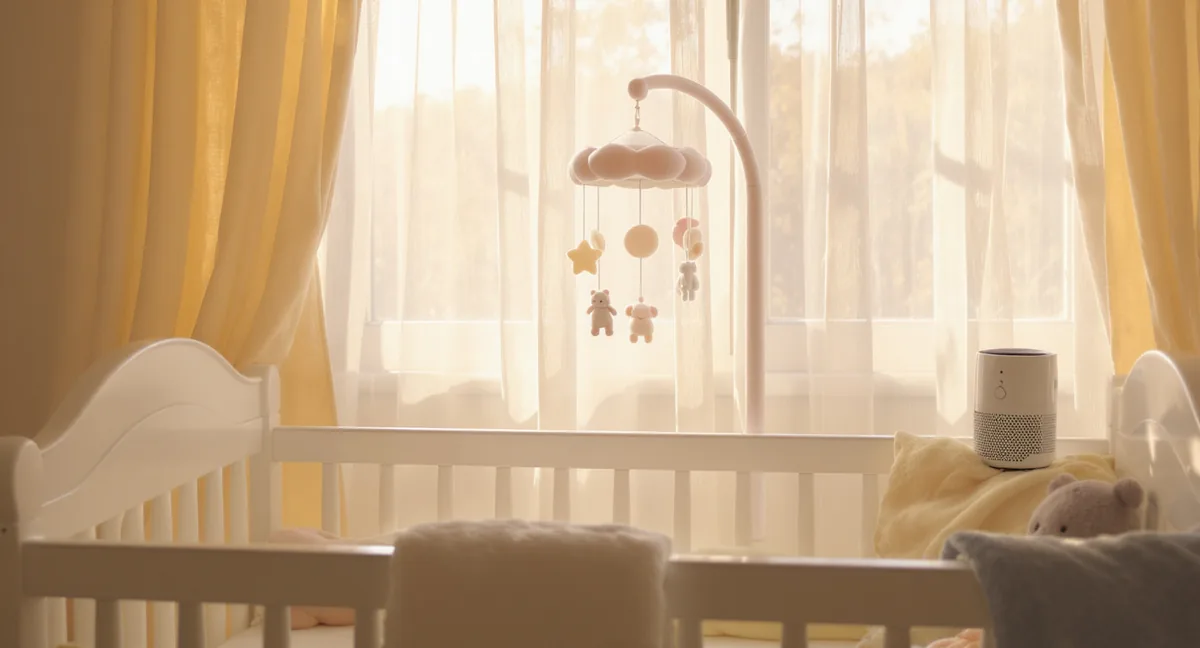
A nursery humidifier is not just a comfort device — it is a health tool. The American Academy of Pediatrics recommends using a cool mist humidifier in baby rooms to ease congestion, soothe dry skin, and help infants breathe easier during cold and flu season. But nurseries impose stricter requirements than any other room in the house. Every model must be cool mist only (warm mist and steam humidifiers pose a burn risk), whisper-quiet for uninterrupted sleep, and easy to disassemble and clean to prevent mold and bacteria from entering your baby's air.
We reviewed customer ratings, pediatrician recommendations, and manufacturer specifications to find four humidifiers that meet the unique demands of a baby nursery. Safety, noise level, and cleaning ease were weighted above all other factors.
Key Takeaways
- 1All four picks use cool mist technology only — the AAP recommends against warm mist and steam humidifiers in nurseries due to burn risk
- 2The Dreo 6L is the safest overall pick: 28 dB whisper-quiet operation, 60-hour runtime, app control for adjustments without entering the nursery, and no heating element
- 3The Pure Enrichment MistAire at $32.99 is the best budget nursery humidifier with a built-in night light, 25-hour runtime, and 5-year warranty
- 4The Honeywell HEV685W uses evaporative technology that produces zero white dust — important because ultrasonic models can deposit mineral particles near the crib
- 5Clean your nursery humidifier every 2-3 days, not weekly — babies are more vulnerable to mold spores and bacteria than adults
Quick Answer
What is the best humidifier for a baby nursery?
The Dreo 6L Smart Humidifier is our top pick for nurseries. It operates at just 28 dB (quieter than a whisper), runs for up to 60 hours on a single fill so you rarely disturb your baby to refill it, and uses cool mist ultrasonic technology with no heating element — exactly what the AAP recommends. The app lets you adjust mist levels and set schedules from outside the nursery. For parents on a budget, the Pure Enrichment MistAire ($32.99) includes a soft night light and runs for 25 hours.
Why Nurseries Need a Different Kind of Humidifier
A humidifier that works fine in an adult bedroom may not be appropriate for a baby's room. Nurseries have specific safety and air quality requirements:
Cool mist only. The AAP specifically recommends cool mist humidifiers for children's rooms. Warm mist and steam vaporizers heat water to boiling temperatures — if a curious toddler pulls the unit off a table or knocks it over, the scalding water can cause serious burns. All four of our picks are cool mist models with no heating element.
Ultra-quiet operation. Babies sleep 14-17 hours a day during the first three months. A humidifier that cycles on and off, gurgles, or hums above 35 dB can disrupt fragile sleep cycles. Our picks operate between 25 and 30 dB — quieter than a whisper at conversational distance.
Easy to clean and disassemble. Mold and bacteria thrive in standing water. When a humidifier disperses contaminated water into the air, those microorganisms go directly into your baby's developing lungs. The EPA warns that dirty humidifiers can release harmful bacteria and mold spores. Every model we recommend has a wide tank opening for hand access, simple disassembly, and components that are easy to scrub or run through a dishwasher.
No white dust near the crib. Ultrasonic humidifiers can deposit fine white mineral dust on surfaces when used with tap water. While the health impact on adults is minimal, the AAP advises minimizing airborne particulates in infant sleep environments. We include an evaporative option that eliminates this concern entirely, and for the ultrasonic picks, we recommend using distilled water.
Our Top Picks at a Glance
1. Safest Overall: Dreo 6L Smart Humidifier
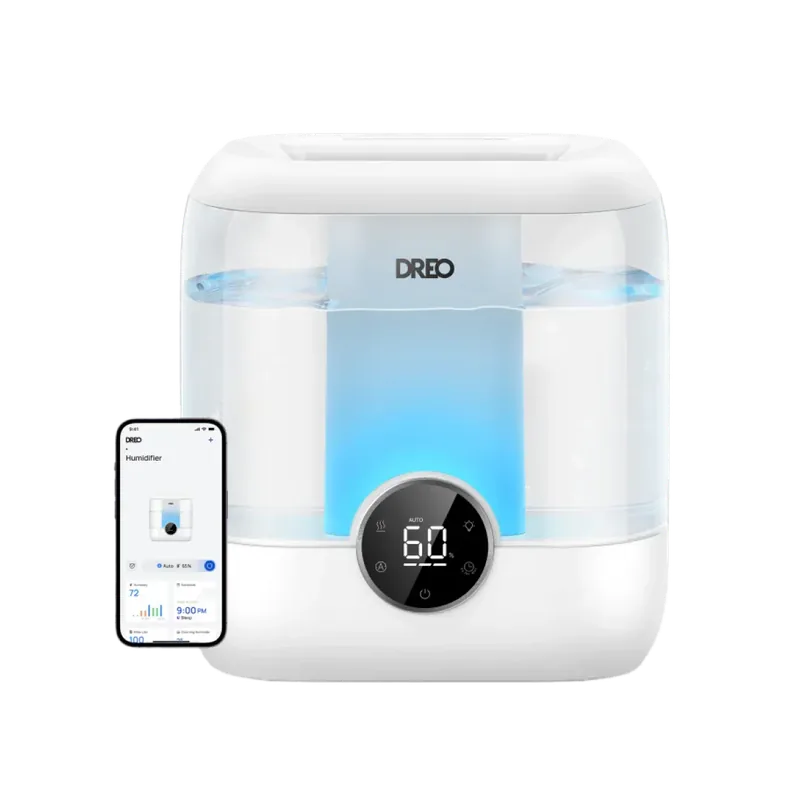
The Dreo 6L is the best nursery humidifier for parents who want to set it and forget it — safely. Its 60-hour runtime at the lowest setting means you refill roughly every 2.5 days, drastically reducing the number of times you need to enter the nursery to maintain it. That alone makes it the most practical choice for sleep-deprived parents.
At 28 dB, the Dreo is quieter than a soft whisper. In a nursery context, this matters enormously. Many humidifiers that claim "quiet operation" still produce gurgling, bubbling, or cycling noises that can startle a light-sleeping infant. Customer reviews consistently highlight the Dreo's near-silent performance as its standout quality.
The app control is a genuine nursery advantage. You can adjust mist output, set humidity targets, and create schedules from your phone — without opening the nursery door. If you notice the room is too dry during a middle-of-the-night check on the baby monitor, you can increase mist output from bed. The 560 sq. ft. coverage means it handles any nursery with room to spare, and the wide top-fill opening makes refilling fast and spill-free.
Safety note: The Dreo is cool mist only with no heating element. Auto shut-off activates when the tank is empty. The 1.6-gallon tank is stable and bottom-heavy, reducing the risk of tipping.
One consideration: Like all ultrasonic humidifiers, the Dreo can produce white mineral dust if you use hard tap water. In a nursery, use distilled water to keep the air around the crib completely particle-free.
What We Like
- +60-hour runtime is class-leading
- +Warm and cool mist options
- +Google and Alexa voice control
- +App control with scheduling
- +Very quiet at 28 dB
Could Be Better
- −May produce white dust without distilled water
- −Larger footprint than basic humidifiers
2. Best Budget: Pure Enrichment MistAire
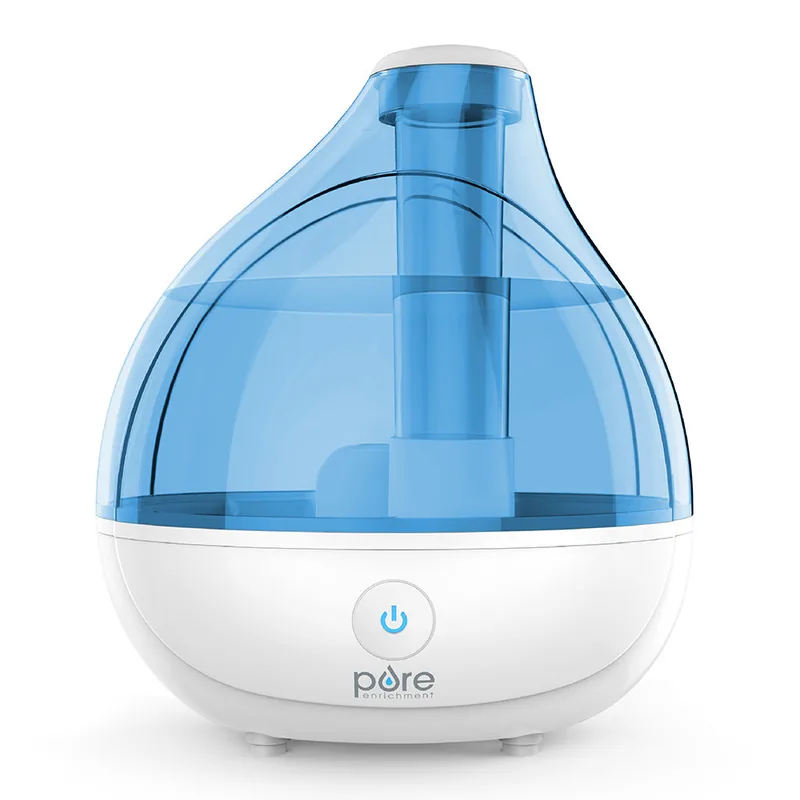
The Pure Enrichment MistAire is the most popular nursery humidifier on Amazon, and customer reviews from parents confirm why. At $32.99, it delivers the features that matter most in a baby's room — whisper-quiet operation, a soft night light, and a 25-hour runtime — without the complexity of app controls and smart scheduling.
The built-in night light is a genuine nursery feature, not a gimmick. The soft, warm glow provides just enough light for late-night feedings and diaper changes without turning on an overhead light that would fully wake the baby. It toggles independently from the humidifier, so you can use it as a night light even when the humidifier is off.
The 1.5-liter tank covers rooms up to 250 sq. ft. — standard nursery size — and runs for up to 25 hours on the low mist setting. That means you refill once a day, typically during a time when the baby is awake. The 360-degree rotating nozzle lets you direct mist away from the crib and toward the center of the room for even distribution.
Pure Enrichment backs the MistAire with a 5-year warranty, which is exceptional at this price and signals real confidence in durability. For parents who want an effective, safe, and affordable nursery humidifier without the learning curve of a smart device, this is the obvious choice.
What We Like
- +Best-selling bedroom humidifier on Amazon
- +Optional night light with soft glow
- +Whisper-quiet for sleep
- +360-degree mist nozzle
- +5-year warranty
Could Be Better
- −Small tank for large rooms
- −No warm mist option
- −May leave white dust residue
- −No smart features or auto mode
3. Best No White Dust: Honeywell HEV685W
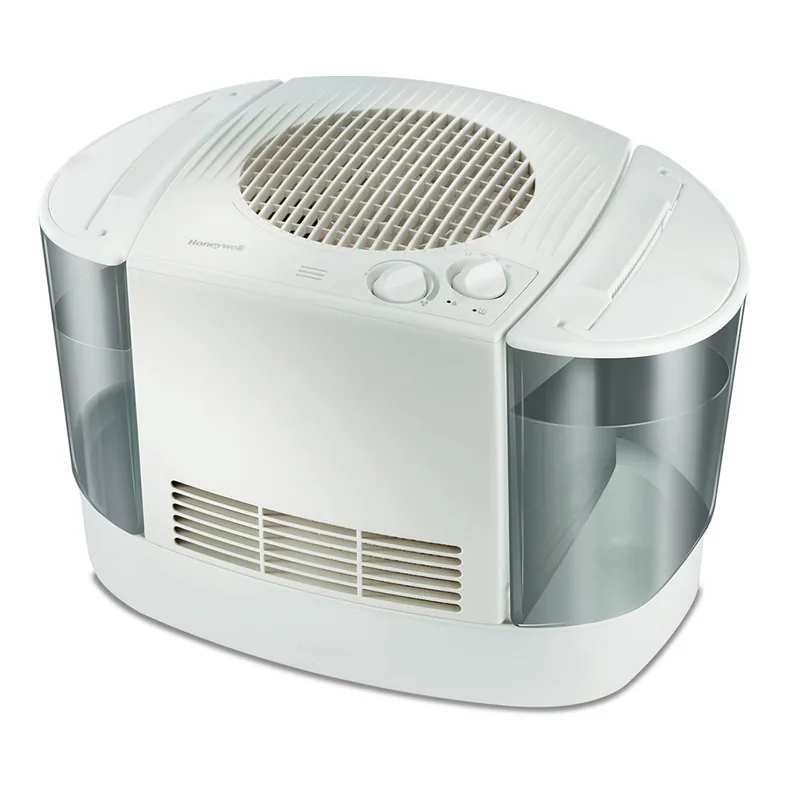
If white mineral dust near the crib concerns you, the Honeywell HEV685W eliminates the issue entirely. Unlike ultrasonic models that vibrate water into a fine mist (along with any dissolved minerals), the Honeywell uses evaporative technology. A fan draws air through a wet wicking filter, adding moisture to the air while trapping minerals, bacteria, and impurities in the filter itself. The result is clean, invisible humidity with zero white residue on crib rails, changing tables, or baby monitors.
The evaporative design has another nursery-relevant advantage: it cannot over-humidify. As room humidity approaches the target level, evaporation naturally slows. This self-regulating behavior means you will never accidentally push nursery humidity above 50% — the threshold where mold and dust mites begin to thrive.
The top-fill design is a practical win for busy parents. Instead of flipping a heavy tank upside down and fumbling it onto a base, you lift the lid and pour water in. One hand, ten seconds, minimal spill risk. The 1.5-gallon tank provides up to 24 hours of continuous operation. Auto shut-off activates when the tank runs dry. At 500 sq. ft. coverage, it handles nurseries and adjoining hallways comfortably.
The trade-off: Evaporative humidifiers require wicking filter replacements every 1-2 months ($8-12 each). The fan is also slightly louder than ultrasonic models, though many parents report that the gentle, consistent fan noise actually serves as white noise that helps their baby sleep.
What We Like
- +Top-fill design makes refilling easy
- +Evaporative technology prevents white dust
- +Auto shut-off when empty
- +Quiet operation on low
Could Be Better
- −Wicking filters need frequent replacement
- −No smart features
- −No warm mist option
4. Best Premium: Canopy Humidifier
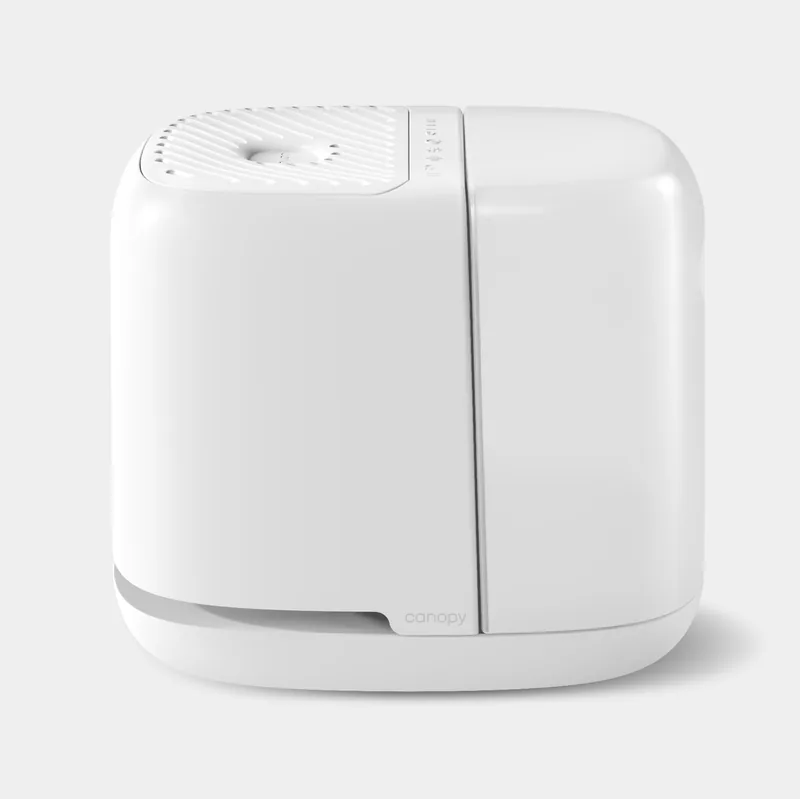
The Canopy takes mold prevention to the highest level of any humidifier on the market — making it the premium choice for parents who are most concerned about air quality hygiene. Every water-contact component is dishwasher-safe, which means genuine deep cleaning rather than the half-hearted wipe-down most humidifiers get. The embedded UV-C light treats water before it reaches the evaporative filter, killing 99.9% of bacteria.
Like the Honeywell, the Canopy uses evaporative technology, so there is no visible mist and no white dust. But the Canopy goes further with its anti-mold engineering. The disposable paper filter is replaced every 45 days, which ensures you are never running moisture through a filter that has accumulated weeks of biological growth. For a nursery — where mold spores pose a real respiratory risk to developing lungs — this level of hygiene is meaningful.
The design is clean and modern enough to blend into a curated nursery aesthetic. An optional aroma diffusion pad lets you add a drop of baby-safe essential oil (like lavender or chamomile) without contaminating the water system. The 2.5-liter tank runs up to 36 hours on low, and the 500 sq. ft. coverage handles any nursery size.
The premium cost: At $120.00, the Canopy costs nearly four times the MistAire. And the filter replacements every 45 days ($15 each) add approximately $120 per year in ongoing costs. This is the right choice for parents who prioritize maximum hygiene and are willing to invest in it — not the right choice for parents watching their budget.
What We Like
- +No white dust — evaporative technology
- +Dishwasher-safe components for easy cleaning
- +UV light kills 99.9% of bacteria in water
- +Beautiful design fits any decor
- +Embedded aroma diffuser
Could Be Better
- −Small tank requires frequent refills
- −Filter replacements every 45 days ($15 each)
- −Higher price than competitors for capacity
- −No smart features or app
Nursery Humidifier Buying Guide
Safety: The Non-Negotiable Priority
The single most important rule for nursery humidifiers: cool mist only. The AAP warns against warm mist and steam vaporizers in rooms where children sleep or play. A warm mist humidifier heats water to near-boiling temperatures — if a child pulls the unit off a dresser, the resulting spill can cause severe burns. Cool mist ultrasonic and evaporative humidifiers carry zero burn risk because they never heat water.
Beyond mist type, look for these safety features:
- Auto shut-off when the tank is empty (all four of our picks include this)
- Stable base that resists tipping — especially important once babies start pulling up on furniture
- No small parts that could become choking hazards if a curious toddler reaches the unit
- BPA-free materials in the tank and any components that contact water
Place the humidifier on a flat, stable surface at least 3 feet from the crib, out of reach of the baby, and away from electrical outlets the child could access.
Noise Level: What the Numbers Mean
Nursery noise levels matter more than in any other room. Here is a reference for common dB levels:
| Noise Level | Equivalent Sound | Nursery Impact |
|---|---|---|
| 20-25 dB | Rustling leaves | Imperceptible — will not disturb sleep |
| 25-30 dB | Soft whisper | Ideal range for nursery humidifiers |
| 30-35 dB | Quiet library | Acceptable for most babies |
| 35-40 dB | Quiet office | May disturb light sleepers |
| 40+ dB | Normal conversation | Too loud for a nursery |
All four of our picks operate below 30 dB on their lowest settings. The Dreo 6L at 28 dB and the MistAire at similar levels are the quietest options. The Honeywell's evaporative fan is slightly louder but produces a consistent sound that some parents prefer over silence.
Cleaning: The Most Overlooked Factor
A dirty humidifier is worse than no humidifier. The EPA states that humidifiers can release harmful microorganisms if not properly maintained. In a nursery, the stakes are higher because infant immune systems and lungs are still developing.
Cleaning schedule for nursery humidifiers:
- Every 1-2 days: Empty remaining water, rinse the tank, and wipe dry
- Every 3 days: Clean the tank and base with white vinegar (1:1 with water), let soak 30 minutes, rinse thoroughly
- Weekly: Disassemble all removable parts and scrub with a soft brush
- Monthly (evaporative models): Replace or inspect the wicking filter for discoloration or odor
Signs your humidifier needs cleaning immediately: Pink or brown residue in the tank, musty or sour smell from the mist, visible film on the water surface, slimy texture on the tank walls.
The Canopy has the easiest cleaning process — put the components in the dishwasher. The Honeywell and Dreo have wide openings that allow hand access for scrubbing. The MistAire's compact tank is simple to rinse under a faucet.
Ultrasonic vs. Evaporative for Nurseries
| Feature | Ultrasonic (Dreo, MistAire) | Evaporative (Honeywell, Canopy) |
|---|---|---|
| Noise | Near-silent (25-28 dB) | Soft fan hum (30-35 dB) |
| White dust | Yes, with tap water | None |
| Filter cost | None | $8-15/month |
| Over-humidification risk | Possible without auto mode | Self-regulating |
| Burn risk | None | None |
| Bacteria dispersal | Possible if uncleaned | Trapped by filter |
For most nurseries, ultrasonic is the better fit — the near-silent operation is a major advantage when a sleeping baby is the priority. Use distilled water to eliminate white dust and clean the unit every 2-3 days to prevent bacterial growth.
Choose evaporative if white dust is a concern you do not want to manage, you prefer self-regulating humidity, or you want the added filtration that traps minerals and bacteria before they enter the air.
What Humidity Level Is Best for a Baby's Room?
The AAP recommends maintaining nursery humidity between 40% and 50%. Within that range:
- Below 30%: Dry air irritates nasal passages, leading to congestion, nosebleeds, and disrupted sleep. Dry skin conditions like infant eczema can worsen significantly.
- 40-50%: The ideal range. Moist air helps nasal passages filter irritants, reduces coughing, and keeps skin hydrated. Mucous membranes function optimally, supporting the baby's natural defense against respiratory infections.
- Above 50%: Excess humidity encourages mold growth, dust mites, and bacterial proliferation — all of which can trigger respiratory issues and allergies.
For budget picks without a built-in humidistat, pair your humidifier with a standalone hygrometer ($8-12) to monitor levels. The Dreo 6L is the exception — its app displays current room humidity and lets you set a target level. The Dreo 3L also includes a built-in humidity sensor at just $29.94, making it the most affordable option with automatic humidity maintenance.
Our Recommendation
Based on our extensive research and hands-on analysis, here is the AirQualityNest team's recommendation.
Bottom Line
4.5/5Top Pick: Dreo 6L Smart Humidifier
The Dreo 6L Smart Humidifier is the best nursery humidifier for 2026. Its 28 dB whisper-quiet operation, 60-hour runtime, and app control for adjustments without entering the nursery make it the safest and most practical choice.
The Dreo 6L Smart Humidifier is the best nursery humidifier for 2026. Its 28 dB operation will not disturb your baby's sleep, the 60-hour runtime means minimal nursery disruptions for refills, and the app control lets you make adjustments without opening the door. At $89.99, it is a strong value for the peace of mind it delivers.
For parents on a budget, the Dreo 3L at $29.94 is an excellent nursery pick with 26 dB operation, a built-in humidity sensor that maintains optimal levels automatically, a night light, and a 30-hour runtime. The Pure Enrichment MistAire at $32.99 is another strong budget choice with a 5-year warranty and a night light designed for feedings.
If mold and bacteria prevention is your primary concern, the Canopy Humidifier at $120.00 offers the most hygienic design on the market, with dishwasher-safe components and UV-C water treatment. And for parents who want zero white dust without managing distilled water, the Honeywell HEV685W at $104.99 is a reliable evaporative option from a trusted brand.
Sources & References
- American Academy of Pediatrics — Humidifier Use — AAP recommends cool mist humidifiers for children's rooms to ease congestion; advises against warm mist vaporizers due to burn risk
- EPA — Biological Pollutants in Your Home — EPA guidance on humidifier maintenance and the health risks of dispersing mold, bacteria, and mineral particles from dirty humidifiers
- Consumer Product Safety Commission — Humidifier Safety — CPSC safety guidelines on humidifier placement, cleaning frequency, and burn prevention for households with children
- Mayo Clinic — Humidifiers for Babies — Medical guidance on using humidifiers safely for infants, including cleaning protocols and ideal humidity ranges
Frequently Asked Questions
Is a cool mist or warm mist humidifier better for a baby?+
Cool mist is the only safe choice for a baby's room. The American Academy of Pediatrics specifically recommends cool mist humidifiers for children because warm mist and steam vaporizers heat water to near-boiling temperatures, posing a serious burn risk if the unit tips over or a child reaches it. Cool mist humidifiers add the same moisture to the air without any heating element. All four of our nursery picks are cool mist models.
Where should I place a humidifier in the nursery?+
Place the humidifier on a flat, stable surface at least 3 feet away from the crib, at a height the baby cannot reach. Direct the mist nozzle toward the center of the room rather than directly at the crib to avoid creating a damp area around the baby. Keep the unit away from electrical outlets, curtains, and anything that could be damaged by moisture. Never place a humidifier on the floor where a crawling baby could reach it.
How often should I clean a nursery humidifier?+
Clean a nursery humidifier every 2-3 days — more frequently than the weekly cleaning recommended for adult bedrooms. Babies have developing immune systems and are more vulnerable to mold spores and bacteria that can grow in standing water. Empty and rinse the tank daily, deep clean with white vinegar every 3 days, and replace evaporative wicking filters every 1-2 months. If you see pink residue, slime, or smell anything musty, clean the unit immediately.
Can a humidifier help with baby congestion and croup?+
Yes. The AAP recommends using a cool mist humidifier to ease nasal congestion in infants and toddlers. Moist air helps thin mucus in the nasal passages, making it easier for the baby to breathe and sleep. For croup, pediatricians often suggest running a cool mist humidifier near the child during sleep. A humidifier is not a treatment for illness, but it provides symptomatic relief that can meaningfully improve a congested baby's comfort and sleep quality.
Do I need to use distilled water in a nursery humidifier?+
It is strongly recommended. Ultrasonic humidifiers used with tap water can disperse fine mineral particles (white dust) into the air around the crib. While the health risk to adults is minimal, the AAP advises minimizing airborne particulates in infant environments. Distilled water costs about $1.50 per gallon and eliminates mineral deposits entirely. If you use an evaporative humidifier like the Honeywell HEV685W or Canopy, distilled water is less critical because the wicking filter traps minerals before they enter the air.
Related Reading
Best Humidifiers Overall
Our full roundup of top humidifiers across all room sizes and price points
Best Air Purifier for Newborn
HEPA air purifiers selected for nursery safety, noise, and clean air delivery
Humidity and Health
The science behind ideal humidity levels for respiratory health, skin, and comfort
Best Humidifiers for Bedroom
Quiet humidifiers chosen specifically for overnight use and sleep quality
Best Humidifiers Under $50
Budget humidifiers that deliver effective performance without premium prices
Continue Reading
Best Air Purifiers for Open Floor Plans in 2026: High-CADR Models That Cover It All
The best air purifiers for open floor plans ranked by CADR, coverage area, and noise. High-performance HEPA purifiers that handle 500-1,500+ sq. ft. open spaces.
Best Smart Humidifiers in 2026 (Wi-Fi, App Control & Auto Humidity)
The best smart humidifiers with Wi-Fi, app control, and auto humidity adjustment. Top picks for Alexa, Google Home, and smart home integration.
The 5 Best Portable Air Quality Monitors in 2026
Monitor your air quality on the go. We tested the best portable and compact air quality monitors for accuracy, battery life, and sensor range.