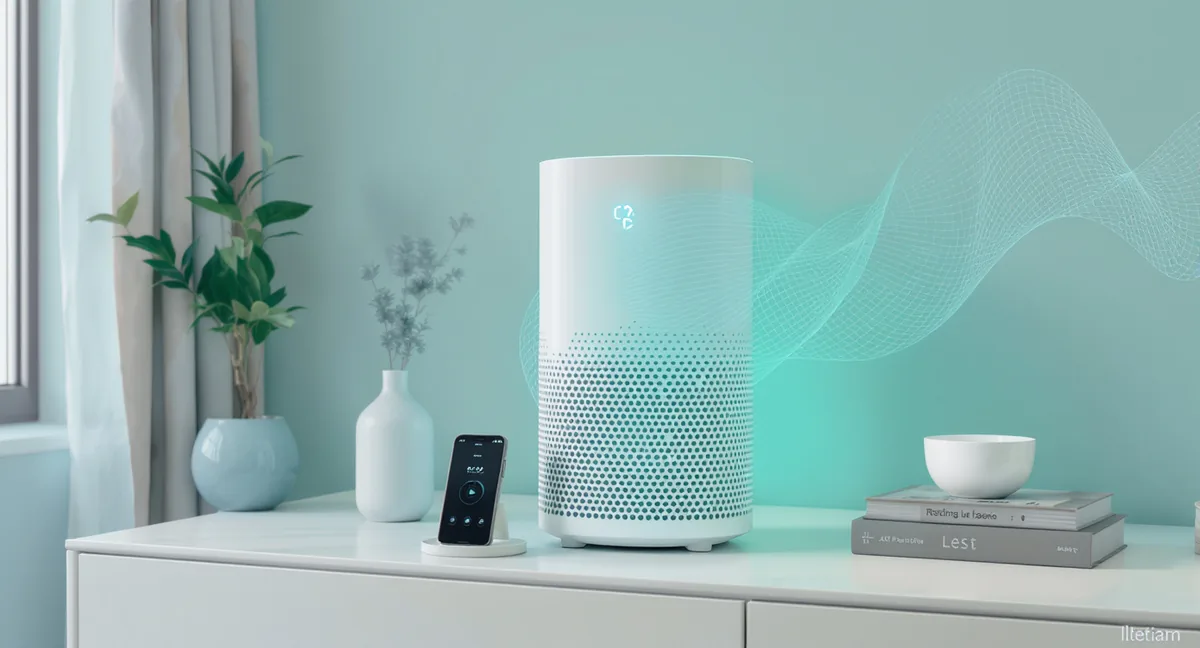
At the $1,029-600 price point, you are no longer buying an air purifier. You are buying a piece of connected furniture that also happens to clean your air. The Samsung Bespoke Cube Air Purifier and the Dyson Big Quiet Formaldehyde both understand this — they are designed to look as good as they perform, with smart ecosystems that transform them from passive appliances into interactive air quality platforms.
But these two premium purifiers take fundamentally different design approaches. Samsung built a minimalist cube that blends into modern interiors like a side table. Dyson built a signature amplifier tower with a gold-accented catalytic filter and an LCD display that puts real-time particle data on display. Both connect to mature smart home ecosystems. Both deliver strong HEPA filtration. The differences are in the details — and at this price, the details are what you are paying for.
Key Takeaways
- 1The Dyson Big Quiet delivers a higher CADR (423 CFM) and offers dedicated catalytic formaldehyde destruction — a filter that never needs replacement and continuously breaks down formaldehyde into water and CO2.
- 2The Samsung Bespoke Cube integrates with the SmartThings ecosystem, offering seamless control alongside Samsung TVs, appliances, and smart home devices. Dyson uses its own Dyson Link app.
- 3Samsung's cube design is intentionally furniture-grade — meant to disappear into a room. Dyson's tower design is meant to be noticed, with its signature amplifier loop and real-time LCD display.
- 4Both purifiers operate at ultra-quiet levels on low settings (around 20-23 dB), making them suitable for bedroom use without disrupting sleep.
- 5At similar price points ($1,029-600), the choice comes down to ecosystem preference (SmartThings vs Dyson Link), whether formaldehyde destruction matters to you, and which design philosophy fits your home.
Quick Answer
Should I buy the Samsung Bespoke Cube or the Dyson Big Quiet?
Buy the Dyson Big Quiet Formaldehyde if you want the highest CADR in this class (423 CFM), catalytic formaldehyde destruction, real-time air quality data on an LCD display, and do not mind Dyson's standalone app ecosystem. Buy the Samsung Bespoke Cube if you are invested in the SmartThings smart home ecosystem, prefer a minimalist cube design that blends into your decor, and value Samsung's multi-device integration. Both are excellent premium purifiers — the Dyson edges ahead on raw filtration performance, while the Samsung excels at smart home integration and unobtrusive design.
Quick Decision Guide
| What Matters Most | Best Choice |
|---|---|
| Highest CADR | Dyson Big Quiet (423 CFM) |
| Formaldehyde destruction | Dyson Big Quiet (catalytic oxidation) |
| SmartThings ecosystem | Samsung Bespoke Cube |
| Most discreet design | Samsung Bespoke Cube |
| Real-time air quality display on device | Dyson Big Quiet (LCD screen) |
| Voice assistant breadth | Both (Alexa, Google, Bixby for Samsung; Alexa, Siri for Dyson) |
| Quietest low setting | Dyson Big Quiet (20 dB) |
| Most furniture-like aesthetic | Samsung Bespoke Cube |
| Strongest air quality sensors | Dyson Big Quiet (PM2.5, PM10, VOCs, NO2, formaldehyde) |
Full Specs Comparison
| Feature | Samsung Bespoke Cube | Dyson Big Quiet Formaldehyde |
|---|---|---|
| Price | ~$599.99 | ~$1,029.00 |
| CADR | ~310-350 CFM (estimated) | 423 CFM |
| Room Coverage | ~930 sq ft | 1,076 sq ft |
| Filtration | H13 HEPA + Activated Carbon + Deodorization | H13 HEPA + Catalytic Oxidation (formaldehyde) + Carbon |
| Formaldehyde Removal | Carbon adsorption (saturates over time) | Catalytic oxidation (never needs replacement) |
| Air Quality Sensors | PM2.5, PM10, VOCs, odor | PM2.5, PM10, VOCs, NO2, formaldehyde |
| Noise (Low) | ~23 dB | 20 dB |
| Noise (High) | ~50 dB | 48 dB |
| Smart Platform | Samsung SmartThings | Dyson Link app |
| Voice Assistants | Alexa, Google Assistant, Bixby | Alexa, Apple Siri |
| Display | LED indicator lights | Full LCD air quality display |
| Design Form Factor | Minimalist cube | Signature amplifier tower |
| Annual Filter Cost | ~$80-100 | ~$80-100 |
| Weight | ~26 lbs | 17.4 lbs |
| Warranty | 1-year standard | 2-year Dyson warranty |
1. Design Philosophy
Winner: Depends entirely on your aesthetic preference
This is where these two purifiers diverge most dramatically, and it may be the single biggest factor in your decision.
Samsung Bespoke Cube: The Invisible Purifier
Samsung designed the Bespoke Cube to not look like an air purifier. Its minimalist cube form factor — clean lines, muted tones, fabric-textured panels — is meant to blend into a modern living space like an end table or media console. Samsung's "Bespoke" line is specifically designed to match their appliance aesthetic, so if you already have Samsung Bespoke kitchen appliances or a Samsung The Frame TV, this purifier looks like it belongs in the same design language.
The top surface is flat and clean enough that some owners use it as a display surface for a plant or a small lamp. According to customer reviews, the Bespoke Cube is the air purifier most likely to draw comments like "I didn't even notice that was a purifier" from guests — which is precisely the point.
Dyson Big Quiet: The Statement Piece
The Dyson Big Quiet Formaldehyde takes the opposite approach. Its signature amplifier loop, gold-accented catalytic filter housing, and full-color LCD display are designed to be seen and admired. This is a piece of industrial design that makes a visual statement — much like Dyson's fans and vacuum cleaners, it looks like nothing else in your home.
The LCD display is a functional design element, not just decoration. It shows real-time particle counts (PM2.5, PM10), VOC levels, NO2 readings, formaldehyde concentration, temperature, and humidity. Watching the numbers drop after turning the purifier on or spike when you start cooking provides genuine, actionable information — and customer reviews consistently cite this display as one of their favorite features.
Our editorial take: If your ideal purifier is one that disappears into your decor, the Samsung Bespoke Cube does that better than any premium purifier on the market. If you want a design object that doubles as an interactive air quality monitor, the Dyson Big Quiet is the more engaging choice. Neither is wrong — they are expressing different design philosophies.
2. Filtration and Air Cleaning Performance
Winner: Dyson Big Quiet Formaldehyde
The Dyson Big Quiet holds a clear advantage in both CADR and specialized filtration capabilities.
CADR and Coverage
The Dyson Big Quiet delivers 423 CFM — among the highest CADR ratings of any residential air purifier. It covers up to 1,076 sq ft, making it suitable for large living rooms, open-concept spaces, and even small apartments as a single-unit solution.
The Samsung Bespoke Cube has a lower CADR in the estimated 310-350 CFM range with coverage rated around 930 sq ft. Samsung does not always publish standardized CADR numbers through the AHAM Verifide program, so exact comparisons require some inference from published specifications and room coverage claims.
At 4 Air Changes Per Hour:
- The Dyson Big Quiet handles rooms up to approximately 700-800 sq ft
- The Samsung Bespoke Cube handles rooms up to approximately 550-650 sq ft
Formaldehyde: The Key Differentiator
This is where the Dyson Big Quiet earns its "Formaldehyde" name. Its catalytic oxidation filter uses a manganese dioxide cryptomelane catalyst to continuously break down formaldehyde (HCHO) molecules into water and CO2. This process is:
- Continuous — it works passively even when the fan is on low
- Permanent — the catalytic filter never needs replacement
- Verified by a dedicated sensor — the Dyson displays real-time formaldehyde levels so you can see the reduction
The Samsung Bespoke Cube addresses formaldehyde through its activated carbon and deodorization filter, which adsorbs formaldehyde molecules. This works, but carbon filters saturate over time and need replacement. They do not destroy formaldehyde — they capture it temporarily.
For homes with new furniture, engineered hardwood, fresh paint, cabinets made with particleboard, or recent renovations, formaldehyde off-gassing is a genuine concern. The Dyson's catalytic approach is objectively superior for this specific pollutant.
Standard Particle Filtration
Both purifiers use H13 HEPA filtration capturing 99.97% of particles at 0.3 microns. For pollen, dust mites, pet dander, mold spores, and most bacteria, both perform equally well. The Dyson's higher CADR means it processes more air per minute, but the filtration quality at the filter level is comparable.
3. Smart Ecosystems
Winner: Samsung Bespoke Cube (ecosystem integration) / Dyson Big Quiet (air quality data depth)
Both purifiers are fully connected, but they serve different smart home strategies.
Samsung SmartThings
The Samsung Bespoke Cube integrates with SmartThings — Samsung's smart home platform that connects TVs, refrigerators, washing machines, robot vacuums, door locks, lights, and more. If you are a Samsung household, the Bespoke Cube becomes one node in a unified control surface. You can:
- Create automations (e.g., turn purifier to high when the smart oven detects cooking, or boost fan speed when the front door opens)
- Control the purifier from your Samsung TV, phone, or Samsung watch
- Use Bixby, Alexa, or Google Assistant for voice control
- View air quality data alongside other Samsung appliance status
The breadth of SmartThings integration is Samsung's strongest argument. No other air purifier connects to as many household devices and appliance categories.
Dyson Link App
The Dyson Link app is a standalone ecosystem — it does not integrate into a broader smart home platform the way SmartThings does, but it is exceptionally polished for air quality monitoring. It offers:
- Real-time and historical graphs for PM2.5, PM10, VOCs, NO2, and formaldehyde
- Temperature and humidity tracking
- Remote control and scheduling
- Auto mode driven by the purifier's onboard sensors
- Integration with Alexa and Apple Siri (but not Google Assistant)
- If you own other Dyson products (fans, heaters, vacuums), they all live in the same app
The Dyson app provides deeper air quality data than Samsung's SmartThings integration. The dedicated formaldehyde sensor and NO2 monitoring are features that Samsung does not match. For buyers who specifically want granular air quality analytics, Dyson's data presentation is superior.
Our editorial take: If you are already a SmartThings household, the Samsung Bespoke Cube will feel native and connected in ways the Dyson cannot replicate. If you care most about air quality data depth and do not need cross-appliance automation, the Dyson Link app is the more informative tool.
4. Noise Levels
Winner: Dyson Big Quiet Formaldehyde
| Setting | Samsung Bespoke Cube | Dyson Big Quiet |
|---|---|---|
| Low | ~23 dB | 20 dB |
| Medium | ~38 dB | ~35 dB |
| High | ~50 dB | 48 dB |
The Dyson Big Quiet lives up to its name. At 20 dB on low, it is below the threshold of perception in most rooms — you will not hear it running unless you are standing directly next to it. The Samsung Bespoke Cube at approximately 23 dB on low is also extremely quiet and suitable for bedroom use, but the Dyson has a slight edge at every speed level.
Both purifiers are quiet enough for overnight bedroom use on low settings. The difference between 20 dB and 23 dB is perceptible only in a very quiet room with no other ambient noise. For most practical purposes, both are excellent.
On high speed, the gap narrows — 48 dB (Dyson) vs 50 dB (Samsung) is a minor difference. Both produce a gentle airflow sound comparable to a quiet fan.
5. Filter Costs and Long-Term Value
Winner: Dyson Big Quiet Formaldehyde (slight edge)
Annual Filter Costs
Both purifiers have similar annual filter costs in the $80-100 range. However, the Dyson has a structural advantage: its catalytic formaldehyde filter never needs replacement. Over 5+ years, this compounds into meaningful savings compared to Samsung's approach of using replaceable carbon filters for chemical filtration.
5-Year Cost Comparison
| Cost Factor | Samsung Bespoke Cube | Dyson Big Quiet |
|---|---|---|
| Purchase price | ~$599.99 | ~$1,029.00 |
| Filters (5 years) | ~$400-500 | ~$400-500 |
| Catalytic filter replacement | Included in above | $0 (never needs replacement) |
| Electricity (5 years, est.) | ~$70-90 | ~$65-80 |
| 5-Year Total | ~$1,070-1,190 | ~$1,045-1,160 |
The 5-year totals are remarkably close. The Dyson's slightly lower purchase price and its never-replace catalytic filter give it a small long-term advantage, but this is not a comparison where cost should be the deciding factor. At this price tier, you are paying for ecosystem, design, and feature preferences.
Warranty
The Dyson offers a 2-year warranty, while Samsung provides a standard 1-year warranty. For a $1,029-600 purchase, Dyson's extra year of coverage is a notable advantage.
6. Air Quality Sensors
Winner: Dyson Big Quiet Formaldehyde
The Dyson Big Quiet has the most comprehensive sensor array of any consumer air purifier:
- PM2.5 — Fine particulate matter (smoke, combustion)
- PM10 — Coarse particles (dust, pollen)
- VOCs — Volatile organic compounds (cleaning products, paints)
- NO2 — Nitrogen dioxide (gas stoves, traffic pollution)
- Formaldehyde (HCHO) — Dedicated solid-state sensor for formaldehyde specifically
- Temperature and humidity
The Samsung Bespoke Cube monitors PM2.5, PM10, VOCs, and odor — a strong sensor suite, but it lacks the dedicated formaldehyde and NO2 sensors that the Dyson provides. For most indoor air quality concerns, Samsung's sensors are sufficient. But if you want to track formaldehyde off-gassing from new furniture or monitor NO2 from a gas stove, only the Dyson provides that data.
Who Should Buy Which
Buy the Samsung Bespoke Cube (~$600) if:
- You are invested in the Samsung SmartThings ecosystem and want your air purifier to integrate with your other Samsung devices
- A minimalist, furniture-grade design that blends into your decor is a top priority
- You want the broadest voice assistant support (Alexa, Google, Bixby)
- Cross-device automations — linking your purifier to other smart home devices — are part of your vision for your home
- You prefer a cube form factor over a tower design
Buy the Dyson Big Quiet Formaldehyde (~$1,029) if:
- You want the highest CADR available in this price class (423 CFM)
- Formaldehyde is a specific concern — new furniture, renovations, engineered flooring
- Real-time air quality data displayed on the device itself matters to you
- You value the most comprehensive sensor suite available (including formaldehyde and NO2)
- You prefer the Dyson design aesthetic and do not mind a standalone app ecosystem
- You want the quietest possible operation — 20 dB on low is essentially inaudible
- A 2-year warranty (vs Samsung's 1-year) provides peace of mind on a premium purchase
The Bottom Line
The Dyson Big Quiet Formaldehyde is the better air purifier — it has higher CADR, more comprehensive sensors, catalytic formaldehyde destruction, quieter operation, and a longer warranty. If you are evaluating these two purely on air-cleaning capability and the depth of air quality data they provide, the Dyson wins on nearly every metric.
The Samsung Bespoke Cube is the better smart home device — it integrates into the SmartThings ecosystem in ways the Dyson cannot, connects with a wider range of household devices and voice assistants, and its minimalist cube design disappears into modern interiors more gracefully than the Dyson's statement-making tower.
Based on our research and analysis of customer reviews, the right choice depends on whether you are buying an air purifier that happens to be smart (Dyson) or a smart home device that happens to purify air (Samsung). Both do their jobs well. The Dyson simply does the air purification part better, while the Samsung does the smart home integration part better.
For most buyers, we give the edge to the Dyson Big Quiet Formaldehyde. Its combination of 423 CADR, catalytic formaldehyde destruction, best-in-class sensors, and 20 dB quiet operation is difficult to match at any price — let alone at $1,029.
Sources & References
- Samsung Product Specifications — Manufacturer-published specifications for Samsung Bespoke Cube air purifiers
- Dyson Product Specifications — Manufacturer-published specifications for the Dyson Big Quiet Formaldehyde
- SmartThings Platform — Samsung SmartThings smart home ecosystem and device compatibility
This guide was researched and written by the AirQualityNest editorial team. We update our content regularly to reflect the latest products, pricing, and research.
Frequently Asked Questions
Does the Samsung Bespoke Cube remove formaldehyde?+
The Samsung Bespoke Cube can capture formaldehyde through its activated carbon and deodorization filters, but it uses adsorption — meaning the carbon filter will eventually saturate and need replacement. The Dyson Big Quiet uses catalytic oxidation to continuously destroy formaldehyde molecules, converting them into water and CO2. The catalytic filter never needs replacement. If formaldehyde is a primary concern, the Dyson's approach is more effective long-term.
Can I use the Samsung Bespoke Cube without SmartThings?+
Yes. The Samsung Bespoke Cube has onboard controls and can operate independently without SmartThings or any app. However, you lose access to scheduling, remote control, automations, and detailed air quality data without the SmartThings connection. The purifier still monitors air quality and runs auto mode using its onboard sensors regardless of app connectivity.
Which premium purifier is quieter for bedroom use?+
The Dyson Big Quiet Formaldehyde at 20 dB on low is slightly quieter than the Samsung Bespoke Cube at approximately 23 dB. Both are excellent for overnight bedroom use — the difference between 20 dB and 23 dB is barely perceptible in a room with any ambient noise. Either purifier will run silently enough to not disrupt sleep.
Is the Dyson Big Quiet compatible with Google Assistant?+
No. The Dyson Big Quiet Formaldehyde works with Amazon Alexa and Apple Siri, but it does not support Google Assistant. If Google Home is your primary smart home platform, the Samsung Bespoke Cube — which supports Google Assistant, Alexa, and Bixby — is the better choice for voice control integration.
Are Samsung and Dyson air purifier filters interchangeable?+
No. Samsung and Dyson use proprietary filter designs specific to each purifier model. Samsung Bespoke Cube filters must be purchased from Samsung, and Dyson Big Quiet filters must be purchased from Dyson. Annual filter costs are comparable at approximately $80-100 per year for both purifiers.
Related Reading
Best Smart Air Purifiers
Top picks for app-connected purifiers with real-time monitoring
Best Premium Air Purifiers
Our top picks for buyers ready to invest in serious air quality
Dyson Big Quiet Review
In-depth editorial review of Dyson's highest-performance purifier
IQAir vs Dyson
Medical-grade filtration vs premium smart design compared
Continue Reading

Best Air Purifiers for Open Floor Plans in 2026: High-CADR Models That Cover It All
The best air purifiers for open floor plans ranked by CADR, coverage area, and noise. High-performance HEPA purifiers that handle 500-1,500+ sq. ft. open spaces.
Best Smart Humidifiers in 2026 (Wi-Fi, App Control & Auto Humidity)
The best smart humidifiers with Wi-Fi, app control, and auto humidity adjustment. Top picks for Alexa, Google Home, and smart home integration.
The 5 Best Portable Air Quality Monitors in 2026
Monitor your air quality on the go. We tested the best portable and compact air quality monitors for accuracy, battery life, and sensor range.